 Facebook
  Twitter
  Soundcloud
  Youtube
  Rss
Rss 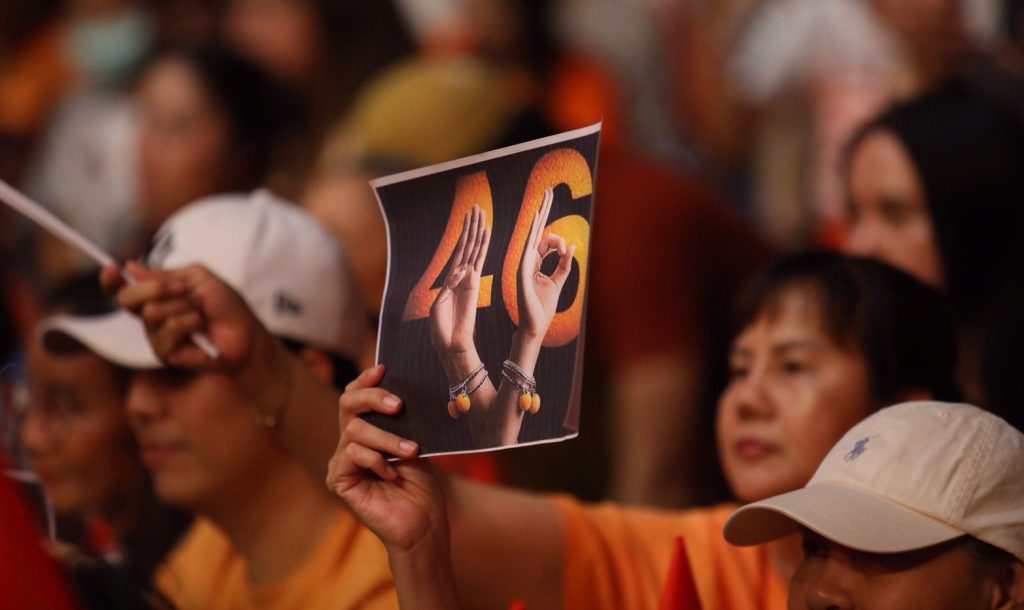




On 8 February Thailand’s democratic forces suffered their first genuine electoral defeat in 25 years. The Electoral Commission’s final certification of results from 499 out of 500 parliamentary seats has officially confirmed that Bhumjaithai surged to 191 seats, Pheu Thai plummeted from 141 to 74, and the People’s Party declined from Move Forward’s 151 to 120. For the first time, the pro-democracy parties have lost their parliamentary majority and both have lost a significant share of the popular vote.
The People’s Party trajectory—from its 2023 electoral success as Move Forward, through the Thailand–Cambodia border conflict, the Paetongtarn Shinawatra–Hun Sen phone call scandal, and finally the elevation of Anutin Charnvirakul to the prime ministership—constitutes a case study in how liberals’ strategic missteps gave conservatives a final bolt of energy to revive their political hegemony. I argue that the reconsolidation of conservative power resulted fundamentally from the People’s Party’s idealistic politics and its treating its rivalry with Pheu Thai—a secondary dynamic within the democratic bloc—as the primary conflict while downplaying the struggle against the royalist–military establishment. This led to efforts to weaken Pheu Thai, the only party with the organisational capacity, policy legacy, and mass base to concretely challenge conservative hegemony.
The end of the 25-year struggle
Pheu Thai and its predecessors embodied long-term counter-hegemonic struggles as well as efforts to gradually shift patronage-based electoral politics to policy-driven politics. When Thai Rak Thai won Thailand’s first outright parliamentary majority in 2001, it marked the emergence of a class-based political project that shifted state policy away from serving Bangkok elites toward addressing the material needs of the rural and urban working classes. Thaksin Shinawatra’s innovation was not to eliminate patronage. That was impossible given existing power structures. Rather, he introduced a counterweight through universal policies that reduced citizens’ dependency on local bosses. The 30-baht universal healthcare scheme, village development funds, agricultural debt relief, and infrastructure investment in rural areas created a material basis of support independent of traditional patronage chains. Citizens supported Thai Rak Thai because government policy tangibly improved their lives.
These policies were not articulated via leftist or anti-globalisation language, which disappointed many on the left. This linguistic choice reflected political pragmatism rather than ideological commitment—Thaksin himself was no leftist but a bourgeois figure seeking to dominate politics through mass mobilisation. Yet this pragmatic strategy required genuine policy delivery that materially benefited working class. Many of the Pheu Thai policymakers who implemented these programs were former communist insurgents from the student movements of the 1970s who brought a class-based perspective to the project.
Universal healthcare, debt relief, and infrastructure investment didn’t just deliver material benefits, they broke these feudal patron–client bonds and integrated rural populations into market relations. This policy-driven approach threatened the entire edifice of elite power: if rural voters could access healthcare, credit, and economic opportunity through universal state programs rather than through relationships with local elites connected to Bangkok power networks, the fundamental mechanism of establishment control would erode. The vehement elite reaction to Thaksin, resulting in the 2006 coup, cannot be understood as mere opposition to corruption—establishment figures were hardly paragons of virtue—but as class warfare against a project that threatened to dismantle the patronage networks through which elites maintained their hegemony.
The tragedy of the 2026 election lies precisely here: this 25-year project of gradual hegemonic shift, of building alternative material bases of political support, of demonstrating that policy-driven politics could serve working class interests—all this was not merely defeated electorally, but actively undermined by forces claiming to represent progressive politics. To understand this requires examining the rise and contradictions of the “orange” camp.
Orange contradictions
If Pheu Thai represented a policy-driven mass politics that drew on the class-based perspective of the Octoberist generation, the orange camp embodied a different vision: that of liberal democratic reform, emerging from the urban middle-class reaction to military rule, and positioning itself as a “fresh alternative” uncorrupted by Pheu Thai’s pragmatic politics.
The Future Forward Party offered something genuinely new in Thai electoral politics when it emerged in 2018 under the leadership of the charismatic young billionaire Thanathorn Juangroongruangkit, who explicitly rejected military influence, called for institutional reform including reducing the military’s political role and budgets, and mobilised a social base outside traditional patronage networks. Future Forward’s founders included leftist intellectuals, NGO activists, issue-based civil society organisations, and businessmen. Its supporters were mainly the petit bourgeoisie, university students, and urbanites alienated by both military authoritarianism and what they perceived as Pheu Thai’s corrupt populism.
As a result, they sounded left-leaning—unlike Pheu Thai, which used non-leftist languages in its narratives. But Future Forward’s ideological framework was inherently liberal-democratic. They demanded constitutional reform, human rights, civilian control of the military, reduction of royal power (proposing the amendment of lèse majesté laws), free market economics with social welfare provisions, and a vision of politics as policy debate among rational citizens rather than patronage distribution.
Thai conservatives have sought to prevent reformists from putting down roots in society—and it’s worked
Thailand’s deinstitutionalised democracy movement
This positioning proved electorally potent. In the 2019 election, the first after 5 years of quasi-military rule, Future Forward won 81 seats, becoming the third-largest party and demonstrating unexpected strength among young, urban voters. When the Constitutional Court dissolved Future Forward in 2020 (ostensibly for illegal loans from Thanathorn), its successor the Move Forward Party grew stronger, winning 151 seats for a first-place finish in the 2023 election.
Yet electoral success masked fundamental contradictions.
These began on the ideological and rhetorical front: Move Forward, including in its most recent incarnation as the People’s Party, oscillated unpredictably, sometimes appealing to progressive principles, sometimes capitulating to popular prejudice (e.g. nationalism over Cambodia, ambiguity on economic redistribution framed as “fiscal discipline”). The result was strategic incoherence. No one, not even party leaders themselves, could predict when principle would prevail and when electoral calculations would override it. The party’s ideological guru Piyabutr Saengkanokkul regularly cited Marx, Mao, Lenin and Gramsci in his speeches and positioned them as an “ideological basis” of his party. The party campaigned on “1% versus 99%” rhetoric, casting itself as a radical left rather than merely liberal force. Yet while the party’s leadership deployed class-based rhetoric, its policies increasingly reflected right-wing economic designs. Welfare proposals got watered down with each party reincarnation. The party’s policy on forest reservation echoed conservative stances. Fiscal discipline became central in a campaign against Pheu Thai’s massive stimulus policies, crafted by a policy director who came from a think tank with a longstanding focus on fiscal restraint. Thanathorn, a vastly wealthy as a third-generation heir to an auto-parts empire, was nonetheless framed as different from other billionaire demagogues.
The party meanwhile gradually incorporated elite networks, technocrats, business elites, and traditional ban yai political clans. Most significantly, after the 2023 election, prominent establishment figures aligned with what became branded as the “Professionals” campaign. The party claiming to break from elite politics became a scaffold for elite reformism, a managed reform preserving fundamental hierarchies while eliminating authoritarian excrescences.
Certainly, the 151 seats Move Forward won in 2023 represented genuine popular support. But the military-appointed Senate, and all the mechanisms establishment forces had built to prevent democratic victory remained fully operational. Move Forward could win an election but, as the failure of its subsequent bid to have Pita Limjaroenrat appointed prime minister demonstrated, could not form government against establishment opposition. This conviction led to their dismissing Pheu Thai as a rival rather than pursuing a necessary alliance, even as they faced common enemies. The People’s Party, formed after Move Forward’s ban, engaged in a “more-progressive-than-thou” game in a naive belief about the possibility of overthrowing elites within the rigged architecture of the 2017 Constitution.
In Thailand’s 21st century political conjuncture, the principal contradiction was between democratic forces—both Pheu Thai and People’s Party—and royalist-military establishment. Secondary contradictions existed within the democratic bloc—different class bases, historical experiences, and political styles—but these paled compared to the fundamental divide between democratic and authoritarian forces. The People’s Party inverted this analysis: it treated its secondary conflict with Pheu Thai as its principal one, while treating the greater opposition to the establishment as secondary. This eliminated the possibility of building solidarity.
In short, the Shinawatras/Pheu Thai and the royalist–military establishment were not equivalent but antagonistic forces locked in genuine struggle, despite the compromises Pheu Thai made in order to advance after 2023. The orange camp’s inability to recognise this would prove catastrophic.
The 2025 border conflict and the fall of Pheu Thai
The recent Thailand–Cambodia border conflict provided a test for the People’s Party—and it failed. When nationalist fervour rose over border tensions, the party capitulated. Rather than resisting the nationalist currents, party leaders either remained silent or actively participated in nationalist rhetoric. When Paetongtarn Shinawatra attempted diplomatic engagement with Cambodia, the People’s Party joined the establishment in attacking her approach as “unprofessional” and unsuitable for her role. The conflict was framed by the People’s Party as a “family affair”.
People’s Party leader Natthapong Ruengpanyawut called for Paetongtarn to step down because she lacked the ability to solve the crisis. Other party figures demanded her resignation. Most significantly, the People’s Party called for parliament dissolution and new elections, declaring this is “the only legitimate solution” to the crisis. In effect, this move gave to the very discursive tools that Bhumjaithai would later weaponise against both democratic parties.
All this culminated in one decision: the People’s Party’s choice to support Anutin Charnvirakul’s appointment as prime minister following the constitutional court’s removal of Paetongtarn on 29 August 2025. Both Pheu Thai and Bhumjaithai sought the People’s Party’s support, with Pheu Thai proposing a coalition that included it. Bhumjaithai proposed a minority government with the party providing confidence and supply without joining the government. The choice should be obvious: the People’s Party should have supported an imperfect democratic ally against conservative forces, and join a Pheu Thai-led government. The small cost in ideological purity would be vastly outweighed by benefits people would gain. Instead, the People’s Party chose Bhumjaithai on the condition of a constitutional referendum and parliament dissolution within four months, without joining the government to provide checks and balances.
This farce ended with an ironic situation in which Pheu Thai—attempting a coalition with Bhumjaithai while maintaining checks on conservative power—stood accused of “selling out” or “ตระบัดสัตย์.” The People’s Party, even while enabling Bhumjaithai’s complete dominance of the government with no internal opposition, claimed to defend democratic principles through “principled” opposition. Its strategy destroyed that capacity, removing all checks on conservative power and enabling the very restoration it claimed to oppose. Buoyed by strong media support and favorable public opinion polling, People’s Party calculated they could win the promised election outright and thereafter form a coalition on their terms. This confident stance dramatically overestimated the party’s leverage and underestimated the conservatives’ capacity to reconsolidate between August 2025 and February 2026.
Conservative counteroffensive
With full cabinet control and no internal opposition, Bhumjaithai executed a systematic reconsolidation and prepared for the elections that had been the price of its deal with the People’s Party. Anutin’s government rapidly reshuffled senior bureaucratic positions, replacing Pheu Thai-aligned officials with Bhumjaithai loyalists. A few months earlier, Anutin held a position as Interior Minister and had already initiated reshuffles of provincial officials, positioning Bhumjaithai loyalists in key administrative posts. Once he assumed the premiership with full cabinet control in September 2025, moves to extend bureaucratic control accelerated: by December 2025, Bhumjaithai had reshuffled over 400 bureaucrats, and effectively colonised the state apparatus.
Bhumjaithai used government resources to systematically absorb ban yai patronage networks—a tactic used by the NPCO and its successor civilian regime and embraced enthusiastically by Bhumjaithai after it gained full control of the government. Provincial powerbrokers aligned with Pheu Thai saw Bhumjaithai controlling state resources, and the logic of patronage dictated they shift their allegiance. Throughout late 2025, a cascade of ban yai networks—many of which were allied to Pheu Thai—defected to Bhumjaithai.
Bhumjaithai also implemented policies delivering tangible benefits to those in rural constituencies supporting Pheu Thai, such as agricultural supports and “Kon La Kueng (Half-Half),” a massive government relief scheme initiated under Prayuth but which proved effective in relieving people financially, especially in urban settings. The cruel irony is that many of these policies were continuations of Pheu Thai initiatives. But because Bhumjaithai controlled the government when they bore fruit, it reaped all the political credit.
Bhumjaithai also weaponised nationalist sentiment. Conservative media replayed the Paetongtarn–Hun Sen conversation endlessly. Anutin and conservatives escalated tensions by proposing to revoke the longstanding “MOU43–44” regarding the status quo of the Thai–Cambodian border. This constant drumbeat of conflict enabled Anutin and conservative forces to tie electoral politics to narratives of sovereignty and defence, as well as accusing both democratic parties of being unpatriotic.
In the end, Bhumjaithai won on 8 February because it offered what millions wanted: stability, policy delivery, nationalist assertion, and an absence of political chaos. Bhumjaithai reconstructed patronage networks with full state backing. Voters who supported Pheu Thai for policy achievements saw Bhumjaithai continuing those policies, while Pheu Thai was excluded. When Bhumjaithai delivered improvements with greater efficiency, therefore, support shifted. The People’s Party meanwhile not only failed to defend Pheu Thai but actively participated in attacks against it using rhetoric reminiscent of 2014 coup apologists—corruption allegations, emphasis on Shinawatra influence, questioning patriotic credentials.
The tale of two democracies? Not really
The election results reveal a more complex story than a wholesale rejection of pro-democratic politics, however. While Bhumjaithai won constituency seats across central, northern and northeastern regions that had been Pheu Thai strongholds, the most revealing pattern emerged in the form of ticket-splitting: in many constituencies where Bhumjaithai won the local seat, voters gave party-list votes to Pheu Thai or the People’s Party. Far from vindicating narratives about rural ignorance or susceptibility to vote-buying, it instead reveals a sophisticated political calculation. Voters chose constituency MPs from Bhumjaithai because local ban yai had defected to it in the knowledge that it controlled access to state resources. Practical necessity dictated voting for whoever could deliver immediate services. It shows that, despite being in accordance with patronage relations, the people have more bargaining power when it comes to whether or not the elite patronage had actually “worked” for them.
It could be said that Bhumjaithai has inverted what Thai Rak Thai tried to build. Whereas Thaksin’s party in its original incarnation used policy delivery to weaken patronage dependency, Bhumjaithai used policy delivery to strengthen patronage under its state monopoly, synthesising Thai Rak Thai’s effectiveness with traditional patronage’s personalistic control. Bhumjaithai’s months of total control in the cabinet allowed systematic absorption of Pheu Thai’s local networks as Pheu Thai provincial politicians faced extinction without their party’s control of ministries.
However, for party-list votes that more squarely express ideological preference, the same voters chose democratic parties. They hadn’t abandoned political commitments or been “bought”—they were navigating the material reality that Bhumjaithai controlled the state apparatus, while still maintaining an ideological alignment with democratic forces. Meanwhile, the People’s Party swept every constituency seat in Bangkok and urban areas nationwide, proving their middle-class base remained intact.
A reckoning for the orange camp
“You cannot build from ashes alone.” Whatever reconstruction occurs must build upon rather than negate what Pheu Thai achieved over the past 25 years. Organisational networks, policy legacy, survival strategies, and a mass base represent accumulated political capital that took decades to build and cannot be rapidly replaced. Pheu Thai, whatever its flaws, fought genuine battles against establishment forces and achieved material improvements for the working class.
The orange camp needs leadership capable of recognising class-based interests, and pursuing class-based mobilisation, in furthering the progressive political project. And ultimately, they need to uproot their dichotomy between “old politics” and “new politics,” between the “politics of hope” and “politics of fear,” between the “politics of the past” and “politics of the future.” This framework is not only fundamentally empty rhetoric: it is also a dangerous dogwhistle reminiscient of the People’s Alliance for Democracy (PAD), the extreme reactionary yellow-shirt movement of Bangkok elites and bourgeoisie whose interests were genuinely threatened by Thaksin’s redistributive policies. When the People’s Party deploys this “old versus new” framework, they unwittingly reproduce the very discourse that enabled the 2006 and 2014 coups. The question is never old versus new, but rather: whose interests does one’s politics serve?
The orange camp must prioritise winning and wielding state power, forming or joining government, rather than engaging in endless performances of “keeping promises”, maintaining “integrity”, and refusing to “betray principles” by working with “those corrupt parties”, all wrapped in the vacuous rhetoric of “new politics”. The urgent task is finding pathways to state power within the rigged constitutional system to implement at least some portion of the policies the party claims to champion. Throwing away millions of votes by deliberately choosing permanent opposition over governing is a betrayal of a popular mandate. Eight years in opposition have yielded what exactly? Time is running out. The currency of being “the fresh alternative” depreciates with each passing year.
The ambition that the orange camp will eventually form government only after winning a landslide like Thai Rak Thai’s in 2005 must be abandoned. What this fantasy obscures is that Thai Rak Thai achieved that landslide precisely because they had already entered government in 2001 with a bare majority—and only then delivered policies that built the foundation for overwhelming support four years later. Without policy delivery from within the government, no amount of idealist rhetoric will prevent popular exhaustion. Politics must be materialist or it becomes irrelevant over time.
Thai conservatives have sought to prevent reformists from putting down roots in society—and it’s worked
Thailand’s deinstitutionalised democracy movement
Above all: refuse to repeat PAD’s trajectory. That path locked Thai politics into destructive cycles: coups, constitutional engineering, managed democracy, popular resistance, coup again. These cycles ensure that policies never serve the 99% because governments never last long enough to implement or institutionalise redistributive programs. If the orange camp genuinely seeks to serve working class interests rather than middle class aesthetic preferences, the anti-Shinawatra obsession must end. Learn from Pheu Thai’s successes and failures instead of treating them as equivalent to royalist–military forces.
The conservative elite had learned from Pheu Thai’s strategy. The result is they have finally won an emphatic election victory. The empire has struck back. Whether democratic forces can learn from this devastating defeat or continue the ideological confusions and strategic errors that enabled it remains to be seen. For now, the lesson is clear and bitter: idealism without materialism, moralism without power analysis, purity without organisation—these are luxuries progressive forces cannot afford when fighting for democratic futures against entrenched authoritarian power. The work of reconstruction begins with this recognition.