 Facebook
  Twitter
  Soundcloud
  Youtube
  Rss
Rss 




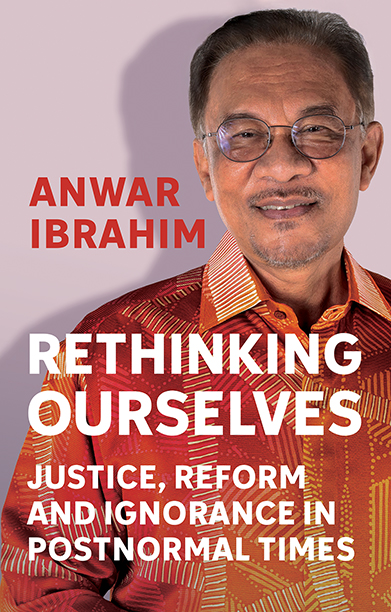 Anwar Ibrahim’s new tome, Rethinking Ourselves: Justice, Reform and Ignorance in Postnormal Times, appears at a time when both Malaysia and the international community are wrestling with uncertainty and rapid change. As Malaysia’s tenth prime minister, Anwar brings an unusually lived experience: decades of student activism in the late 1960s and 1970s, two stints as a senior cabinet minister, two imprisonments on charges widely regarded as politically fabricated, and now a return to the highest office.
That long and often punishing trajectory gives the book an authenticity that is difficult to dismiss. Dedicated to his wife, Wan Azizah Wan Ismail, who stood by him through every setback, the work carries an unmistakable personal tone. Anwar’s central ambition is to demonstrate that Islamic ethical traditions can serve as a viable foundation for pluralistic, tolerant, and democratically accountable governance. He contends that Islam, when interpreted through its deeper principles of mercy, justice, and rational inquiry, has historically nurtured societies that were both devout and comparatively open. The notion of Muslim democracy recurs throughout the text as a model in which Islamic values do not compete with democratic norms but instead reinforce them.
Anwar places this argument against the backdrop of what he terms “postnormal times”, an era characterised by extreme volatility, overlapping crises, and contradictions that defy conventional policy responses. In such conditions, he writes that societies must undertake a fundamental rethinking of both individual conscience and collective institutions. The book moves fluidly between personal reflection and broader analysis. The passages in which Anwar recounts his years in detention are among the most compelling. Prison, he recounts, stripped away illusions and forced a confrontation with the human capacity for both cruelty and compassion. These experiences deepened his conviction that genuine leadership requires empathy, moral consistency, and a willingness to question one’s own assumptions. He draws on an eclectic range of sources, Ibn Khaldun’s cyclical theory of civilisations, classical Islamic scholarship on governance, and selected modern Western thinkers like John Rawls, to construct what he calls an “inclusive synthesis”.
The result is a vision of global order that seeks to reconcile Eastern and Western intellectual heritages while prioritising sustainability, compassion, and innovation. For scholars of political philosophy and Islamic political thought these sections offer substantial material for engagement on the issue of democratisation. Anwar stay away from dense jargon while still conveying complex ideas, and the autobiographical elements help ground abstract arguments in lived reality. His critique of global injustices, such as Islamophobia, colonial legacies, and the moral failures of contemporary power structures, will resonates with readers who feel that established world liberal frameworks have not adequately addressed the concerns of Muslim societies.
In the Malaysian context, where Islam is the religion of the federation, the book’s insistence on the compatibility of Islam and democracy challenges persistent stereotypes and holds out the possibility of progressive reform. Yet any serious reading of Rethinking Ourselves must confront an uncomfortable truth. The ideals Anwar articulates so persuasively on the page sit uneasily alongside the political record of his administration since he became prime minister in 2022. The Unity Government he leads depends on a formal alliance with UMNO, the party he spent much of his political career criticising for entrenched corruption, patronage, and authoritarian tendencies. In 2025, high-profile corruption cases involving senior UMNO figures, notably Deputy Prime Minister Ahmad Zahid Hamidi, were discontinued or downgraded. These developments have been interpreted as pragmatic trade-offs made to preserve political survival rather than as principled advances in the fight against corruption. They sit in sharp contrast to the book’s unequivocal condemnation of systemic plunder and unaccountable power.
“This is a book with a whole lot of heart for Myanmar and her people.”
Review: “On the Shadow Tracks”
In conclusion, Rethinking Ourselves is intellectually stimulating, offering a nuanced Islamic perspective on contemporary crises. Yet its author’s political choices ruling Malaysia exposes it as aspirational rhetoric far removed from reality. Anwar, like many politicians, excels as a political philosopher but falters in practice, guilty of preaching democracy while entrenching authoritarian tendencies, and universal Islam while tolerating repression of other faiths. This dissonance not only diminishes the book’s impact but highlights a broader malaise in leadership: the gap between words and deeds. For Malaysia to truly rethink itself, it needs leaders who live their philosophies, not merely articulate them.