 Facebook
  Twitter
  Soundcloud
  Youtube
  Rss
Rss 




Since the end of the Sino–Vietnamese War (part of the Third Indochina War) in 1989, the Vietnamese government has directed its attention towards development in northern border regions to strengthen territorial sovereignty and border control. This is particularly true for the karst plateau in the northwest, which home to various ethnic minorities and forms part of “zomia”—an area purportedly long existing outside nation-state governance. The Vietnamese government has consistently endeavoured to integrate these ethnic minorities into the nation-state’s economic development and mainstream culture through targeted poverty alleviation, education policies, and tourism projects. Over the past three decades, border ethnic minority communities, such as the Hmong people, have undergone profound transformations closely linked to the state’s development initiatives.
As two Hmong researchers, we have focused on ethnic dynamics along the Sino–Vietnamese border, conducting ethnographic research there from 2018 to 2022 as part of our doctoral and master’s research projects. Among these, a Hmong village (anonymised here as Mong) in Đồng Văn County, Hà Giang Province, Vietnam, served as a primary fieldwork site. Through this extensive fieldwork, we explored how the Vietnamese government intervened in and drove socio-economic transformations along the border, examining the interactions between this state power and beyond-border ethnic cultures.
Recent research on Hmong communities on the borders of nation-states has gradually shown that these upland Hmong populations—often portrayed as having resisted state authority for centuries—are gradually being integrated into national development and even wider processes of globalisation. They are beginning to identify and engage with the construction of the nation-state, though their engagement is fragmented and heterogeneous. The Hmong have strategically selected and negotiated modernity between state policies and localisation, and benefited from state projects. While acknowledging the value of prior research in understanding Hmong social transformation, we ask: do Hmong people really have bargaining rights when the state comes to their land?
Here we examine how the Vietnamese government’s efforts to nationalise its borders—through tourism with strong national symbols—challenge the metaphors of holy land and ancestral belief of the Hmong people, revealing the unspoken pains of social transformation within Hmong culture. This social transformation not only deepens the Hmong communities’ integration into the nation-state but also alters traditional Hmong values. The spirits of ancestors linger over the bustling tourist spots and Hmong land, casting a shadow over this transformation.
Tourism and ancestral land
Tourism has been regarded by the Vietnamese government as a key strategy for promoting economic growth in ethnic minority regions and safeguarding national defence along border areas. In 2010 the Dong Van Karst Plateau (Cao nguyên đá Đồng Văn) in Hà Giang Province was designated a UNESCO Global Geoparks Network (GGN) site. The local government has accelerated tourism development since then, leading to significant landscape and economic transformations in numerous villages across Đồng Văn County.
Lũng Cú Commune, where the Hmong village Mong belongs, is Vietnam’s northernmost point, and has become a key development and investment focus for Đồng Văn County and Hà Giang Province. Among tourist attractions of Lũng Cú, the Lũng Cú Flag Tower (Cột cờ Quốc gia Lũng Cú, pictured above) is the most prominent one. In Vietnamese official discourse, Lũng Cú Flag Tower originated in the history of protecting Vietnam from invasion of China and France. The national flag of Vietnam was first set up here in 1978, and then renovated in 2000 and 2010. When renovations were finished in 2010, Hà Giang Province praised it as a symbol of nationalist identity, reinforcing the nation’s standing and safeguarding its sovereignty. The flag tower subsequently became a defining tourist landmark for both Đồng Văn County and Hà Giang Province over the following decade, with frequent government events held here to enhance its strong nationalist significance. Mong village, situated near the Lũng Cú Flag Tower, has consequently emerged as an important hub within the tourism industry.
In 2016, The Hà Giang Province Government authorised the construction of the Lũng Cú Cultural Ecological Tourism Zone centred around the Lũng Cú Flag Tower, encompassing new tourist attractions and wide roads. Within the planned area, many households in Mong village faced the demolition of their ancestral land. According to the data we requested from Lũng Cú Commune government, the total land area requiring clearance was 85,518.5m2, affecting approximately 40% of households in Mong village.
The most sensitive part of this project was that a holy mount—a burial site chosen by many Hmong people for their deceased—had to make space for the construction of new tourist attractions. Though the government provided compensation for grave relocations, from VND15–20 million (approximately US$569–759) per grave, it still caused panic. The relocation of ancestral graves has been considered highly taboo among the Hmong.
Hmong people emphasised the importance of ancestors and family traditions, cherishing the ancestral land. The attachment for ancestral land has been a base for their customary law of land use, and formed an integral part of the Hmong faith. The holiness of ancestral burial grounds is especially prominent, as it is directly concerned with the peace of ancestral spirits and the wellbeing of family descendants. The holy mount, where many ancestral graves were lain, boasted excellent feng shui according to Hmong geomancy. It has served as the burial ground for generations of Hmong ancestors. The older people in Mong told us that, the land where ancestral graves lie must be visited annually for cleaning, soil replenishment, and burning offerings, regardless of how far the people have migrated. If subsidence or erosion of soil and rock in certain grave sections is deemed inauspicious, descendants are believed to fall ill and suffer misfortune, potentially leading to the family’s extinction.
Relocating a grave means its complete destruction and is strictly forbidden in Hmong tradition. Thus, they held that only those harbouring ill will—enemies of the family or clan—would attempt to desecrate ancestral graves. Within this cultural context, the government’s planned relocation of graves encountered resistance from the villagers, especially from those families directly affected by these projects.
Mobilisation and morality
The resistance of Hmong villagers did not last long. Between 2016 and 2020, the Lũng Cú Commune gradually persuaded these families to consent to the relocation through various means. Ultimately, all 95 graves requiring relocation were moved.
The sociopolitical dynamics revealed in this process were closely intertwined with the contemporary post-socialist mobilisation that is deeply embedded in everyday socialist life. It frequently manifests under the guise of development, morality, and the public interest, cloaking the state’s pervasive power within discourses of “freedom” and “collective progress”. Previous research on ethnic minorities at the borders of Southeast Asian countries has showed that ethnic minority communities were “mobilised” for state modernisation projects and that this “mobilisation” combined top-down authoritative governance with neoliberal rationality. Here we understand mobilisation as embedded relational and moral practice. The relocation of ancestral graves in Mong Village exemplifies this logic of contemporary socialist mobilisation.
Le, a Kinh official from Đồng Văn County government, emphasised during an interview that “county, commune and village authorities must effectively mobilise the people, persuading residents door-to-door. We explain that construction serves to develop tourism and improve local livelihoods, not to harm them.” This statement helps illustrate how grave relocation was framed within a collective development and welfare discourse from a top-down perspective, thereby not only reinforcing the political legitimacy of government actions but also trying to secure the moral high ground. The development narrative redefined potential conflicts as necessary individual sacrifices for the collective interest.
At the same time, we observed how political relations penetrated and fractured Hmong community during the mobilisation process. A Hmong official Vang of Lũng Cú Commune detailed the mobilisation to us:
At first, the clearance committee and villagers failed to agree on relocating these graves. It was therefore decided to first mobilise households with civil servants, (Communist) Party members, or army cadres, as these individuals were expected to lead by example for the people. After these households agreed, through repeated visits and persuasion by the local army and village leaders, people gradually realised that many in the village and commune had consented. Consequently, even the most conservative individuals ultimately agreed to the relocation.
This process can be viewed as a form of moral and relational mobilisation. Rather than confronting the community directly, the state leveraged social ties and emotional bonds to transform state objectives into internal moral obligations within the community. These Hmong cadre were both extensions of the state governance system and as internal members of the local community. Their dual identity compelled them to prioritise political authority in value conflicts, temporarily setting aside their ethnic tradition. Through these Hmong individuals wielding public authority and discourse power, the state reorganised power dynamics within the Hmong community, mitigated collective resistance, and achieved local governance via local actors.
As an example, the recollection of a villager named Sinh, whose family had one of most conservative voices on the issue of grave relocation, further illustrates how this political mobilisation harnessed ethnic identity through personal connections:
Finally, a police officer from the commune came to our house to meet with my father and uncle. He was Hmong and also my deceased grandmother’s cousin [….] He advised our family to agree to let the state do it, since other families had already allowed the state to do so. If just our family refused, the state wouldn’t accept it. Out of respect for this uncle and recognising his reasoning, my family agreed to relocate the graves elsewhere.
We would argue that mobilisation was achieved through kinship ties and moral persuasion. Though the presence of army and police in this process hinted at the underlying coercive part of state authority, the state power became internalised through intra-clan emotional bonds, presenting obedience as a voluntary moral choice. This demonstrates what Nikolas Rose argued, a form of “governing through freedom”—where individuals are called upon to take responsibility for their own compliance and find moral legitimacy within it.
Grave relocation
Though being persuaded on the grounds of ethnic morality and relationships, these Hmong villagers remained deeply uneasy about breaking the holy tradition of ancestral graves. With no precedent for relocating graves, the Hmong people in Mong were forced to devise ways to alter and update their customs to accommodate the situation. These changes, made to adapt to national development projects, were rushed and haphazard.
Many families lacked the courage to relocate ancestor graves by themselves, so the commune committee dispatched a police team and Hmong officials to assist these families with the relocation. Families selected an auspicious date and then coordinated with committee members to finalise the work plan. This date was determined through divination by the Hmong shaman or fortune-teller. Offerings were prepared by the commune officials, including 2–3 metres of Chinese silk, incense sticks, paper money, alcohol, and rice. On the day of the relocation, a male representative of the family stepped forward to burn incense and offerings, seeking forgiveness from the deceased. They also requested the assistance and witness of other male clan members to jointly perform the prayers and relocation rituals.
Some families were more cautious, choosing to relocate graves themselves without seeking assistance from the commune committee. These families preferred to prevent people from other families from touching their ancestors’ graves. They also feared that officials might not be very careful, potentially making unnecessary mistakes that could affect their family’s and clan’s future prospects. They received compensation from the government for the relocation, then purchased sacrificial offerings themselves and selected a proper date to carry out the work.
All these graves were relocated to the commune’s new cemetery. This grave relocation challenged Hmong customs, requiring reconsideration of taboos and preparation of sacrifices, and offerings. After the new graves were completed, families brought offerings to worship the deceased and performed soul-soothing rituals as in a regular funeral. After consulting shamans and elders, they typically prepared offerings based on the deceased ancestors’ preferences or drew inspiration from families who had recently moved graves.
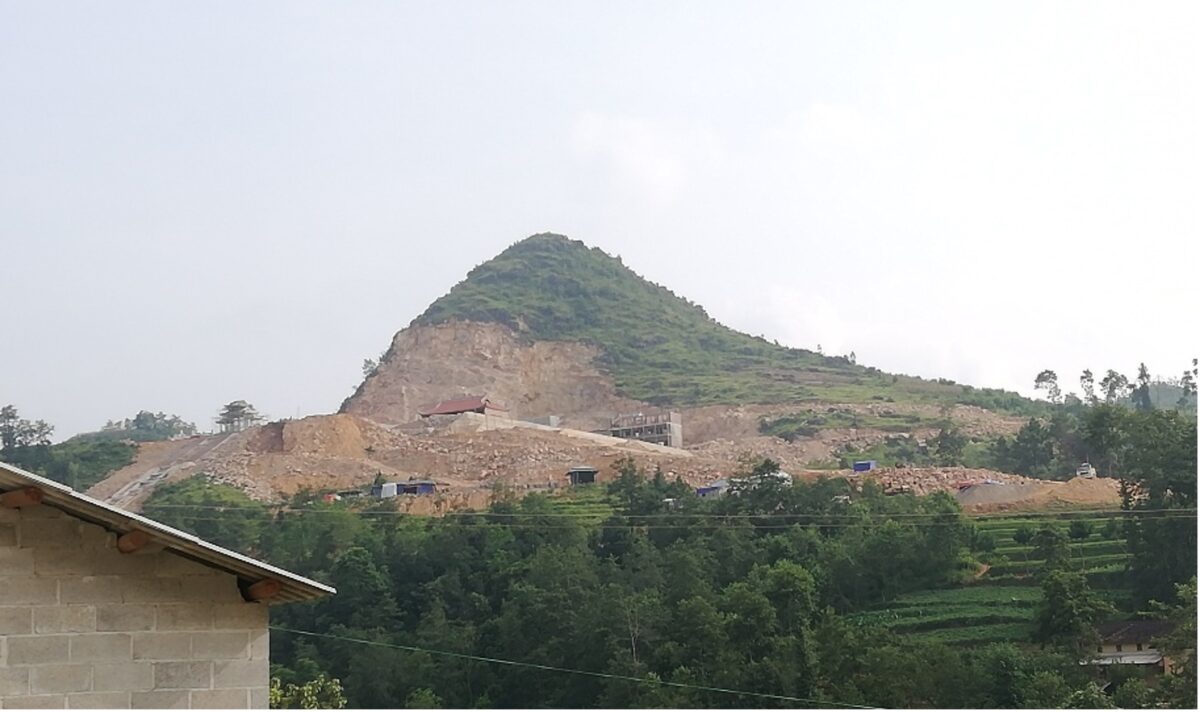
Construction on holy mount after grave relocation (Photo: Chen Yi Ting)
Unsettled fear
By early 2020, the commune had fully relocated all 95 graves requiring removal. However, the influence of relocation remained, leaving lingering fears among the deceased’s families. Many felt unsettled, continuing to offer costly animal sacrifices at the newly relocated graves during the subsequent Qingming Day (a day for venerating ancestors) and consulting fortune tellers to seek reassurance.
For the Hmong people, new graves typically do not celebrate Qingming rituals; they only do so when a grave has stood for three years or more. Qingming Day is calculated according to the lunar calendar, generally falling in March of the Gregorian calendar, which is when they usually maintain graves. Before Qingming, family members gather to discuss performing the Qingming rites for the deceased. Alternatively, if family members dream of the deceased, they may consult a fortune teller to determine what offerings are required for the Qingming ritual. While a rooster is the customary offering, pigs, dogs, or goats may be needed if specified by the deceased.
Following this recent relocation of graves, the Hmong people conducted religious rituals and offerings with heightened caution. If they sensed potential punishment from their ancestors, they would consult fortune tellers to avert misfortune. For example, during the Qingming Days of 2020 and 2021, Sinh’s family offered goats at the grave of their grandmother, who had been relocated in 2019. Sinh’s family feared something might go wrong, or that the grave relocation could disturb his grandparents. Sinh’s grandfather had been an easy-going man in life, so he might forgive his descendants, while Sinh’s grandmother had been a difficult person.
Coffee, conflict, and inadvertent state-building in Vietnam
How state-building can work from the bottom up
Sinh family’s fear was not merely a superstitious reaction, but rather a panic stemming from the fracture of their deep-seated belief in the ancestral order. The ancestral graves symbolised the continuity of the family and clan, serving as an ethical nexus that sustained the relationship between the family and their ancestral spirits. For the family, the relocation of the graves struck at the core of this ethical order. Thus, they felt compelled to restore balance with their ancestors through rituals of sacrifice and supplication for forgiveness. On the surface, they claimed to be obeying state orders. Yet, at a deeper level, they employed religious and emotional rituals to imbue this coercive act with moral and emotional legitimacy.
The story of Sinh’s family was not an isolated case; many families who relocated graves performed additional rituals and offered extra sacrifices. In 2021, villager Mua’s family also made supplementary offerings at their grandfather’s grave, seeking his forgiveness and blessings. During the government’s land acquisition, the Mua family not only relocated their ancestral graves but also had a section of their woodland expropriated. Although the family received some compensation when agreeing to the expropriation in 2018, they soon realised after the COVID-19 pandemic in 2020 how the loss of this woodland impacted their livelihood. They had to spend more time searching for grass to feed their cattle and for firewood to keep warm, struggling through the winter. Though they felt regret they were powerless against the government. Thus, Mua could only offer more sacrifices to the ancestors’ graves, praying for the ancestors’ blessings to help the family through the hardship and achieve a better life in the future.
Internalising the state’s logic
The cases of Sinh’s and Mua’s families offer typical and insightful examples that help illuminate the tension between political and ethnic identities. While we can observe how the mobilisation to relocate graves was emotionalised and moralised through community power proxies like Hmong cadres, the Hmong villagers were still aware of the political coercion underlying this mobilisation. They endured both the external pressure to obey state orders and the internal constraints of ethnic beliefs and ancestral ethics.
As Claes Corlin observed in the course of analysing land reform in Vietnam in 1990s, border ethnic minorities have little voice in planned national development projects—yet they must implement and bear the consequences of these projects. The ritual practices of these Hmong people following the grave relocation represented an active pursuit of psychological and moral balance while internalising the logic of state development. The moral burden and economic losses incurred by compliance with state projects necessitated reaffirming ancestral dignity through ritual offerings and supplications—thus creating an emotional outlet for their compliance.
In this relocation of graves, state power intervened in traditional life in the name of development and rationality, while individuals transformed these external political demands into actionable practices acceptable to their own moral worlds through emotion, faith, and ritual. Compliance thus ceased to be a mere political outcome, becoming instead a politically disciplined act tamed by emotion.
The negotiation of politics and belief discussed in this article demonstrates how state power has been internalised by Hmong communities and transformed into individual emotional practices, resulting in persistent fear and identity fractures. The national flag on the border, as a symbol of state power, has brought tourism and economic opportunities while simultaneously disrupting the Hmong value system, causing psychological disorientation.