 Facebook
  Twitter
  Soundcloud
  Youtube
  Rss
Rss 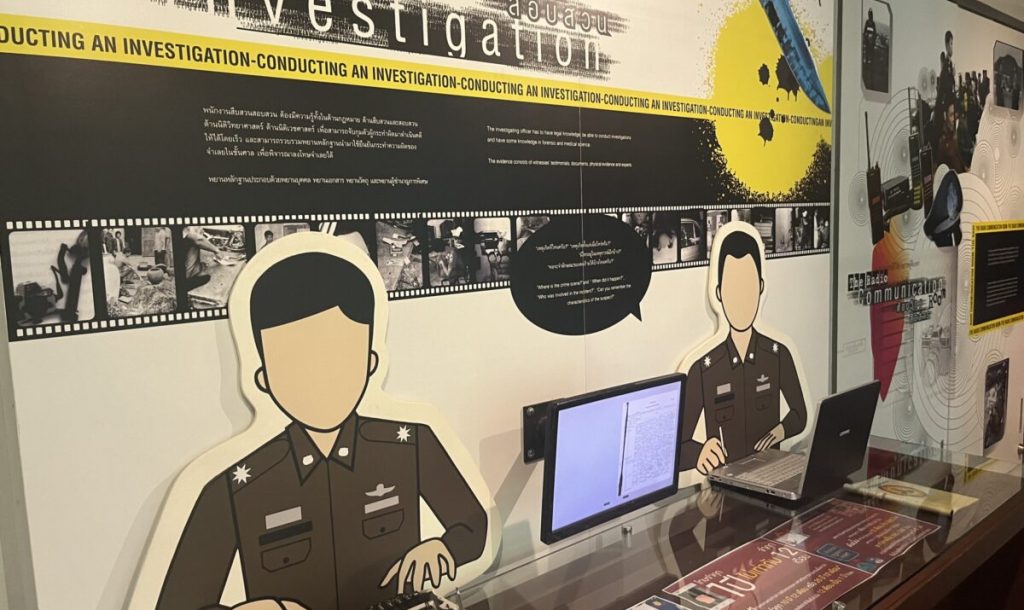




When I arrived in Thailand for my doctoral fieldwork in February 2024, the threads of a corruption scandal involving then-Police Commander Torsak Sukvimol and Deputy Police Commander Surachat “Big Joke” Hakparin were beginning to unravel. Big Joke was accused of allegedly being involved in an illegal online gambling ring and Torsak was accused of alleged malfeasance. In response, Prime Minister Srettha Thavisin transferred both men to inactive posts and by August, Big Joke was dismissed from the force.
This episode revealed deep and serious cracks within the Royal Thai Police (RTP), viewed by many as one of the country’s most corrupt and least trusted institutions. Analysts and scholars have extensively documented the politicisation and partisanship of the police, as well as the impunity that exists surrounding the institution’s human rights violations.
The scandal made my project feel timely. But I also worried whether police officers would close ranks and avoid talking to a foreign researcher like me. To my astonishment, that didn’t happen. While some officers remained guarded, many opened up to me about the struggles they faced. They told me about their frustrations around the lack of public trust in policing. They commiserated with me about their small salaries. They expressed annoyance—sometimes even anger—at the RTP’s suffocating hierarchy.
These discussions evolved into conversations about the day-to-day lives of police that revealed the significant, albeit constrained, discretion that officers wield. Officers, particularly those who interact closely with citizens, have opportunities to choose when to bend (or even break) the rules and law. While this discretion is sometimes employed for personal financial and political gain, many use it to manage the pressures that come with police work. Some officers told me how they use their discretion to avoid what felt like unnecessary work, like the ones who told me they might listen to citizen complaints but don’t file an official report when they know a case is unsolvable. Others told me how they bend the rules out of genuine concern for the citizens that they are pledged to serve and protect, like one officer who told me that as a young cop he rarely ticketed the poor for traffic violations.
The nature of interactions between citizens and police officers are significant because they are some of the most direct ways that citizens experience the state. As Michael Lipsky points out, “most citizens encounter government (if they encounter it all)…through their teachers and their children’s teachers and through the policemen on the corner or in the patrol car”. It is these “street-level bureaucrats,” teachers, welfare officers, and cops, that do the hard work of making policy reality, especially when resources are scarce and goals aren’t clear. And for them, implementing policy is personal.
These differences in treatment are an inevitable part of bureaucratic decision-making. By deciding who is eligible for government goods and services, street-level bureaucrats can determine the bounds of citizenship, particularly for the poor, who depend on police and public services the most. Who receives something and when they receive it thus has a direct impact on how citizens experience citizenship. The experiences people have with the police ultimately depend on the discretion of police officers who make decisions based on their moral dispositions and the formal and informal exigencies inherent to their work. As a result, how police choice to enforce the law (or not) results in them “making law.”
When police officers in Thailand interact with citizens, they are navigating their formal responsibilities as law enforcement agents and their informal relationships to politicians and licit and illicit business figures. This shrouds interactions with the police with an added layer of uncertainty because citizens rarely know why an officer is exercising their discretion.. Citizens are left wondering whether police officers will use their discretion to undermine their rights or to protect them. Interactions with the police can already be intrusive, unwanted, and unintended. But in Thailand, citizens deal with an added layer of uncertainty. What kind of obligations is the officer beholden to? What is his primary concern today: meeting his arrest goals for the month or clearing the streets because an important political figure is visiting?
Flat conversations on police use of force
When I first started my fieldwork I didn’t expect to focus on the day-to-day work of police officers. My doctoral project initially looked at how professionalisation efforts (the development of standards of conduct, expertise, and internationalised norms)and political ideology shape police practices, particularly practices around the use of force.
Consequently, my early interviews were about the use of force. My interlocutors carefully responded to my questions, outlining the ways they were trained to use force during arrests, protests, and when intervening when fights broke out between citizens. But when I asked if they had ever witnessed a moment when an intervention didn’t go as planned, or when they felt their training wasn’t adequate, the answer was almost always a bland “no,” even though my interlocutors and I knew that while the guidelines for the use of force were strict on paper, they weren’t always followed in practice.
Why are millions of Indonesian workers taking up methamphetamine?
Indonesia’s new economy of speed
It was only occasionally after an interview that interlocutors would admit that reality was a bit more complicated. That the situation isn’t as bad as it was twenty or thirty years ago, they would tell me, but there are still significant issues. Yet, besides these comments, officers would only discuss use of force according to the guideline they were taught during their training.
The Royal Thai Police’s street-level bureaucrats
Because officers weren’t interested in talking about use of force, I started asking them about their daily lives. What did a typical day look like? What are their colleagues like? What were some of the biggest challenges they face? In short, I asked them about the everyday decisions and practices they make as street-level bureaucrats. Street-level bureaucrats often work in environments with drastically limited resources and chronic staff shortages. These are environments where they often must confront “incompatible goals, unrealistic targets, arcane rules, and an endless stream of emotionally trying encounters with clients”. In short, street-level bureaucrats are caught between the intentions behind the goals of their superiors and the demands of the people they are meant to serve. This is certainly the case for Thai police officers.
Scholars have long pointed out that a key power street-level bureaucrats have at their disposal to deal with the challenges of these environments is their discretion. Street-level bureaucrats can decide to bend, twist, and sometimes even break the rules. This “selective implementation” or “non-compliance” offers street-level bureaucrats like police officers a significant amount of leverage over their “clients.” This power can be exercised in different ways. Bernardo Zacka, for example, identifies three pathologies of street-level bureaucrats: the indifferent, who is simply following procedure, the enforcer, who is trying to prevent and punish abuse of the system, and the caregiver, who is just looking out for their client’s needs.
In many ways the structure of Thai police stations lends itself to creating these kinds of interactions. When citizens arrive in a police station, the first person they meet is an inquiry officer who documents their complaints, collects initial evidence, investigates if needed, files the preliminary report, and comes up with a resolution if they can. Inquiry officers, however, are overworked and understaffed: instructors at the RPCA point out that inquiry officers do much of the work that would be expected from a prosecutor’s officer in North America or Europe. Several officers told me that they are sometimes expected to meet unrealistic key performance indicators (KPIs), with one office mentioning he once worked at a station where they were expected to have an 80% clearance rate for cases they get. Consequently, inquiry officers have admitted that their discretion plays a role in determining how a citizen interaction will go. An inquiry officer mentioned that he and his colleagues sometimes don’t even file a formal report if it they think the case can’t be solved.
It isn’t just with inquiry officers that we see discretion play out. During an interview in the Northeast of Thailand, a police colonel asked me at the end of an interview if there was anything about Thai law enforcement that surprised me. I told him I was surprised at how rarely people wore a helmet when they rode a scooter. The officer leaned in. The reason is simple, he said. Strictly enforcing traffic laws unfairly burdens some citizens more than others. Wouldn’t stopping a poor mother driving her two children to school cause serious problems for her if she is unable to pay the fine? This officer’s sense of justice or injustice contributes to his discretion in terms of traffic law enforcement.
The existence of police discretion is hardly a feature unique to the RTP. Police scholars have frequently highlighted how it is a fundamental aspect of policework. Melissa Jardine, for instance, shows how officers in Hanoi see the effective use of discretion as the hallmark of a competent officer. Crucially, the officers differentiated discretion as being separate from corruption: the former is a way for police officers to maintain order in society when the rigidity of the law may create problems, whereas corruption is an attempt to benefit personally from a system intended to protect people. The line between corruption and discretion is thin, however. Is an officer accepting a bribe that is “cheaper” than a ticket corrupt or using his discretion?
Constraints to discretion
Though the discretion of street-level police is significant, it is also deeply constrained. Many of the police officers that I talked to found themselves caught between the demands of their superiors and the expectations of the public, struggling to navigate a satisfying middle point between the two.
The demands from their superiors commonly stem from the strict hierarchy imposed by the fact that the RTP’s command structure strongly emulates the military. It is one of the first things officers learn during their training. Cadets, regardless of whether they train as commissioned or non-commissioned officers, are placed in a military like environment during their training. They are divided into companies, are expected to salute whenever a senior officer passes by, and even march to and from their classrooms to their dormitories or when they are dismissed from a meal. A couple of officers also talked about experiencing SOTUS (Seniority, Order, Tradition, Unity, Spirit) during their training, a form of hazing in Thailand that often reproduces informal hierarchical relations (and which regularly leads to serious injuries and deaths).
Formal and informal hierarchies follow officers throughout their careers. Junior officers are expected to follow their superior officers’ orders without question: you do what your senior officer wants, and no more. Even when officers mentioned superiors who would solicit advice and thoughts from their subordinates on how to proceed with a criminal investigation, they acknowledged that the final decision on how to act came from their immediate superior. More concerningly, several officers told me that they had also been ordered by a superior officer to drop a case, delay sending a case to court, or to hold off on an investigation altogether. These kinds of orders were seen to protect the interests of phu mi itthipon (“persons with influence”), politicians and business leaders who held sway over their bosses.
Indeed, my interlocutors often talked about the considerable influence that politicians and business leaders have on their careers. Many officers noted that one of the difficulties of their job was the unwritten responsibility of caring for government officials, business leaders, and MPs because their bosses either had business interests with them or because they facilitate promotions. Thus, being in the good graces of one of these phu mi itthipon can ensure a smooth trajectory to higher branches of the police. A poignant example is the so-called “Elephant Ticket” scandal of 2021, which exposed officers’ alleged payments of millions of baht to secure promotion, a practice allegedly still happening at the time of my fieldwork.
There are also very real constraints related to money and resources. Officers have universally commiserated about pay, many contending it is the central reason why Thai law enforcement remains corrupt and ineffective. Officers find themselves in positions where they needed to make difficult decisions about how to use the limited resources they have. In many cases, officers claim to use their own money for what would otherwise be considered official duties. I was repeatedly told that officers paid for the petrol to drive police vehicles. Several investigative officers, particularly in rural parts of Thailand, pointed out that this created logistical challenges for their cases. Pursuing a promising lead at the other end of province would cost them more than a less promising one in a nearby district.
Why are millions of Indonesian workers taking up methamphetamine?
Indonesia’s new economy of speed
Discretion versus patronage
One of the key insights on research about street-level bureaucrats is that they are “ethical problem solvers who confront successive moral puzzles,” as Zacka puts it. What the multiplicity of pressures reveals—from the lack of resources, to demands from formal and informal hierarchies in the police force, and the politicisation of the police—is that officers in Thailand have to weigh the needs of their clients with the patrimonial demands that are placed upon them. Making an arrest might upset a superior, have an impact on KPIs, or simply result in overtime that the officer would rather spend working at their coffee shop to earn extra money for their family. But while these pressures were seen as a burden, many also saw their ability to navigate them as a source of pride. I remember during a conversation at a roadside coffee shop, a patrol officer explained that having to pay for things with his own money was natural. Good police officers make sacrifices.
All of this has severe implications for citizens’ interactions with the police, and the extent to which they can provide security and uphold the rights of citizens. The level of corruption and patrimonialism within the RTP means that officers are often prioritising the wants of a privileged class of citizens over the needs of the poor. Even when officers feel strongly about their duty, they are pulled in multiple directions by the demands of their superiors and the expectations of citizens, demands that they have to navigate with a lack of adequate resources. Police officers find themselves influenced by a mix of external and internal forces that create opportunities to exercise significant decision-making power, and instances where they feel entirely powerless.
• • • • • • • • • •
This post is part of a series of essays highlighting the work of emerging scholars of Southeast Asia published with the support of the Australian National University College of Asia and the Pacific.