 Facebook
  Twitter
  Soundcloud
  Youtube
  Rss
Rss 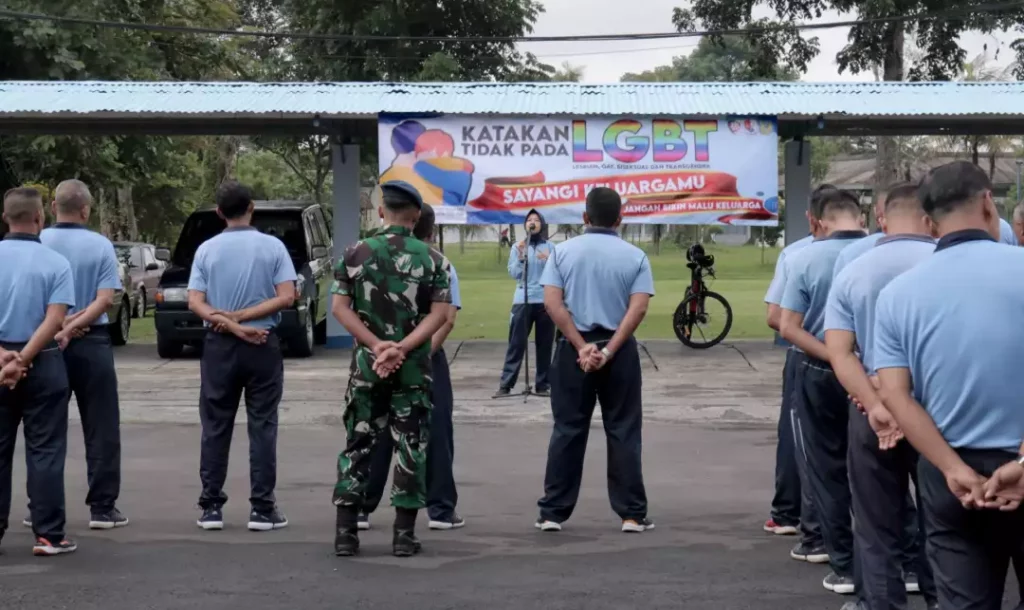




Prejudice against queer people in Indonesia is on the rise in many forms. Academics, journalists, and organizers writing on the subject combine references to public opinion surveys, viral statements by politicians, professional associations’ classification of queer identities as mental illness, discrimination in hiring and education, lurid hate crimes, high-profile police raids, and laws regulating homosexuality.
Michael Bosia and Meredith Weiss use the term “political homophobia” to describe intentional deployments of anti-LGBT prejudice as a state strategy and within social movements. This broad definition has clear advantages: it identifies the common anti-gay roots of seemingly different events, and that underlines the cascade effect of moral panics. In Indonesia, a 2016 anti-gay crusade began with then-education minister Mohamad Nasir publicly calling for a ban of queer organisations on university campuses. It eventually spiralled to influence police raids, communications policy, and national defence considerations.
Yet this expansiveness also risks overgeneralisation, and in the worst cases caricature. The term political homophobia may lump together the government’s policies, its employees’ actions, professional diagnoses, organisations’ campaigns, and public incidents. Rare, dramatic hate crimes are bundled with everyday biases, physical and economic violence with hurtful misconceptions. Contrasting types of prejudice can illuminate as much as finding their parallels.
Digging into the details of different government ministries’ policies unearths two political homophobias framing the country’s so-called “LGBT crisis”. One frames queer people as a dangerous element that should not exist and cannot be worked with. The second frames them as a population to be managed or even helped.
Like all national governments, the Indonesian government is a complex assemblage trying to meet many different objectives: health, order, morality, development, welfare, and so on. These objectives are in tension, and the government’s different ministries are hardly unified in their approach to balancing governance problems. Even in an era of authoritarian consolidation, coherent government policy is often a myth: instead, the fabric of policy is woven by laws, government and ministry regulations, ministry decrees, presidential instructions, and other such documents.
Doctors, soldiers, and social workers have different professional responsibilities and different methods of socialisation, so state homophobia takes different forms. Several government bodies orient their official policy towards banning queer people from public life. At the same time, other government bodies have developed policies to manage and incorporate queer people within the formal economy, healthcare system, and so on.
As part of my doctoral research into local service delivery to at-risk populations in Indonesia, I spent 10 months based in the Special Region of Yogyakarta between November 2023 and January 2025, with periodic travel stints to East Java, Central Java, and Jakarta. In this time, I observed queer organisations and allied organisations work as service providers to their communities: they assisted, managed, operated, or contracted to provide healthcare services, vocational training, educational film screenings, relief funds, protection from violence, community spaces and more.
Though a single political homophobia suggests that organisations have no choice but to hide or resist, a pair of homophobias presents them with different tradeoffs. Activists and organisers working on outreach and services for the LGBT community in Indonesia have differing assessments of the best course of action given these opportunities and dangers. I observed organisations construct alternative infrastructures outside of the state, and I observed other organisations gamble on cooperation and the possibility of reform with the government.
In short, queer organisations operate in a far more complex tactical environment than first meets the eye.
Repressive homophobia
Many government officials and psychiatric professionals in Indonesia label LGBT identity as a symptom of a dangerous foreign ideology that must be quarantined and fought. The government’s most infamous policies towards queer people punish them for forming relationships, having sex, or openly expressing their identities. These policies—generally favoured by the military, police, and education and communications authorities—aim to drive queer people into hiding.
Effective 2 January 2026, Indonesia’s National Criminal Code criminalises sex outside of marriage, and therefore same-sex relations, for the first time in the country’s history. Though the law will likely make life harder for queer Indonesians, the new law does limit reporting power to spouses or immediate family members of the couple. Though the reputational damage of a court process will cause many people to hesitate before reporting, some family members will use the threat to push out children or unfaithful spouses back into the closet.
The new Criminal Code is a grim landmark of a steady backslide. Police and prosecutors already used the 2008 Pornography Law as pretext for high-profile raids. Nearly a decade ago, Hendri Yulius Wijaya and Nurdiyansah Dalidjo documented the government’s weaponisation of public indecency and pornography charges against men having sex at spas or private parties in hotels.
Outside the Criminal Code, criminal law and ministries’ binding decrees lay down fines, license revocations, and prison time for queer content. For example, the Communications Ministry published Decree 172/2024 in March 2024, fining digital platforms publishing prohibited user-generated content. Such prohibited content can be very loosely defined, including “content that unsettles society” and “content that violates law”. The former is listed as urgent, while illegal content is not. I spoke with Indonesian organisers who claimed that this had already been weaponised against organisations’ social media accounts, which the government labelled as private. As of June 2025, proposed revisions to the existing Broadcast Law would ban LGBT content across both conventional and online media, broadly defined.
The armed forces and defence offices discriminate as a matter of security policy. A 2021 internal study of the National Defence Institute, which reports directly to the president and is responsible for educating and training Indonesia’s cadres and national leadership, found that the vast majority of its respondents shares the former defence minister Ryamizard Ryacudu’s opinion that queer people are agents in a “proxy war”. Military tribunals have dishonourably discharged or imprisoned soldiers for homosexuality: listed evidence for one case included photographs of the two convicted naval officers, a blood test with HIV-negative results, and photocopies of three separate internal military decrees prohibiting same-sex relations.
Paternalistic homophobia
Other government ministries—like those in social affairs, health, population and civil registration, and elections administration—have policies treating queer people as a population that should be folded into mainstream society. Local governments’ Social Affairs Offices may fold specific queer populations into existing designated categories for people who require social assistance: “people with social welfare problems” (Penyandang Masalah Kesejahteraan Sosial) or “the socially disadvantaged” (tuna sosial). At the national level, the Social Affairs Ministry even listed transgender people as a target population in their internal performance scoring matrix for their 2020–2024 strategic plan.
As one bureaucrat employed in election administration said to me:
People with different sexual orientations, they have the same rights, don’t they? Sex workers too, they have the same rights, don’t they?…They’re still made into a minority group. Those people in society are going to look down on these groups, so accessible information does not reach them. They’ll become a group that is made to be on the margins.
In practice, this approach often straddles welfare concerns and respectability politics. The 2015 Social Affairs Ministry Regulation for the Standards of Social Rehabilitation Providers for the Socially Disadvantaged defines socially disadvantaged people as people who:
Due to certain factors, are unable or less able to live a decent life or in accordance with religious, social or legal norms and tend to be socially isolated from community life such as vagrants, beggars, prostitutes, human trafficking victims, former inmates, and people with HIV/AIDS.
More concretely, the Directorate of Social Rehabilitation for Social Problems and Victims of Human Trafficking has carried out the Social Affairs Ministry’s Character Guidance program for several populations, including trans women detained in sex worker raids. These programs bundle basic essentials and healthcare with other programs designed to meet state priorities, like vocational training and counselling. Jobs trainings, healthcare services, and food distribution offer a possible path to financial stability.
At the same time, human rights monitors have observed that the government counselling services are often conversion therapy, ranging from talk therapy to forced exorcism. This is unethical by human rights criteria. It is also ineffective even for the government’s aims, as many people would reject it in practice. As one gay activist told me in an interview:
The first [challenge for the queer movement] is recognition. Prior to the rest is recognition, because [queer people] aren’t viewed as individuals but as a type of sexual deviation. That’s how it’s regarded by the government. That’s why government programs, like the Social Affairs Office, have a corrective character, they want to return them to heterosexuality.
Healthcare is subject to specific and competing criteria for regulatory scrutiny. The 2023 Health Law lists sexual orientation and gender minorities as a vulnerable population requiring outreach in its formal explanation. At the same time, Article 433 of the Health Law imposes up to 10 years in prison and a 2 billion rupiah fine for performing plastic surgery that is intended to change a person’s identity or otherwise violates local norms. The explanation of this article specifically references gender transition that is not authorised by a court.
The relationship these offices have with queer communities is evidently fraught. Some of these policies are repressive in their own right, others are potentially useful for the community, and many are both. Nevertheless, some offices’ interest in service provision makes them prospective partners for queer organisations.
Strengthening state services
Activists I interviewed described ongoing engagement and even cooperation between queer organisations and government agencies. Queer organisations worked with public health offices for HIV/AIDS outreach, registration offices for identification cards, and even fisheries offices to receive authorisation to open a fishpond. One gay rights organisation has worked with the vocational training centre at their local employment office by recruiting people for pre-existing training workshops in sewing, cooking, vehicle repair, and cosmetics, and by running surveys and interviews within the community to identify demand for specific subject areas.
Such cooperation happens in numerous localities, including Yogyakarta, Surabaya, Jakarta, and Ambon. In rare instances, this relationship even is formalised: the Social, Labor, and Workforce Office of Yogyakarta City, for example, recognised the organisation Kebaya as a social welfare institution (Lembaga Kesejahteraan Sosial) serving people who are HIV-positive in 2021. Kebaya is run by a waria, has many queer staff, and serves many queer beneficiaries.
When organisations forge partnerships with local government in the shadow of repression, they assume personal and organisational risk. Organisations and individual members both become more visible to state authorities. Yet in an ideal case, organisations could offer their subject matter expertise and field staff, while local governments could contribute resources, technical staff, and logistical support.
Well-designed services targeting queer people are essential to improve their quality of life in Indonesia. Civil society organisations representing them or otherwise working with them have key advantages relative to the government when designing and implementing soft infrastructure. Because of their access to community knowledge, organisers are often able to anticipate design flaws in interventions that would reduce community engagement or uptake. Equally importantly, civil society organisations also often have access to contact lists and trusted intermediaries to spread information, making advertisement easier and more effective than comparable government efforts.
However, queer organisations’ spending power and personnel count are orders of magnitude smaller and many are principally or solely staffed by volunteers. This makes it taxing for most organisations to scale services or provide consistent services on their own.
As a result, local partnerships between queer organisations and government offices are a high-risk, high-reward proposition that relies on courage on the part of organisers and mutual—if often limited—trust. Some experienced organisers have working relationships with specific civil servants or state offices dating back to the 1990s and early 2000s, when the state quietly worked with queer organisations to control the spread of HIV/AIDS. Some staff or volunteers working with these well-connected activists have formed their own relationships with the state as a result. As one experienced organiser told me about her own personal lines of communication with civil servants, after other cooperative ventures between the queer community and the state broke down:
Yes! The government could still help because of their closeness with me. I knew them before I had [my organisation].
Several waria organisations maintain direct working relationships with various state offices in four of Yogyakarta’s five districts. I asked one community liaison who has worked with the waria community’s organisations and the government between 2021 and time of interviewing in December 2024. Sleman District clearly has the most comprehensive state approach to political cooperation with waria of the five counties. The liaison described waria organisations as trusted partners with the district’s Social Affairs Office, entrusted by the government to advocate for eligible waria and non-waria alike to be registered for state-subsidised health insurance system for free. He added, “Waria friends can communicate it to the Social Affairs Office to be immediately followed up.” Furthermore, while the relationship with the Social Affairs Office might be unusual, it is by no means the only relationship these organisations have with the regional government. As the liaison explained to me, sitting casually on the floor of the sparse room:
For Sleman’s offices it’s not just the Social Affairs Office, [but also] the Health Office, The Population and Civil Registration Office, and the Fishing and Agriculture Office. Even at the beginning of this year, waria colleagues sent a proposal that they wanted to construct an orchard and fish pond and it was responded to by the Fishing and Agriculture Office.
A successful identity card registration drive for transgender Indonesians shows this directly. A national identity card is crucial in Indonesia for accessing a wide variety of public services, but many transgender people do not have this crucial document. In 2021, the Home Ministry’s Directorate-General of Population and Civil Registration released multiple circulars ordering all regional offices to assist transgender citizens applying for civil registration documents and document changes like national identification cards, domicile transfers, and so on. The Directorate General also revised guidelines based on organisation feedback, allowing letters attesting to birth gender to be approved by a transgender community organisation rather than a state healthcare provider.
This process only took place after queer organisation Suara Kita lobbied the relevant director general. Suara Kita was key in fielding personnel for the program’s implementation. Its 2022 report of this initiative began with congratulatory public statements from the commissioner of the National Human Rights Commission, the chairperson of the National Commission on Violence Against Women, regional civil registration officials, and the director-general of population and civil registration. In the director-general’s comments, he directly referred to transgender people as a vulnerable population with equal rights:
Considering the conditions of vulnerable people, such as the victims of natural disasters, remote indigenous communities, the poor, people with mental disabilities, the disabled, and transgender people, who all really do find it difficult to reach civil registration services, the Directorate General of Population and Civil Registration and the respective offices intend to reverse the direction of movement… This letter aims to strengthen the facilitation of data collection and issuance of civil registration documents for transgender communities, so they can enjoy equal rights to public services as other groups do.
Of course, such cooperation cannot occur without trust—and for good reason, many queer organisers deeply distrust the government. Others simply consider cooperation with the government untenable due to their political opposition to its conservatism. That does not mean, however, that these organisers are any less committed to organising within their communities.
Making alternative services
Rather than directly engaging with the government to improve services, create services, or decriminalise services, many organisations and activists try to build substitute infrastructure.
This has two principal virtues: autonomy and security. Many organisers expressed concern that the government will target them as individuals, co-opt the organisation, fail to create programming respecting the needs of the queer community, or otherwise weaken their own operations. Independence frees organisations to exercise complete control over program design, subject to their budget and personnel constraints.
Many services that organisations provide relate in some way to education, whether as consciousness-raising or skill development. Film screenings provide “edutainment” and opportunities for debate and discussion about queer issues. One organisation identified and trained community members to politically organise, educate peers about their rights, and prepare them to advocate for their own rights when interacting with police officers. Other organisations are trying to improve members’ digital security by circulating phishing and doxxing explainers, studying basic best practices like using secure password safety applications.
Some organisations produce programs that assist with healthcare, economic, and safety needs. One queer organiser routes transgender Indonesians to private healthcare providers willing to provide them silicone injections, botox injections, and breast implants to facilitate gender transition. Organisation members actively maintain mutual aid networks to help community members struggling to make ends meet. Charitable fundraisers are common for people in crisis. Another queer collective organiser described a self-defence workshop they taught several years previously, with the intent to teach community members to take care of each other without involving the police.
At its most basic level, many organisations focus on creating community forums. Though these are obviously sources of joy and solidarity, they are also sites of political strength. In the short term, several queer people involved in such work discussed the importance of “found family” as a resource and support system. Over time, social clubs are fertile ground for movements: they reproduce the necessary skills and motivation. One organiser recounted their organisation’s shift from recreation to completing donor-funded informational campaigns like this:
At first, we honestly didn’t plan to have certain projects or certain campaigns. What’s certain is that our original intention was just to have a space, to have a space for people who wanted to hang out. It was more of a casual thing. Its original nature wasn’t a serious matter. But for our social media, truly we made basic information that’s timeless and easy to access and we also made sure that the way in which we used language was easily understood by [other] people. So it wasn’t planned from the start, only after sharing and time moved forward. Following that, there were a few projects that it turned out we could get support from people to make this and that work. That’s it. We’d also never specifically searched for projects or funding, honestly.
The largest such forum by the numbers is Pride. Numerous organisations have coordinated a privately-held annual pride festival for three consecutive years. Though the festival is held in private locations for safety reasons, each year’s event has accommodated hundreds of attendees. Programming across the years has included oral histories shared by older figures in the movement, workshops for sign language interpretation and scrapbooking, a fashion show, and stalls for selling handicrafts. Though many people criticized aspects of Pride’s management or programming, everyone I interviewed expressed gratitude for its existence as a forum to make new friends, to inspire dialogue between generations, and to promote queer life more generally.
Indonesian queer histories as solace and resistance
A colonial record’s hint at a forbidden lesbian relationship is a reminder of the potential for historical research to uncover queer life in Indonesia’s past and present
Embers of tolerance
The two political homophobias can feel overwhelming, when considering the combined weight of society and the government. One seeks to erase queer people, the other to manage them to better align with their vision of the world. On top of the threats they face from the government, queer organisations are still subject to the same challenges of underresourced non-profits and volunteer-dependent organisations across the world: burnout, personality clashes, free riding, financing, and more. Pessimism and uncertainty are common and reasonable reactions to the current moment.
This makes it even more remarkable that queer organisations continue to create resources for their communities: whether by building alternative institutions, identifying reform-minded allies, or both. They direct resources to the places that they are needed most, making their solidarity a bulwark in difficult times. Just as importantly, community provides joy and laughter. Kindness, resilience, and creativity together keep the embers of tolerance alive. As one organiser said, “Search for community. Don’t be scared of getting to know new people or opening up, because you cannot do everything on your own. You need the reassurance that we’re all in this together”.