 Facebook
  Twitter
  Soundcloud
  Youtube
  Rss
Rss 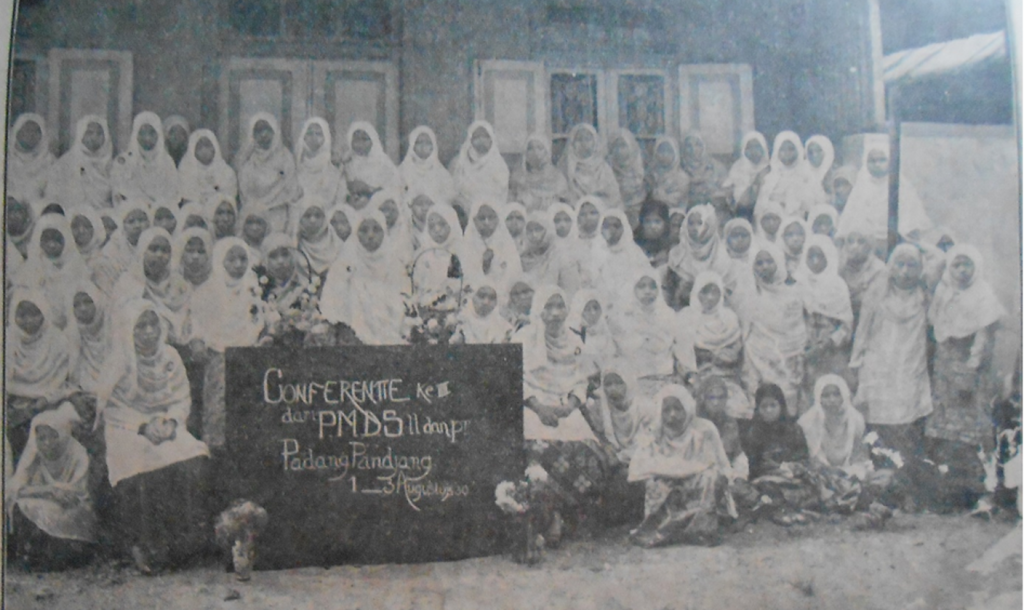




In August 1930, young people from all over the district of West Sumatra in the Dutch East Indies flocked to the highland town of Padang Panjang to attend a conference. For three days, the town was taken over by students as they gathered in classrooms, coffee houses, and mosques. Teenage and primary school age boys and girls, as well as their teachers, attended meetings organised by the region-wide student association they all belonged to: the Persatoean Moerid-Moerid Dinijah School (PMDS), the Association of Students of Religious Schools. The picture above was taken at a meeting of the so-called Girls’ Council, where girls from different schools held lively debates. To mark the festive occasion, the girls posed with vases and baskets of flowers. Without doubt many of them were students at Dinijjah Poeteri (Religious Education for Girls), that had opened its doors in Padang Panjang in 1923 at the initiative of the female scholar of Islam, Rahmah el Joenoessijjah. The first of its kind in colonial Indonesia, Dinijjah Poeteri was a modern pesantren (Islamic boarding school) that attracted girls from all over the Indonesian archipelago and even from British Malaya.
The people of Padang Panjang were used to the sight of students on their way to class or making their way to their dormitories. Their town had been a hub of reformist Islamic education for several decades. The educational reforms of a cohort of forward-thinking Islamic scholars known as Kaum Muda (the Young Group) had spurred the introduction of boarding schools, age-graded classes, and the adoption of classroom technologies such as blackboards and exercise books in Islamic education. Students at Islamic schools now studied non-religious subjects alongside Quranic interpretation and the study of the Hadith.
Muslim educators introduced these reforms into their classrooms as a response to the challenge of Western colonialism. In the face of the colonisation of almost the complete Muslim world, they sought to strengthen Islam from within by educating young generations in new ways. They combined a new emphasis on literal interpretations of scripture with the acquisition of knowledge that originated from the Western world. As a result, modernist Islamic scholars were often critical of religious beliefs that were rooted in local customs rather than directly derived from the Quran.
The opening up of new educational opportunities for girls was another important aspect of this wave of educational renewal. In West Sumatra, there were longstanding cultural traditions that ensured girls’ access to religious education. Traditionally, they started studying the Quran around the age of six under the guidance of a female teacher. From the beginning of the 20th century onward, girls of primary school age attended the rudimentary village schools that were established by the Dutch colonial government in relatively great numbers, making up about 30% of the village school population by the mid-1920s.
Once reformist Islamic schools became more commonplace in the region, small numbers of girls also attended coeducational institutes. But the Dinijjah Poeteri school was one of the first places in Southeast Asia where Muslim girls could combine thorough religious schooling with the acquisition of up-to-date scientific knowledge. The school curriculum was modern in every sense of the word: apart from extensive education in Islamic law, morality, and philosophy, Rahmah el Joenoessijah’s students also became knowledgeable in English, geography, and history, as well as other school subjects that were on the curriculum of secular colonial schools. When the French anthropologist Jeanne Cuisinier visited the school in the 1950s, she was astonished at the amount of time the students spent on secular themes. The school director explained to her: “At my school, the students learn about Islam, and everything in this world is a part of Islam”. The school celebrated its 100th anniversary a few years ago. It remains a prestigious educational institute and is a testament to the ongoing relevance of reformist Islamic girls’ education in Indonesia.
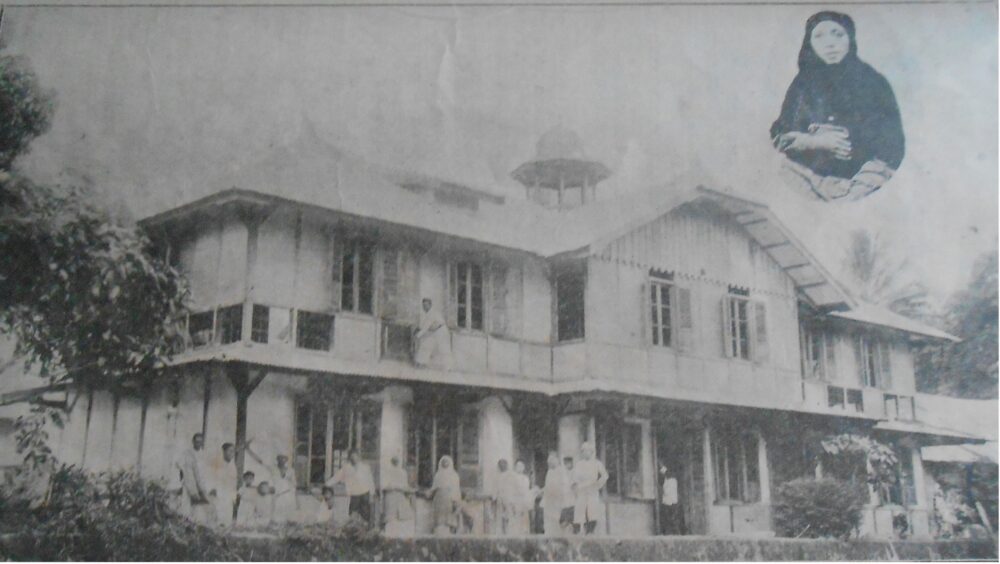
The Dinijjah Poeteri school building with a portrait of Rahmah el Joenoessijah. Source: Boekoe Peringatan 15 Tahoen “Dinijjah School Poeteri” Padang Pandjang (Padang Panjang 1938). Reproduced with kind permission of Perguruan Diniyyah Puteri.
Unfortunately, no written report of the Girls’ Council meetings at the PMDS conference has survived. It is likely, however, that the conversations of the council members meandered from religious to more worldly topics. Religious duties, including proper Islamic attire for girls, were almost certainly on the agenda. All those present covered their head and chest with a long scarf, and many wore baju kurung, a garment that hides the body shape, either in white or in a colourful batik pattern. In an era where Indonesian women were increasingly confronted with Western fashions, clothing was frequently discussed in the flourishing Muslim women’s Malay-language press, alongside modern childrearing philosophies, domestic science, and healthcare.
The image of dutiful Muslim girlhood that the girls presented in the conference picture might hide the radical political implications of their education. Reformist Muslim schools, and especially student organisations like the PMDS, were important hubs of anticolonial activism. In the Dutch East Indies, the 1920s and 1930s were a time of political upheaval, marked by the explosive growth of Indonesian nationalist movements. In this context, privately funded schools that operated outside of the colonial public school system, the so-called “wild schools”, played an important role in spreading anticolonial messages among Indonesian young people.
The most well-known school organisation was the Javanese-nationalist Taman Siswa (Garden of Students). Like Dinijjah Poeteri, Taman Siswa emphasised the importance of educating Indonesian girls in a nationalist spirit. In the varied educational landscape of the Dutch East Indies, these schools existed alongside institutions that vigorously upheld the cultural values of the colonial government, such as Christian missionary schools. Doing research about girls’ education in colonial Indonesia, as I have done over the past years, means to grapple with many different, and often contradictory, discourses about what kind of education was most appropriate for Indonesian girls.
The colonial government responded to the growth of the nationalist movement with unprecedented repression. After communist riots shook West Sumatra in early 1927, thousands of young men were exiled to the notorious Boven-Digoel prison camp in Papua, a world away from their home region, with little hope of ever returning home alive. For Indonesians, even being overheard when making a negative remark about the colonial government was dangerous: a so-called spreekdelict, a “spoken offence”, could lead to an arrest.
Given the turbulent political atmosphere in their region, it is very likely that the girls at the PMDS conference discussed the Dutch colonial occupation of Indonesia and the struggle for independence. The student association was well-known for its anti-colonial stance, and the colonial authorities kept a close eye on its activities. It is almost certain that undercover agents of the secret police were present at the PMDS conference. While the PMDS has left very little archival traces, the activist character of the student organisation clearly comes to the fore in its publications. In the newsletters Soeara Moerid (The Voice of the Students) and Kodrat Moeda (The Spirit of the Young) male and female students discussed their positions as educated young Muslims in a context of colonial oppression. Much like the queer community magazines that are collected by the Queer Indonesia Archive, these publications form a powerful archive of resistance.
Women’s emancipation figured prominently on the pages of Soeara Moerid and Kodrat Moeda. In 1926, for instance, Djawana Basir, a young teacher at Dinijjah Poeteri, published a passionate plea for Muslim women’s right to education. Arguing against people who believed that it was unnecessary or even sinful for Muslim women to study, she mentioned examples of prominent women from Islam who were known for their intelligence and learnedness: Aisha, the third wife of the Prophet, and the Sufi mystic Rabiah al-Adawiyah. Djawana was careful, however, to stress that women were also capable of developing their intellect beyond the religious domain. She mentioned the achievements of the Turkish nationalist Halide Edib and the Egyptian publicist Nabwiyya Musa as proof that Muslimahs could become, in Djawana’s words, “army generals” and “famous journalists”. She ended the piece with a note to all her female readers, whom she encouraged to “seek knowledge (…) so that this changing world will not confuse us”.
Both Soeara Moerid and Kodrat Moeda were short-lived. Soeara Moerid folded after the editor in chief was arrested and sent to Boven-Digoel, presumably on charges of anticolonial activities. It is likely that the same fate befell Kodrat Moeda, which published inflammatory slogans such as: “The Indonesian homeland calls upon its sons and daughters, it asks for effort and vigour, for honesty and sincerity of the heart, for determination and readiness.”
The police often raided reformist Islamic schools in West Sumatra, and girls’ schools were no exceptions. In 1933, the police closed down a girls’ teacher training college in the town of Fort de Kock (Bukittinggi). Officers found nationalist magazines and publications, including work by radical Islamic scholars and a booklet by the nationalist leader Soekarno, who would later become the first president of the Republic of Indonesia. Even more worrying in the eyes of the police were the contents of the student essays they confiscated. In an essay about the permissibility of violence, for instance, the student Soeri Ibrahim wrote that Muslims have the right to wage war against non-believers if they refuse to surrender themselves. Her teachers awarded the essay with the highest possible grade. The policeman who reported on the events noted that the girls’ notebooks were very well-organised and written in a neat handwriting which, according to him, showed that the girls diligently took in the political messages spread at their school. He estimated that at least 90% of the students were members of political organisations. Five girls were active members of the PMDS.
The girls’ college in Fort de Kock was directed by PERMI (Persatoean Moeslimin Indonesia, Union of Indonesian Muslims), an outspokenly anticolonial political organisation that, like others like it, rejected the role of non-Muslims over Muslims. Women played an active role in such movements. In 1932, the PERMI leader Rasoena Said was convicted to an extended prison sentence after she argued for the political independence of Indonesia in a public speech in Padang Panjang. Rasoena spent her 15-month prison sentence in the city of Semarang on Java. The colonial authorities allowed her to keep her baby daughter with her so that she could breastfeed in her cell. PERMI fell apart not long after her release, after most of its leadership was arrested and exiled to Boven-Digoel.
The position of Dinijjah Poeteri as a school in this context is less clear. Rahmah el Joenoessijjah reportedly tried to ensure that the education at her school did not offend the sensibilities of the colonial government. Yet she adopted nationalist terminology, describing her students as “the Muslim daughters of Indonesia”. This was radical at a time when most people identified with their ethnic background and home region rather than with Indonesian nationhood. Moreover, all students at Dinijah Poeteri were PMDS members and participated actively in the organisation. They marched along with its scouting division, wearing insignia on their chest and singing songs, and joined on outings in the region that were meant to stimulate their loyalty to their homeland.
At these gatherings, it would have been easy enough for politically active PMDS members to pass on pamphlets that called for liberation from colonialism to Dinijjah Poeteri students, whether their school director was aware of it or not. While schoolgirls are usually overlooked in historical narratives, the activities of the young Muslim girls who studied, debated and wrote in 1930s Indonesia challenges us to reconsider our assumptions about what anticolonial activism entailed. The struggle against colonialism could emerge in unexpected places — even in a classroom filled with the chatter of girls’ voices.