 Facebook
  Twitter
  Soundcloud
  Youtube
  Rss
Rss 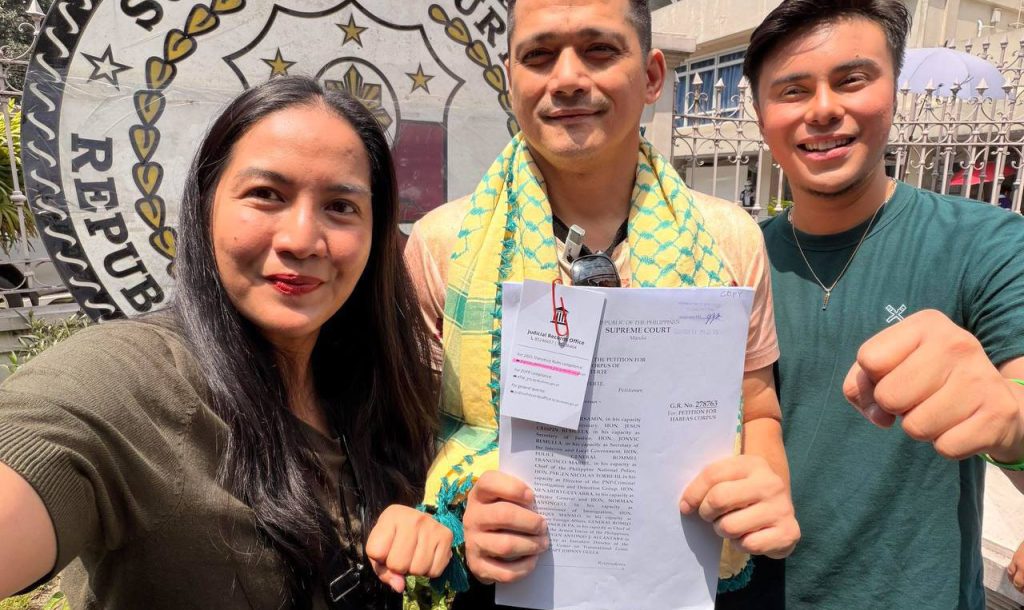




On 11 March 2026, the first anniversary of Rodrigo Duterte’s arrest and transfer to ICC custody, two scenes unfolded across the Philippines. In Manila, families of drug war victims gathered for memorial masses and displayed “wanted” posters of police officials they hold responsible for thousands of extrajudicial killings. For them, the anniversary carried its own moral weight: a nation that allows the trial to proceed is a nation that honours its debt to the dead. Rafaela David, president of the progressive Akbayan party, called the occasion “a historic milestone in the fight for justice where a mass-murdering tyrant was silenced by the people.” Meanwhile, at the Supreme Court, Senator Robinhood Padilla presented a petition bearing over 238,000 signatures demanding Duterte’s return from The Hague. His words distilled the logic animating the petition: “He served us for six years; it is our turn to serve him.”
David and Padilla are not talking past each other accidentally. They are drawing on fundamentally different moral vocabularies—and one year after Duterte’s encounter with the ICC, those vocabularies have not proven equally potent. The language of institutional accountability has secured a courtroom in The Hague. The language of reciprocal obligation has secured for the Duterte clan a critical foothold in the Senate in 2025 and a viable path to recapturing the presidency in 2028.
The puzzle
By the logic of institutional accountability, an ICC arrest on charges of crimes against humanity should erode a leader’s political standing. The opposite has happened. In a Pulse Asia survey conducted days after Duterte’s arrest, President Ferdinand Marcos Jr.’s approval rating collapsed by 17 percentage points, from 42% to 25%, with disapproval surging to 53%. In Mindanao, the Duterte heartland, Marcos’ ratings fell into single digits and have barely recovered since. Economic anxieties and governance scandals contributed to the decline, but the speed and regional concentration of the collapse suggest that the ICC handover activated something deeper than policy disappointment.
In the May 2025 midterm elections, Duterte-aligned candidates swept the top of the senatorial race. Duterte himself, detained in The Hague, was elected mayor of Davao City in absentia. Vice President Sara Duterte, the only top official whose approval rose after the arrest, announced her 2028 presidential bid in February 2026, and early polling for the 2028 presidential race places her at the frontrunner position.
If the ICC’s Pre-Trial Chamber confirms charges against Duterte Sr by its late April 2026 deadline and the case proceeds to full trial, historical precedent suggests the former president could remain in The Hague for five to eight years. The political machinery he built shows no signs of weakening in his absence; if anything, prosecution has galvanised populist support rather than eroding it.
What sustains political loyalty when the leader is physically removed from the political stage? Political analysts and scholars have offered various accounts of Duterte’s enduring popularity, often attributing it to charismatic appeal, or what has been termed “Duterte magic”. But charisma cannot explain a hold on supporters that persists and deepens well beyond the leader’s time in office.
The ICC arrest has sharpened the inadequacy of that explanation: Duterte can no longer perform the strongman persona that supposedly generated his appeal, yet the political loyalty toward him has only intensified. The explanation, Fernan Talamayan and I argue in a recent article in Asia Pacific Viewpoint, lies not in charisma but in utang na loob, a Filipino moral framework that transforms governance into personal obligation, political support into filial duty, one through which loyalty reproduces itself in the leader’s absence. The events of the past twelve months have both vindicated and complicated that argument.
Utang na loob as political grammar
Days after the arrest in March 2025, Duterte’s son Sebastian addressed thousands of supporters in Davao City with a scathing accusation directed at President Marcos: “Wala jud kay utang kabubut-on, ang imong amahan gipalubong sa akong amahan pero akong amahan gipapriso nimo”—“you truly have no debt of gratitude. My father gave your father a hero’s burial, but you imprisoned my father”. The accusation referred to Duterte’s facilitation of the controversial burial of Ferdinand Marcos Sr. at the Heroes’ Cemetery in 2016, a political favour that the Dutertes now claimed Marcos Jr. had repaid with betrayal.
The moral charge packed into that statement draws on utang na loob, commonly translated as “debt of gratitude” but more precisely an obligation that binds the inner self (loob) to those who have shown benevolence (kagandahang-loob) without expectation of return. The imperative to reciprocate comes from within, and its violation (walang utang na loob) constitutes one of the most damning indictments in Filipino social life.
The concept is culturally pervasive, but it becomes politically potent only through deliberate discursive work. In our article, we identify three operations that Duterte supporters perform. First, they establish what counts as kagandahang-loob deserving of reciprocal obligation, transforming routine governance into exceptional personal sacrifice. Second, they construct who participates in this moral economy, pulling voters into a collective identity of grateful beneficiaries through inclusive pronouns, familial terminology (“our tatay”), and temporal framing (“after everything he’s done for us”). Third, they define what reciprocal loyalty demands in the present moment. All three operations were visible in social media discourse during the week of the arrest. The question I want to pose here is: what has happened to them in the 12 months since?
One year of moral consolidation
Each of the three operations has found new material in the events of the past year, and the third has undergone a consequential shift.
Constructing sacrifice. The ICC’s fitness-to-stand-trial process provided rich raw material here. When Duterte’s defence team argued in August 2025 that he suffered from severe cognitive impairment, the ICC appointed an independent panel of medical experts who ultimately declared him fit to participate in proceedings.
Pro-Duterte narratives absorbed this episode into the sacrifice framework: an ageing father figure subjected to foreign medical examination, denied the care his own doctors prescribed, his very mind placed under scrutiny by a tribunal that had no right to judge him. Defence counsel Nicholas Kaufman channelled this sentiment when he read aloud a statement attributed to Duterte during the confirmation of charges hearing in February 2026: “I have done my duty, and I have left my legacy… I have now accepted my fate, and I realise that I could die in prison.” Duterte then waived his right to attend the hearing itself.
Whether this was a principled rejection of the court’s jurisdiction or a tactical manoeuvre, the optics reinforced the sacrifice narrative: a man who gave everything, now resigned to suffering, asking nothing in return. The structure of this narrative mirrors the conditions of kagandahang-loob precisely: benevolence performed without expectation of reward, generating an obligation that only deepens as the benefactor suffers more.
Expanding the moral community. If the first operation transforms what Duterte did into sacrifice, the second transforms who owes him for it. The 2025 midterm elections served as the vehicle. Over 27 million Filipinos voted for Bong Go, Duterte’s closest political lieutenant, placing him first in the senatorial race. Former Philippine National Police (PNP) chief Ronald “Bato” dela Rosa, architect of the drug war’s operational machinery, placed third with nearly 21 million votes. Each ballot can be read as a public declaration of reciprocal obligation directed toward those who stood by Duterte when others would not.
The pattern holds across otherwise dissimilar candidates whose only shared credential was conspicuous loyalty to the detained former president. The 238,000 signatures on Senator Padilla’s Supreme Court petition, submitted on the anniversary itself, performed the same work in a different register: individual acts of moral commitment aggregated into a collective political claim.
What these acts share is the quality of voluntariness that utang na loob requires. Nobody compelled these voters or signatories. The obligation arises from within, from the sense that a debt remains unpaid, and its public expression draws others into the moral community by making the obligation visible.
Redirecting what loyalty demands. Here the most consequential shift has occurred, and it raises a question the framework may struggle to answer. Sara Duterte’s speech to newly inducted PNP officers in April 2025 established the moral template for everything that followed: “Walang kapatawaran ang pagsuko at pagpapakulong sa mga dayuhan ng isang Pilipinong naglingkod ng tapat sa ating bayan”—“There is no forgiveness for surrendering a faithful Filipino to foreign powers”. The invocation of walang kapatawaran (unforgivable) positioned Marcos Jr. as a figure who had committed the most profound kind of moral failure, not a policy disagreement but a betrayal of the inner self.
Ten months later, Sara translated that moral authority into a presidential candidacy. During the February 2026 press conference, she asked forgiveness for helping Marcos Jr. win the presidency, accused him of corruption, and promised to restore her father’s “Tapang at Malasakit” (Courage and Compassion) brand of governance. The timing was deliberate: her declaration came days before the ICC confirmation of charges hearing and just as new impeachment complaints were being filed against her, proceedings that risk activating the same betrayal narrative that galvanised support after her father’s arrest. Supporting Sara becomes the new form of repaying the debt owed to Rodrigo. The moral economy is outliving its original benefactor.
This is where the analysis presses against its own limits. If the obligations Duterte’s supporters feel can be transferred from father to daughter through filial succession and redirected toward whichever ally performs loyalty most visibly, what distinguishes utang na loob from the charismatic appeal that is often invoked to explain Duterte’s hold on supporters? A debt that can be endlessly reassigned to new claimants starts to look less like a moral obligation and more like an instrument of political mobilisation.
The answer lies in the fact that both things can be true simultaneously: the obligation is genuinely felt by millions of Filipinos operating within a coherent moral framework, and it is strategically channelled by political actors who understand its potency. What keeps utang na loob from collapsing into charisma is the felt quality of moral compulsion, the sense that one would be diminished as a person by failing to reciprocate. Duterte’s allies are charting political futures that leverage his name and symbolic capital while his fate before the ICC remains secondary to their ambitions. The transfer of political legitimacy does not require the original benefactor’s active involvement, only the continued performance of loyalty on his behalf.
The accountability paradox
The galvanising effect of prosecution on populist support is a global pattern. Jair Bolsonaro’s conviction and political ban in Brazil left him commanding a mobilised base of 20–30% of the electorate. Donald Trump leveraged his indictments into a second presidential term. Binyamin Netanyahu’s ICC arrest warrant temporarily unified Israeli domestic opinion in his defence on sovereignty grounds. Jacob Zuma’s imprisonment in South Africa catalysed the formation of the MK Party, which captured 14.6% of the national vote and cost the ANC its parliamentary majority for the first time in 30 years.
Each of these cases mobilises its own culturally embedded moral grammar, a set of shared assumptions about who owes what to whom and why loyalty in the face of prosecution becomes a moral imperative: evangelical covenant theology in Bolsonaro’s Brazil, a narrative of deep-state persecution among Trump’s base, Zulu ethnic solidarity and post-apartheid grievance in Zuma’s case.
The Philippine case is not unique in possessing such a grammar. What distinguishes it is the specific content and structure of the moral economy at work: utang na loob dissolves the boundary between state institutions and personal relationships in ways that contractual or transactional notions of reciprocity do not. Sacrifice creates debt (utang), debt binds the inner self (loob), and failure to reciprocate constitutes a violation of one’s moral being.
The filial dimension, where the parent-child bond becomes the template for political authority, transforms democratic checks into something felt as personal and familial betrayal. This configuration produces distinctive political effects: a moral economy that can sustain loyalty across physical absence, redirect obligation to political heirs, and recast international legal accountability as an affront to the inner self of an entire constituency.
The same moral vocabulary, however, is available for mobilisation in the opposite direction. Llore Pasco, a mother of two drug war victims, testified at the ICC confirmation of charges hearing: “Ang mga salita niya ang pumatay sa aming mga mahal sa buhay”—“his words killed our loved ones”. If kagandahang-loob toward Filipino society demands accountability for state violence, then the real utang na loob is owed to the families who buried their children during the drug war, and repaying it requires the trial to proceed. That this counter-framing has struggled to gain discursive traction against the pro-Duterte narrative speaks to the capacity of certain political actors to dominate the interpretation of cultural resources during crisis moments. It does not mean the contest is settled.

Imee Marcos claims the family legacy
Leveraging the Marcos Sr legacy to advance her political standing—even at her brother’s expense?
What comes next
The moral economy of reciprocity will face its most sustained test in the years ahead, especially as Sara’s presidential campaign absorbs the political energy currently directed toward her father’s release. Will the obligations supporters feel toward the father be gradually satisfied through the act of voting for the daughter? Or will the trial itself, if it proceeds, continue to generate new episodes of perceived sacrifice that replenish the debt?
I am not certain the framework I have outlined here can answer those questions in advance. What it can do is reframe how scholars and practitioners of democratic accountability think about the problem. Legal prosecution, however justified on its own terms, can activate moral economies it was never designed to address. The families of the drug war dead deserve their day before the court, and that day should proceed without apology. But the pursuit of justice will be better served by understanding the cultural terrain on which it operates, and by recognising that the same moral vocabularies that sustain impunity also contain the resources to demand accountability in terms that Filipinos already feel as binding.