 Facebook
  Twitter
  Soundcloud
  Youtube
  Rss
Rss 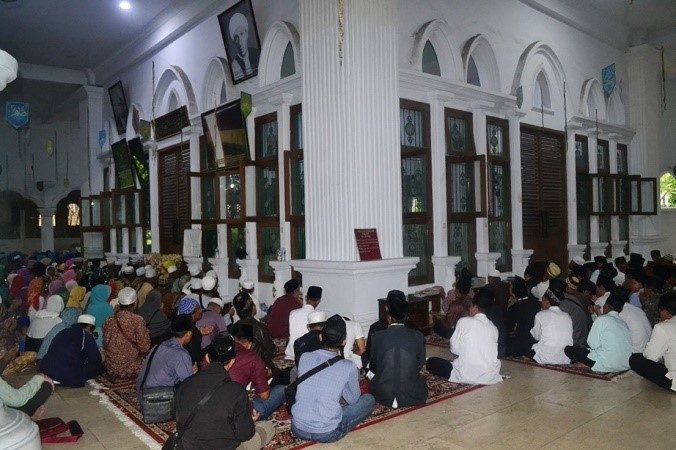




As governor Basuki Tjahaja Purnama (Ahok) faced off against Islamist opponents in Jakarta’s recent election campaign a remarkable story emerged from the grimy wharves and warehouses of the city’s harbour precinct. The story is, perhaps, a side-show to the greater narrative of Ahok’s defeat and subsequent conviction for blasphemy, but it lifts a corner of the curtain that hides unexpected intricacies and paradoxes in Indonesia’s polarising politics of religion.
The story begins two decades ago in a small, ramshackle holy grave that lay like an atoll among the petroleum tanks and shipping containers of the Koja Container Terminal. Many locals believed the grave was the resting place of a saintly Muslim missionary, Mbah Priok, officially known as Habib Hasan Al-Haddad. They said he died at sea in 1756 while on a voyage from Palembang to Jakarta. His remains were brought ashore at Tanjung Priok and buried in the dockside Dobo public cemetery.
In the 1990s the Jakarta government claimed the cemetery as ‘crown land’ and set about removing its thousands of graves so the site could be used to stack shipping containers (see map above). By 1997 all the graves, including Mbah Priok’s, had been cleared. Cowed by the authoritarian order of the time, the Haddad family—custodians of the holy tomb—hadn’t dared protest and the Terminal was poised to move in on the freed-up land.
But history intervened. On May 20th 1998 President Soeharto was forced from office. The old political certainties dissolved, and with them the old fear of authority. The Haddad family seized their chance to make a comeback on the land they had unwillingly vacated.
The following year, without official authorisation, they began to rebuild on the site, and by 2002 a ‘house’ (pictured below in 2008) had appeared in the shadow of the shipping containers. Inside the house lay the newly resurrected grave of Mbah Priok. Emboldened, the Haddad family then sought recognition of their ownership through a civil suit in the North Jakarta state court. The court ruled in favour of the government and the terminal’s managers, the PT Pelindo II stevedoring company. Pelindo II was a subsidiary of Hutchinson Whampoa, now known as CK Hutchinson Holdings, probably the world’s leading port management conglomorate. The company, said the court, was legally entitled to occupy the former cemetery.
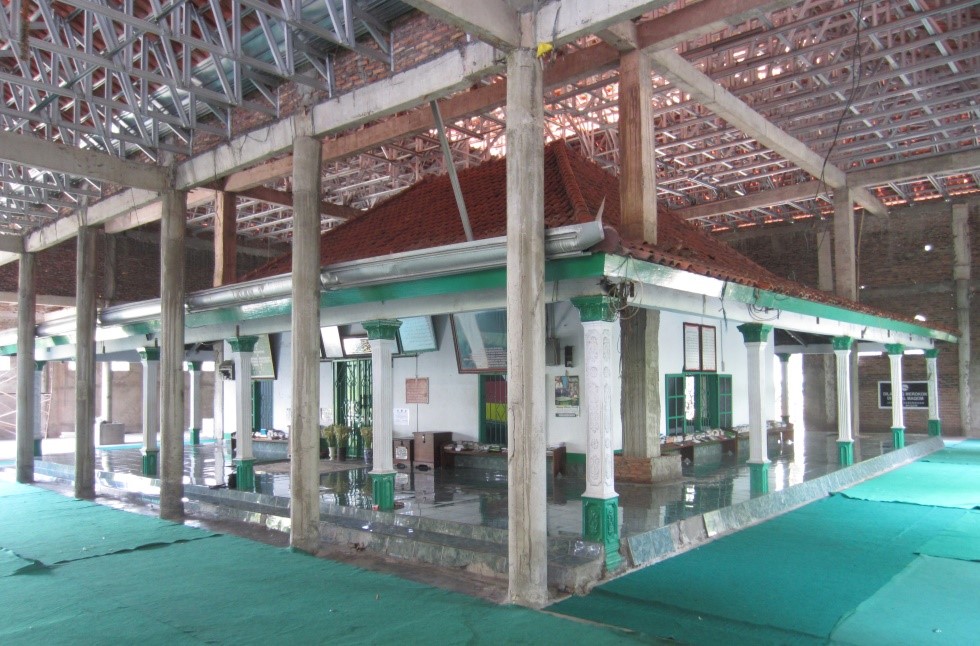
The Haddad family were not intimidated by government or the power of global commercial interests. They simply ignored the court’s ruling and continued to build. As they did, ever-growing crowds of pilgrims were turning up at the site to pay their respects to Mbah Priok. At least once a week, during Thursday night pengajian devotions, they overflowed into a neighbouring roadway, blocking entry and exit by freight trucks loaded with containers.
It was eight years before the Jakarta government, prodded by PT Pelindo II, mustered enough will to enforce the court’s ruling. On the morning of April 14th 2010 a convoy of buses, vans and personnel carrying trucks, sardine packed with almost 3,000 well-padded, helmeted police carrying truncheons and perspex shields, descended on the Terminal. They came with two bright yellow shovel arm excavators, two jet-black water cannon trucks and a good supply of tear gas cannisters. They were on a beautification mission, they said. The target of their artistry was Mbah Priok’s tomb.
But local people resisted and rioting broke out. This galvanised the Islamic Defenders Front (Front Pembela Islam or FPI), led by firebrand cleric Habib Rizieq Shihab. An army of FPI activists filtered out of the surrounding slums and joined local defenders around the holy tomb. Tear gas and water cannon seemed only to enrage them. They split the police, forcing some south towards the city amid burning trucks and cars, and hounding others north into the labyrinth of the terminal. Around four hundred police squeezed through the container stacks and stumbled out of them onto the dockside where they cowered at the water’s edge. A flotilla of fifteen small boats was quickly mobilised to evacuate them by sea. By the end of the day three police officers lay dead, more than seventy police and hundreds of local people had been injured, eighty vehicles had been torched or wrecked, and a good number of office buildings in the terminal were left with sightless windows and fire-blackened walls.
For the FPI the defence of the holy tomb was a big test and a major victory. Habib Rizieq had shown his characteristic opportunism, leaping to the defence of a tomb that, in other circumstances, he might have condemned as a nest of grave-worshipping idolaters. A sense of Hadrami solidarity probably played a role too. Although born in Indonesia, Habib Rizieq is of Hadrami Arab descent, as are the Haddad family, the custodians of the tomb. Possibly he was also moved by memory of the 1984 ‘Tanjung Priok Incident’ in which twenty-four (unofficially as many as one hundred) locals were mown down by army gunfire as they protested against the desecration of a Muslim prayer room and the imposition of the secular Sole Foundation (Azas Tunggal) concept on Muslim organisations.
A chastened Jakarta government backed off. The Haddad family were able to resume construction on the site. They even scored financial support from the government, as well as a new access road.
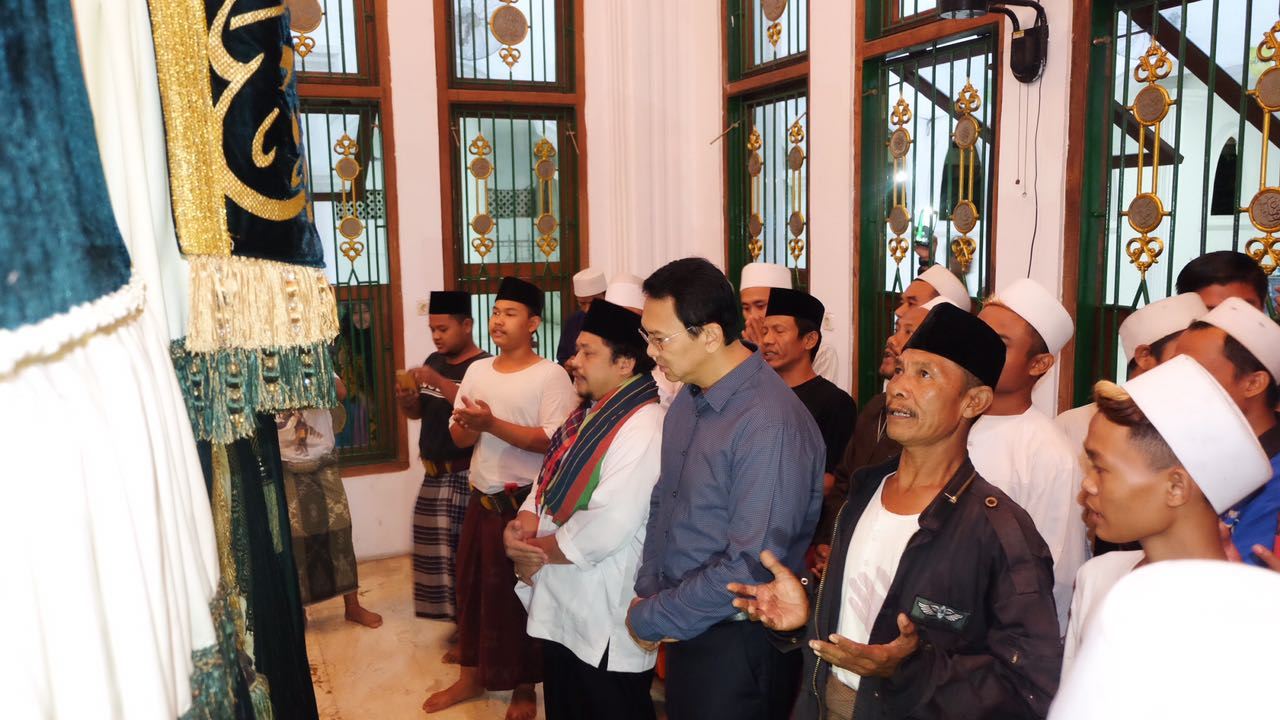
Fast forward six years. Habib Rizieq was a prime force behind the movement to indict Ahok on a charge of blasphemy and remove him from office. In the months leading up to the second round of Jakarta’s gubernatorial election Ahok fought hard to capture Muslim voters. He reached out to the Muslims of north Jakarta by making at least three visits to the tomb of Mbah Priok, the same tomb that his implacable foe, Habib Rizieq, had help protect from destruction. On each visit Ahok was greeted with open arms and ushered into the burial chamber where he paid his respects at the saint’s graveside (below). For the Haddad family it was a golden opportunity to build bridges with the Jakarta government and consolidate their legally questionable occupation of the site.
Two months ago Ahok confirmed that his government would designate the holy tomb of Mbah Priok a ‘cultural sanctuary’ (cagar budaya) and would help fund a massive expansion of the site. It would become an international centre of religious tourism, he promised. The nearby holy site at Luar Batang, resting place of another Hadrami holy man, Habib Husein Alaydrus, would also be redeveloped with help from the Jakarta government. When the results of the election came in, north Jakarta was the only precinct in the Special Region of the Capital where votes for the Ahok-Djarot team managed to match those for Anies-Sandiaga.
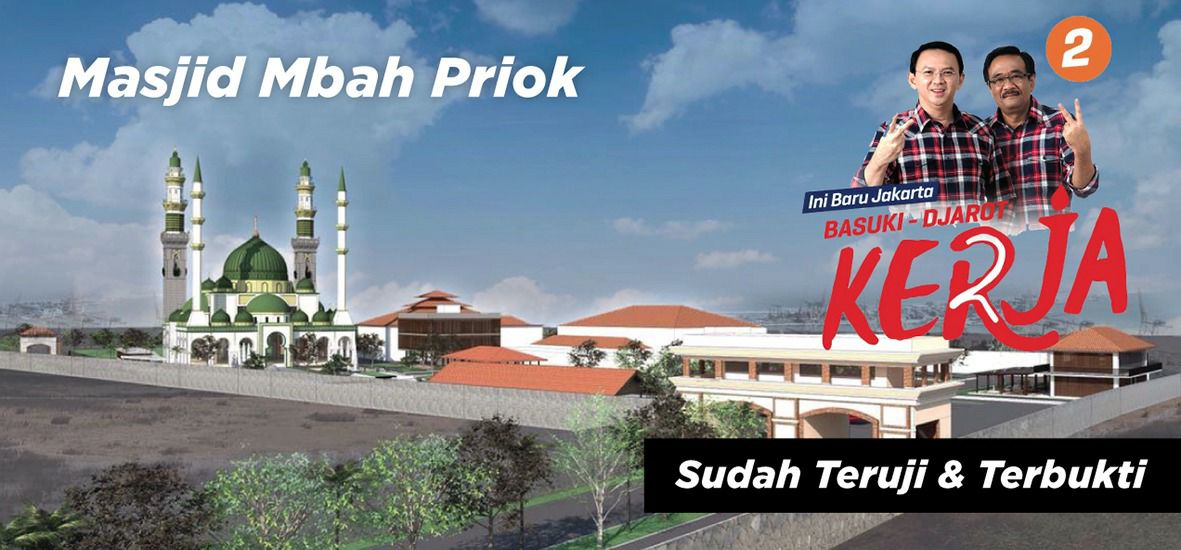
Ahok’s warm reception at Mbah Priok’s holy tomb—so at odds with the rejection of him by Islamist forces in the community at large—was not entirely a matter of nuts-and-bolts expediency for him, or for the tomb custodians. Java’s booming culture of saint veneration remains remarkably inclusive. It embraces Muslims of all stripes as well as non-Muslims. Across Java at least eight Muslim pilgrimage sites explicitly commemorate Chinese Indonesians and extend a special welcome to Chinese visitors, whether they are Muslims or not. They range from the busy tomb of Sunan Gunung Jati in Cirebon (the saint’s wife was Chinese), to the tomb of the Chinese-Muslim artist Kyai Telingsing in Kudus, to the money-spinning twin tombs of the Chinese Eyang Jugo and his adopted Muslim-Javanese son Iman Sujono high on the slopes of Mount Kawi in East Java.
After the riot of 2010 the Council of Indonesian Ulamas (Majelis Ulama Indonesia or MUI) commissioned a report into Mbah Priok’s tomb by a team of respected sociologists and religious scholars. They were horrified to find evidence of irregular devotional practices at the tomb. And the report failed to find any evidence that the site had been a holy place in colonial times. Even Mbah Priok himself, alias Hasan Al-Haddad, had died as recently as 1927 and had never engaged in dakwah missionary work in Java.
But it was too late. A new pilgrimage site is now flourishing in the middle of the Koja Container Terminal. Already it is deeply embedded in the intricate politics of Jakarta, and already it is challenging religious sectarianism with its inclusive embrace, its cagar budaya status, and its commercial potential.
……………
George Quinn is retired head of the Australian National University’s Southeast Asia Centre, and is an Honorary Professor in the ANU’s College of Asia and the Pacific. He has researched, published, and taught extensively on the languages, literature, culture of Indonesia, with a particular focus on Java.
Header image: pilgrims gather round the tomb of Mbah Priok in 2015. Photo by George Quinn.