 Facebook
  Twitter
  Soundcloud
  Youtube
  Rss
Rss 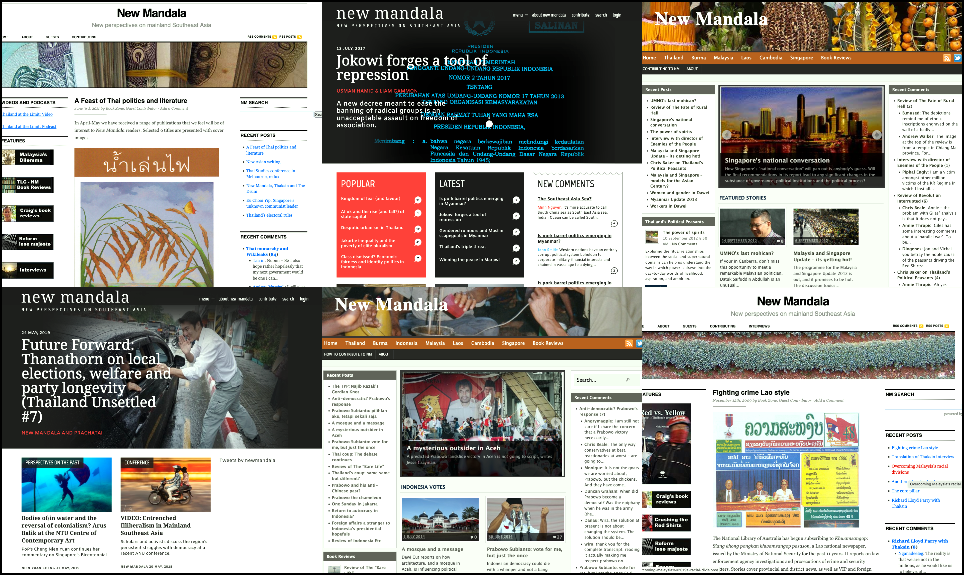




20 years ago today, Andrew Walker’s post “Some thoughts on the political crisis in Thailand” became the first piece of writing to appear at New Mandala.
It was a different era for Southeast Asia, and a different era for Southeast Asian studies. Most of all it was a different (and let’s face it, much better) era for the internet. As an ANU undergrad who read New Mandala regularly in its early years, I thought New Mandala made being Asian Studies academic seem cool and fun (don’t laugh), and I can count myself among a great number of students for whom the site was a stimulus towards deepening our personal engagement with Southeast Asia.
By the time I got involved in New Mandala as a co-editor of the then-brand-new Indonesia section in 2014, it had already become something of an institution under the watch of Andrew and co-founder Nicholas Farrelly. It’s been one of the most rewarding things I’ve done in my career to have joined former editors James Giggacher (2015–2017), Rebecca Gidley (2019–2020) and Elly Kent (2020–2022) in carrying the NM project forward and re-imagining it for the post-blog era. All of us have been lucky to draw upon the expertise and passion of a cast of associate/assistant editors and section and series editors over the years, and on behalf of my predecessors I’d like to acknowledge Nicole Curato, Greg Lopez, Bradley C. Davis, Mish Khan, Andre Kwok, Michael Montesano, Craig Reynolds, Natalie Seeto, Meredith Weiss, Kean Wong and Cat Yen for the incredibly valuable work they’ve done in these roles. I’d also like to add a personal note of thanks to my Indonesia Votes co-editors Jacqui Baker, Dominic Berger, Thomas Power and Ross Tapsell, the team at the Perspectives on the Past blog, and all the people at the ANU and elsewhere in academia who have helped New Mandala behind the scenes over the years, as well as those who since 2019 have served on our editorial advisory board.
The biggest thanks of all, however, has to go to the readers and contributors who have supplied the insights and the audience that are ultimately what keeps New Mandala a going concern. If you haven’t already, do us a favour and sign up to receive new posts in your inbox as they appear (we promise never to spam you).
To mark this very special anniversary, I’m grateful to be able to publish some short reflections (see below) from the editors who’ve shared in the pleasures of editing New Mandala—whether it be coaxing agenda-shaping commentary out of established scholars or giving a PhD student their first opportunity to write about their work for a non-academic audience—as well as its stresses: the late nights dealing with tricky edits or sudden IT meltdowns, or the occasional indignant correspondence from a Canberra embassy.
On behalf of everybody who has had a hand in bringing the site this far: thank you, and here’s to many more years of new perspectives on Southeast Asia at New Mandala.

Liam Gammon, editor (2017–2019; 2022–now)
• • • • • •
Andrew Walker, co-founder, and editor 2006–2015
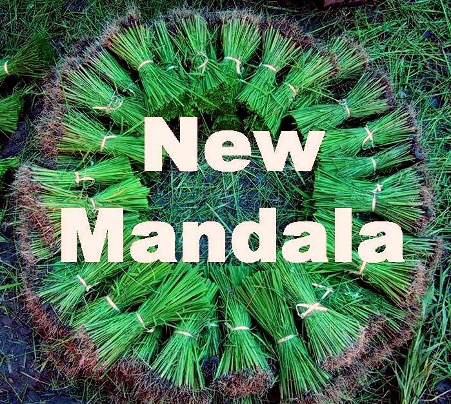 When Nich Farrelly and I founded New Mandala in 2006 it was our intention that it would be exactly that, a new mandala: one in which radiant central power was challenged, critiqued, subverted and sometimes even mocked. It is no coincidence that one of our earliest logos was a mandala made of rice seedlings, assembled by peasants in the far north of Thailand. That rice mandala was hollow in the middle—fecundity was at the margin. We also wanted to challenge some of the conventions of academic power, especially journal publication and peer review. The new mandala was open to all comers, lightly edited, uneven in quality, provocative and irreverent. It valued immediacy over polish; argument over affiliation. It was a blog, not a magazine. Our peer reviewers were a wild band of commenters whose unruliness neatly matched the state of southeast Asian politics that they debated. Even though much of the unruliness of blogging has now moved to new social media platforms, New Mandala has lived on, now reaching a remarkable milestone. I am very grateful to everyone who has contributed to its longevity and I look forward to it carrying its spirit of subversion into the next 20 years.
Nicholas Farrelly, co-founder, and editor 2006–2015
When Andrew Walker and I started New Mandala back in June 2006 we wanted to bring the interesting topics that we talked about—mostly among small groups of academic specialists—to fresh audiences.
We inherited a long tradition at the ANU, including among mainland Southeast Asia scholars, of producing informal commentary and analysis. From the 1980s, the Thai-Yunnan Project had done very well with its newsletter and bulletin. We wanted something relevant for the Internet age.
While we started hesitantly, before long, and mostly thanks to political changes in Thailand, and then elsewhere including in Myanmar, Malaysia and Indonesia, we pulled in plenty of readers and commenters. We had moments when the digital infrastructure of the ANU strained. We also tinkered with podcast and vodcast formats, running weeks-long series on big stories: “Thailand in Crisis”, “Burma Votes”, etc.
Over time, there was a strong team: with talented and prolific writers, astute and courageous editors, and pioneering technicians. There was never much of a budget or too much university bureaucracy.
New Mandala’s founding ambition—getting academic insight to wider audiences—also meant we sometimes received much more critical attention than the average journal paper. But when it really counted, we had plenty of support.
As an experiment in open and participatory publishing, New Mandala’s first 20 years leave behind useful lessons, including about the value of teamwork, improvisation and innovation in academic settings.
I am very grateful to have done my apprenticeship under these remarkable conditions, especially with Andrew’s always generous mentoring. I am so impressed that others have kept the website going and thank everyone who has made its longevity possible. I wish the next generation every success and look forward to New Mandala’s continued contributions to debate and understanding.
James Giggaacher, editor 2015–2017
It was one of the great privileges of my career to serve as New Mandala’s first full-time editor and to work alongside an extraordinary, passionate and generous community of scholars, writers and readers.
From the beginning, New Mandala was about more than academic publishing. It helped make knowledge and expert insights accessible to audiences far beyond universities, bringing the academic enterprise into public conversations across Southeast Asia and beyond. At its best, it connected rigorous research with people who needed it most: journalists, policymakers, civil society leaders and engaged citizens.
New Mandala also provided a vital forum for critical information, analysis and debate about Southeast Asia, often reaching audiences in places and at times when a free press or open internet could not be taken for granted. It demonstrated the importance of independent, trusted expertise and the role it can play in informing—and enriching—public discussion.
Looking back, it’s also clear how pioneering New Mandala was. Long before blogging became commonplace in academia, it helped show Australian universities the power of digital publishing and public engagement. It forged a path and set the standard for academic blogging and demonstrated how scholarly expertise could reach the public in ways that were timely, accessible and influential.
I’m immensely proud to have played a small part in that story. Congratulations to everyone who has contributed to New Mandala over the past 20 years. Its impact has been profound, and its legacy continues. Here’s to many more decades to come.
Rebecca Gidley, editor 2019–2020
I remember the thrill of my first New Mandala publication, getting to tell people about my research on this renowned site I had read for years. Later being asked to consider the editor position was surprising, exciting and a little bit daunting. I felt the immense responsibility of stewardship for this forum that brought together so many scholars of Southeast Asia.
As editor, I remember the thrill of new submissions in my inbox. Seeing a familiar name whose work I had admired, or a brand new name making their first New Mandala submission. I was particularly proud that we were able to publish articles in 2019 in both English and mainland Southeast Asia languages through the Supporting the Rules-Based Order in Southeast Asia project, run by ANU and funded by DFAT.
I offer my immense thanks to all those who supported New Mandala during my time as editor. It would not be possible without the work of many people behind the scenes, including assistant editors, interns, the advisory board and all of our contributors.
Elly Kent, editor 2020–2022, and ARTSEA series editor 2021–present
Five years ago, in a hybrid seminar celebrating New Mandala’s 15th Anniversary, I noted that there were both significant challenges and meaningful opportunities in amplifying voices from and on Southeast Asia through New Mandala. Ongoing crises—at that time particularly COVID-19—had narrowed the range of contributors able to write consistently, while also intensifying broader structural pressures on academic publishing. A central challenge then, and I think still now, is gender. Women remain under-represented among NM contributors, not for lack of interest or skill, but because those broader pressures on academic publishing, and academia in general, disproportionately impact on women’s ability to take on unpaid writing. NM’s precarious funding exacerbates an already wicked structural issue in our field.
Yet despite these challenges, New Mandala remains a bastion of accessible, high-quality scholarly writing on Southeast Asia, and its editors and authors remain committed to the work. New Mandala is among a handful of publications which creates space for diverse voices and sustains meaningful regional dialogue. It actively builds collaborations, encourage co-authorship, and prioritise translation. Amplifying voices from Southeast Asia is one of its most important roles, and there is no other platform that does it so well. For many authors (including me), their publications on New Mandala have been the key that opens the next door in their careers.
So, happy 20th, New Mandala! It’s my fervent wish that at, as the platform stretches into maturity, it is given the opportunity to extend and deepen its impact, fostering future generations of thoughtful, disruptive scholarship on Southeast Asia.