Facebook
  Twitter
  Soundcloud
  Youtube
  Rss
Rss 




In mid-2025, both an armed military conflict and an economic conflict broke out between Cambodia and Thailand. The border conflict—which involved land and aerial fights and threats of a naval blockade—killed dozens of people, displaced roughly a million civilians, and reshaped the domestic politics and foreign policy stances of each country. The conflict’s economic dimension has been less discussed, but is no less important.
Geoeconomics, referring to the competitive use of economic policy or commercial means to advance states’ international interests, has gained popularity in policy discourse in many Southeast Asian capitals. As many Southeast Asian states have limited militaries and are committed to some diplomatic norms of ASEAN, it makes sense for policymakers to prefer competing through economic tools rather than militarily.
When the 2025 border conflict began, Thailand tried to assert a decisive advantage over Cambodia through economic pressure, as a larger, industrialised power sanctioning its lower-income, trade-dependent neighbour. However, unlike during previous border conflicts, Cambodia resisted and largely overcame the economic pressure, and Thailand’s strategy appears to have been largely unsuccessful.
This raises vital questions for each country and for Southeast Asia generally. How did Cambodia persevere as well as it did, despite previously relying on Thailand for much of its energy needs and trade in other goods? How and why did geoeconomic strategy and statecraft succeed or fail?
The economics of the conflict reflects major recent trade and industrial changes in both countries, and suggests lessons in economic policymaking and resilience for both Thai and Cambodian authorities. More fundamentally, the conflict raises difficult questions about how well most Southeast Asian governments—due to geography, political capacity, and changing economic structures—can implement an effective geoeconomic strategy. Many leaders may find that geoeconomics offers them less—or a much narrower policy path—than they had hoped.
The economic policy of the conflict
Thailand historically played a large role in the trade and development of its poorer neighbours. In the 1990s and early 2000s, Thai policymakers encouraged local firms to build regional networks, and the government helped finance new cross-border infrastructure including roads, rails, and electricity. Chuan Leekpai’s administration advocated the development of a Thai–Cambodian industrial zone in Sa Kaeo and Poipet, mirroring a Thai–Burmese zone in Tak Province. With Thailand’s large capital outflows in the years after the Asian Financial Crisis, Thailand temporarily surpassed Japan as a top investor in Cambodia as well as in Myanmar and Laos, moving “so successfully that we appear guilty of economic colonisation,” as Bangkok Post editorialised in 2003.
Thai firms like PTT and Bangchak for fuel, Krungthai and Kasikorn Bank for finance, 7-Eleven and Minor Food for dining and retail, and CP Group in agribusiness established a deep presence in Cambodia’s markets. Over a million Cambodians came to work in Thai agriculture, construction, and manufacturing, where they could gain skills or remit income to families primarily in western Cambodia. Until shortly before the conflict, around 5-8% of Cambodia’s population may have been living and working in Thailand.
Likewise, as it recovered from civil war in the 1990s and early 2000s, Cambodia relied on Thailand for many basic industrial needs. Much of Cambodia’s industrial infrastructure therefore pointed toward Bangkok. Cambodia’s main railway points west to connect with Thailand’s SRT Eastern Line; there is still no railway to Laos or Vietnam. In 2010, Thailand supplied nearly a fifth of Cambodia’s electricity needs, which were less than a tenth of Bangkok’s own municipal consumption, according to data from the Electricity Authority of Cambodia and Thailand’s Energy Ministry. In 2019, Thailand still supplied around a tenth of Cambodia’s electricity, while providing around a third to half of Cambodia’s fuel imports. To reach Cambodia’s main airports in Phnom Penh and Siem Reap, most international travellers long had to fly via Bangkok. As a result, Thailand could apply sharp economic pressure and expect rapid results: in 2003, after anti-Thai riots broke out in Phnom Penh, Thailand imposed trade, visa, and financial sanctions on Cambodia, and Cambodian officials soon offered apologies and compensation for the riots.
This context shaped Thai military planners’ and policymakers’ efforts to apply economic pressure early in the conflict. These efforts are best understood as an initial aim to create economic pressure on Cambodia which led to an evolving mix of policies. As border tensions escalated in June 2025, Thai officers closed the main corridor for bilateral trade around the frontier town of Poipet, with the final land trade corridor around Cambodia’s Koh Kong and Thailand’s Trat Province largely closing in July. Thailand’s cabinet ordered the severing of internet and electricity connections soon after, while local officials also proposed restrictions on agricultural processing and Cambodian migrant workers. As active combat diminished, the border policy was relaxed to allow students and other civilians to travel between border towns, yet restrictions on goods trade only partially eased in August and September to stabilise cross-border manufacturing supply chains.

At the coalface of military indoctrination: the Thai ROTC
Propaganda versus apathy, defiance
By December, Thai regulators seized billions of baht in cash and other assets linked to Cambodian politicians and businessmen accused of profiting from scam centres. From mid-December to late February, Thailand restricted overland fuel trade from Ubon Ratchathani Province to southern Laos to prevent the re-export of fuel into Cambodia, triggering tensions with Laos. Thai officers proposed naval action against Cambodia’s fuel shipments, with broad language around blocking non-Thai ships and declaring Cambodian ports a “high risk” zone for civilian ships. By December 15, Thailand’s National Security Council announced that the navy would block Thai commercial ships from transporting some goods, including fuel, to Cambodia, while not targeting ships from other countries. In March 2026, after several hundred thousand Cambodian migrant workers had left Thailand, Thailand’s Ministry of Labour announced that it would not authorise new migrant workers from Cambodia, citing potential security risks.
Nevertheless, Cambodia likely survived the conflict with only moderately higher inflation in food and fuel prices, a reduced but respectable GDP growth rate around 5 percent, and significant but ambiguous impacts on households and farmers in its western provinces and on migrant workers leaving Thailand. Cambodia has other serious long-term socioeconomic challenges, including distressed real estate, transnational crime and the unwinding of scam networks, and overreliance on exports—problems recently aggravated by Asia’s shortage of fuel from the Strait of Hormuz. Even so, the 2025 conflict itself added fewer challenges than expected. For a poorer country with limited fiscal resources and a historic dependence on its industrialised neighbour, Cambodia economically weathered the conflict remarkably well.
Economic transitions and foundations for adaptability
Why, then, did Thailand’s geoeconomic levers fail to have their intended leverage? To understand, we must update the recent history of Cambodia’s economy, look at product- and sector-level pressures, and then consider their ramifications for Cambodia’s growth and politics.
First, Thai officials likely underappreciated Thailand’s relative industrial decline, the declining importance of Thailand’s economic and infrastructure links with its neighbours, and Cambodia’s rapid shifts in only the last 5 to 10 years.
In the early 2000s, Thailand was Southeast Asia’s second-largest economy and arguably its leading manufacturing power, with industries diversified across vehicles, electronics, food processing, plastics, and other heavy industry like cement production. Cambodia benefited from industries taking a “Thailand+1” strategy, linked to Thailand’s industrial base while accessing new markets, incentive schemes, and lower wages in Cambodia. By the 2010s, however, Thailand’s economy was slowing, falling behind Vietnam in goods exports in 2019 and falling from a tenth of China’s GDP in 2000 to 3% by 2020. China and Vietnam were undergoing a manufacturing boom, which gave Cambodia access to cheaper alternatives for consumer goods, machinery, and processed materials. The conflict likely sped a price-driven transition to new suppliers that was already gradually taking place.
Cambodia’s economy and key trade partners had changed rapidly. While Cambodia had similar export values to Thailand, China, and Vietnam in 2015, exports to Vietnam, China, and the U.S. surged while exports to Thailand stagnated, falling to 3 percent of the total by 2024. In 2022, Cambodia’s imports from Vietnam surpassed its imports from Thailand, while imports from China grew 89 percent from 2020 to 2024. With Chinese, Korean, Malaysian, and World Bank financial and technical support, Cambodia more than doubled its electrical generation from 2020 to 2025, with electrical supplies increasingly spread across the country as well as linked to Vietnam. As important was Cambodia’s industrial boom in Phnom Penh and its southeastern provinces near the Vietnamese border, providing new employment, supply chain links, and foreign investment from firms with a “Vietnam+1” approach. Thailand’s slowdown thus saw Cambodia pivoting east, reducing reliance on Thailand in just the few years before the conflict.
Second, Thai officials seem to have placed more weight on Cambodia’s historic dependence than on its growing trade versatility and the nexus of pains from particular trade restrictions. Fuel and energy presented the clearest means for Thailand to bring economic pressure on Cambodia—Cambodia typically maintains around 3 weeks’ worth of consumption in oil reserves, and one would expect the sudden loss of a plurality of fuel imports to cause a severe crisis.
Though Cambodia likely drew on reserves, the government and firms appear to have rapidly negotiated new fuel deliveries from Malaysia and, most of all, Singapore, with oil imports from Singapore rising from US$48 million in May 2025 to US$107 million in July and averaging over US$115 million a month for the rest of 2025, more than double the average in 2024, before reaching a record of US$169 million in February 2026, according to data from Singapore’s Statistics Department. Since Singapore imports some oil from Thailand, it is possible that Thai sources continued to supply Cambodia via Singapore as well as secretly by fuel trucks over land. But as Cambodia had previously imported Thai oil from the sea, it suffered little loss in the usefulness of existing infrastructure or need to replace infrastructure to facilitate new oil sources.
Although fuel unexpectedly gave limited leverage, other trade restrictions created different difficulties. Japanese vehicle firms had invested heavily in supply chains that crossed the border, with vehicles and vehicle parts among the leading products in bilateral imports and exports for each country. Disruptions to vehicle manufacturers’ operations led to persistent pressure from Japanese businesses and diplomats to ease border restrictions. By September, vehicle-related trade could partially resume and recover to pre-conflict levels. Still, the disruption scarred businesses, with Japan’s ambassador to Phnom Penh commenting that companies may seek to increasingly separate their supply chains.
Third, Thailand’s pressure strategy may have anticipated greater economic impact and political repercussions from the displacement of migrant workers and effects on Cambodia’s western border regions. In the last 25 years, Cambodia’s western provinces developed casinos, entertainment, and other tourism centres intended for Thai visitors, and western Cambodian farms relied on crop processing facilities in Thailand. The conflict sent hundreds of thousands of migrant workers back to Cambodia, largely to Battambang and Banteay Meanchey provinces along the border. The conflict may have permanently damaged the border area’s agricultural and entertainment business models, as the number of Thai visitors to Cambodia fell over 90% percent in the last months of 2025 while Cambodian agricultural exports to Thailand fell by 50 to 90% percent. The Thai military also destroyed some scam centres in western Cambodia, which had exploited Thai citizens but served as a small additional economic driver in the region.
One can only roughly speculate about why this did not have a larger effect. Cambodia had no upcoming elections; migrant workers largely returned willingly; Phnom Penh quickly mobilised agencies, charities, and individual civil servants to aid displaced people in the border areas; and nationalist sentiment propelled individuals in both countries—these factors probably minimised any negative political consequences for Cambodia’s government, just as nationalism helped Thailand’s ruling party win support in northeastern Thailand. Anecdotal reports from both sides of the border, and the lack of large shocks in preliminary labour data, suggest that many returned migrants—tens or hundreds of thousands—likely re-returned to Thailand, against the wishes and without the knowledge of either side’s government, but blunting the economic impact on either country. Cambodia’s labour market also proved relatively flexible, as some displaced workers relocated to the capital and the country’s southeast to enter new manufacturing jobs.
A more sobering possibility is that Cambodia’s western provinces will take years or decades to recover the momentum they had before the conflict. However, the far-western region is no longer a major driver of Cambodian economic growth, and with its small-scale agriculture, regionally-focused tourism, and small industrial sector, does not drive demand for other parts of the country as Phnom Penh, Kandal, and Sihanoukville do. As a result, Thailand’s pressure achieved an economic impact that was too geographically contained to greatly affect Cambodia overall.
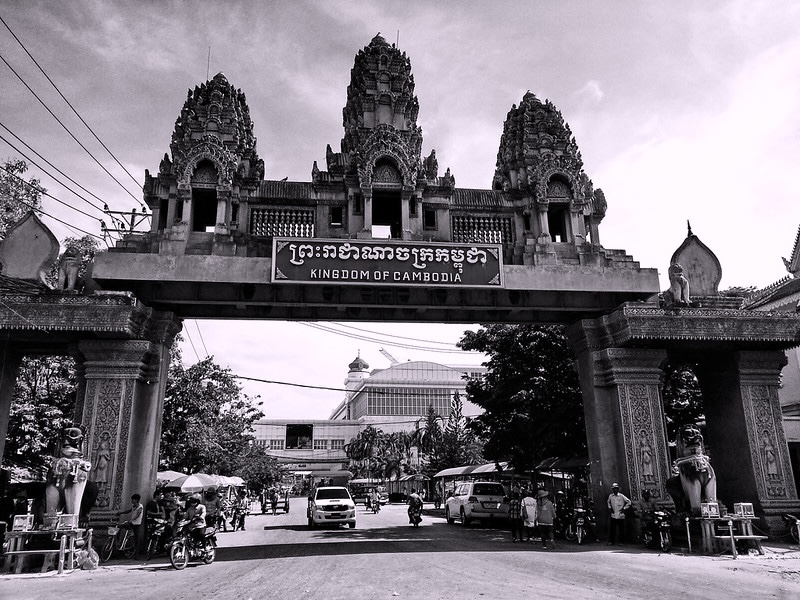
The Cambodian frontier at Poipet, 2015 (Photo: @thanate_tan on Flickr, CC BY 2.0)
Rethinking geoeconomics in Southeast Asia
This raises practical and theoretical questions for Thailand’s and other regional governments. Could Thailand have acted more effectively in its geoeconomic strategy? What conditions helped Cambodia insulate itself from economic pressure? And more broadly, how viable is geoeconomic pressure as a policy approach for most Southeast Asian governments?
Edward Luttwak, in his 1990 formulation of “geoeconomics”, understood it as states’ reliance on the “grammar of commerce” to achieve their international and power objectives. Commercial strategies were supplanting states’ use of militaries as their prime tool for achieving goals, and were increasingly central to the goals themselves, with militaries called upon to defend commerce rather than merchants called upon as secondary actors to reinforce militaries. Geoeconomic strategy, then, would see efforts to promote or manage business activity serve as the main tools for advancing a state’s interests, whether through subsidies for critical industries, trade restrictions or favourable trade access, acquisitions of overseas firms or infrastructure, or even blockades that may involve little fighting but which restrict or benefit merchants from particular countries, creating pressure with selective strains on commercial profits. Businesses and economic planners would thus operate at the centre of the state’s strategy.
Yet in the 2025 border conflict and ongoing border tensions, merchants were at least as likely to receive directions from soldiers as from civilian officials. While the economic pressure of the United States threatening higher tariffs, and Japan raising concerns about supply chains, played a role in curbing the fighting, Thailand’s or Cambodia’s military actions and personal diplomacy shaped each state’s conduct far more than their economic pressure did. Despite popular claims of Thailand being run by corporate oligopolies, Thai companies suffered from the conflict, Thai businesses along the border publicly objected to trade restrictions, and there are few signs that armies on either side were called upon to reinforce business interests. Nor are there many signs that national policymakers closely coordinated strategic efforts even with partially state-owned firms like Thailand’s PTT, which struggled to preserve its gas business in Cambodia.
Using geoeconomic tools more effectively would require a stronger state grasp on trade and business activity, the ability to offer incentives through fast and flexible changes in commercial regulations or direction of private financial resources, and data gathering capabilities to monitor commercial changes in near-real time. In bureaucratic terms, that might mean close coordination by the National Security Council or a similar group with the Finance, Commerce, Defence, and Interior Ministries, Board of Investments, and the central bank. These capacities were limited for a Thai government not used to inter-state conflict or civilian economic–military coordination, and facing internal challenges over vested interests that may have weakened authorities’ resolve. A more effective strategy also would have needed recognition of and adjustment around the supply chain effects on other important economies, particularly for Japan.
Likewise, a more effective Thai pressure strategy would have needed coordination with other regional states. Cambodia quickly shifted to trade with Vietnam, Singapore, and Malaysia, yet neither Thailand nor Cambodia could persuade other ASEAN states to give clear support. If the latter had cooperated with Thailand, then Cambodia would have likely faced a costlier energy transition and far more difficult trade and employment outlook; pressure on Cambodia’s Vietnam-facing manufacturing centres could have reversed most of Cambodia’s growth. Still, Cambodia’s three national land borders, ocean access, steadily improving highways and internal logistics, and increasingly diversified and renewables-driven energy portfolio gave it decent security against economic pressure. If Cambodia—a “land power” in its historical self-image—pivoted more to the sea, with expanded ports and industrial development in poorer coastal areas like Koh Kong Province, which lacks a railway or fully multi-lane highway, then it would likely further enhance its economic resilience.
The limits of geoeconomics are not unique to Thailand and Cambodia. Despite the growing popularity of the “geoeconomics” term in Southeast Asian capitals, there remains a question of how much Southeast Asian states can, on their own, wield geoeconomic power within the region. Either brilliantly or luckily, Cambodia did not rely on its own geoeconomic capabilities but utilised US and Japanese economic pressure to improve Cambodia’s position.
Policymakers in other Southeast Asian states have expressed more frustration in using geoeconomic tools. As Indonesia’s former finance minister Chatib Basri reflected in November, rather than “leveraging [Indonesia’s] geographic centrality… Indonesian political and economic elites [have sought] to profit” from foreign-backed investment schemes. As Jerdwut Kraprayoon, the former commandant of Thailand’s Joint War College, observed, ASEAN has “no enforcement, no intel fusion, no cyber command, no joint policing, no sanctions mechanism” and no apparatus for “regional sanctions or social stigma” on companies engaged in illicit behaviour. Many Southeast Asian states may lack the institutional experiences, political–economic cohesion, inter-agency coordination, data quality and depth, or enforcement willingness and capacity to quickly and effectively wield geoeconomic tools or formulate targeted geoeconomic strategies.
The border conflict also illustrates a more fundamental structural constraint. Most Southeast Asian states are geographically small, and have relatively small consumer bases that do not drive their neighbours’ economies. Most have few critical industries that can be used to apply sustained negative pressure without also experiencing similar pain domestically. Most Southeast Asian states border multiple states that can serve as alternative trade routes to varying degrees. Most have significantly improved their internal and maritime logistics since 2000, enabling them to more easily shift resources across territories and reduce pressure from any particular border.
As a result, intense pressure from one neighbour can lead a country to flexibly shift toward other neighbours, defying economic and trade sanctions. That does not mean that negative geoeconomic pressure is irrelevant: Southeast Asian states may still negatively pressure regions or industries that are politically or culturally sensitive, and potentially depress their growth for many years. But for reasons of geography, economic structures, and historical political relations, Southeast Asia may be poorly suited to applications of negative geoeconomic pressure.
The limited efficacy of Thailand’s economic pressure policies, and the interest of politicians elsewhere in geoeconomics in general, will likely lead policymakers in Thailand and across the region to evaluate new options for developing more effective geoeconomic strategies. Leaders may try to upgrade governing capacity and identify critical weaknesses that would make a negative pressure strategy more viable, with improved data collection, inter-agency coordination, and enforcement.
At the coalface of military indoctrination: the Thai ROTC
Propaganda versus apathy, defiance
These approaches could have time horizons spanning decades. For Thailand to rebuild a central position in mainland Southeast Asia’s economy and re-integrate its neighbours, it might plan for infrastructure development, service sector linkages, and financial and regulatory changes that would come to fruition in the 2030s, with higher-value service sectors performing a role that energy, ports, and rails previously played in anchoring neighbours to the Thai economy.
Southeast Asian policymakers have long contemplated uses of economic pressure to attain geopolitical results. However, the recent border conflict suggests that this approach is not as viable within the region as it may have once been: even lower-income economies in Southeast Asia are more dynamic and flexible than they were in the past.
The author is grateful for helpful comments from Tita Sanglee, Michael Montesano, Herman Li, and others in Thailand and Cambodia.