 Facebook
  Twitter
  Soundcloud
  Youtube
  Rss
Rss 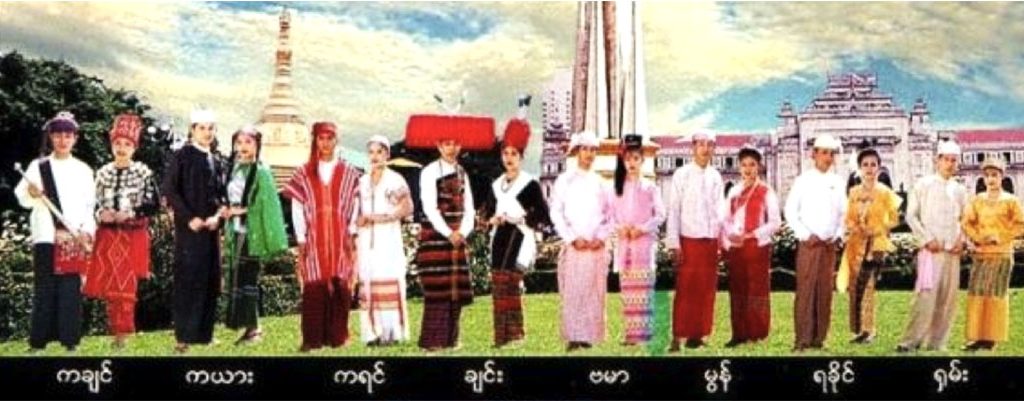




Sebuah penerjemahan artikel ini dalam berbahasa Indonesia telah terbit disini.
‘National races’ or taingyintha is among the pre-eminent political ideas in Myanmar today. It has animated brutal conflict over who or what is ‘Rohingya’ as well as communal violence that human rights researchers and advocates have variously characterised as a crime against humanity, ethnic cleansing and genocide. Although more scholars are struggling to make sense of how and why the ‘Rohingya problem’ appears to be so intractable, little explicit attention has been paid to how the conflict over Rohingya identity specifically, and contemporary politics in Myanmar generally, is contingent on the idea of national races. How did the idea of taingyintha become politically salient? How has it grown, developed and changed?
Taingyintha is a term that, like so many other politically salient modern terms in Southeast Asia, has a history that is neither long nor glorious. It was not a politically significant term in anti-colonial politics. Although at the end of the Second World War it featured in negotiations on the draft constitution, it failed to get a special mention in the 1947 Constitution on the matter of minority rights, succeeding only in getting two modest references in the chapter on citizenship, where in the English version it is translated as ‘indigenous races’. Nor is it found in the 1947 Panglong Agreement, which is commemorated annually on Union Day and mythologised as laying the foundations for taingyintha unity. It remained on the periphery of political language over the next decade.
But on February 12, 1964, a new day dawned for taingyintha, one in which it would go from being a term of limited political salience to the paradigm for military-dominated statehood. General Ne Win, who had seized power for a second time two years earlier, now grasped the idea of taingyintha and wielded it with hitherto unprecedented enthusiasm. Lamenting the mistrust between taingyintha and the failure to achieve reconciliation some 16 years after independence, he used the Union Day address to urge over and over that the national races come together in unity and amity for the good of the nation. He closed the speech by announcing that his government would work systematically to bring economic and social equality to the national races; and, would help them in projects for support of their literature, languages and cultures. Within the same year, the government had set up an Academy for the Development of National Races. The following year, staff from universities around the country began state-directed fieldwork to document and publish authoritative studies on national races’ culture. Taingyintha hereafter obtained a hitherto unprecedented place in state lexicon, and in the state-building programme and its rituals of national unity. By the 1980s it was orthodoxy that political texts at some point refer to national races’ eternal solidarity, their historical fraternity and their intentionality in working together for a new socialist economic order.
Although that economic order collapsed under the weight of nationwide protests in 1988, the national-race idea not only prevailed, but also emerged stronger than ever. The newly comprised military junta that seized control of government announced ad nauseam that ‘non-disintegration of national [taingyintha] solidarity’ was the second of its three main causes. For want of any other unifying motif, national races were invoked on every broadcast and publication, and at every major event. The following year, the junta picked up on the institutional work of its predecessor to establish a new Central Committee for the Development of Border Areas and National Races, which later became a government ministry concerned with the material development of frontier regions.
If the 1940s marked the early emergence of taingyintha as a term of state, and the 1960s its institutionalisation, then the 1990s witnessed its renaissance, yet with at least two distinct meanings at play. In one, national races comprised the members of a single political community, united in struggle against common enemies inside and out. In the other, national races were a sub-section of that community: people living far away who had failed to progress due to civil war and ignorance. Between them, these usages worked to justify relentless military campaigns against armed groups operating under the banners of multitudinous national races. The state’s guiding hand was required to draw all taingyintha together into the natural condition of unity from which they had been driven by historical circumstances.
These messages were conflated with a third message, via the project Gustaaf Houtman described as the ‘Myanmafication’ of the state in which ‘Burma’ became ‘Myanmar’ on the grounds that whereas the former term and its analogues refer to the Burman, the latter supposedly denotes the inclusion of all taingyintha in the Union. Children in schools across the country now sang of Myanmar to signify taingyintha, yet the books from which they learned, ‘Myanmar’ readers, did not include the languages and alphabets of all taingyintha, or even the biggest linguistic groups; merely those of the dominant group. ‘Myanmar’, while signifying national races, above all was to signify the pre-emeninent linguistic and cultural group, the Burmans. To speak and read the language of the Burman, to be civilised and cultured like a Burman was nothing other than to belong to Myanmar, which is to say, to be taingyintha.
Today, the 2008 Constitution cements national races in the country’s formal institutions, addressing the political community not as an aggregation of individual ‘citizens’ but as one of aggregated ‘national races’. From its opening words, it establishes a conceptual relation between national races and citizenship, such that the former is irreducible to the latter. Lexically and legally, national races trump citizenship. To talk of the political community ‘Myanmar’ is to talk of taingyintha, and to talk to that community is above all to address its members not as citizens but as national races.
Because taingyintha identity had trumped citizenship, the place of people belonging to non-national-race groups is precarious. Those people excluded juridically from Myanmar but living within its territory now have to find a way back in to the political community. And the only way available to them politically, as a collectivity, is to submit to the politics of domination inherent in the national races project, and insist that they too are taingyintha, which is exactly what Rohingya advocates have done.
Rohingya advocates make their claim to be taingyintha in two parts: one evidentiary, establishing the existence of ‘Rohingya’, the other typological, situating Rohingya as a category in the national races schema. The first part, aimed at demarcating the Rohingya as a distinctive linguistic and cultural group deserving of a category in the schema, emerged out of political and ideological struggle in the same period that taingyintha grew in stature, from the 1930s or 1940s onwards. The second part of the claim requires advocates of Rohingya claims to be taingyintha to work inferentially and establish their credentials consistent with the conditions that attach to being members of the national races in official histories published since. To write history for this purpose of establishing the existence of Rohingya is to rely upon the official history-writing project and the claim that ‘national races’ also exist. It is to engage in a box-ticking exercise: national races have lived in the territory now designated Myanmar anterior to 1823, and so have Rohingya; national races lived together amicably prior to the British invaders’ arrival, and so did Rohingya; national races fought together against the imperialists from the time of their incursion until the time of national independence, and Rohingya also laid down their lives for this cause.
Thus, the alternative history that Rohingya advocates articulate does not question the premises of the national-race idea. Instead, Rohingya advocates also must reproduce the idea in order to be heard. They have little choice but to give assurances that if included in the schema of national races they will be demonstrably good citizens by showing their commitment to the idea of taingyintha. Because people in a tenuous position have more to gain from showing their commitment to a project for political domination than people who are secure in their membership, ironically they aim to show that given the chance they could be the more vociferous defenders of national-race identity than anyone.
Under these circumstances, a special responsibility falls to people who are not beholden to the politics of taingyintha, not subject to its practices of elision and domination, to ask questions of it, to interrogate it. This responsibility extends beyond pointing to specific arrangements to deny Rohingya a place in the political community, and rightly condemning the gross and manifest abuses of human rights that people who identify or are identified as Rohingya suffer. It also extends to recognising and explaining how ultimately Myanmar’s problem is not a ‘Rohingya problem’ but a national-races problem: how the idea of taingyintha itself is the problem.
……………
Nick Cheesman is a Fellow in the Department of Political and Social Change, Australian National University, and in 2016-17 a Member of the Institute for Advanced Study, Princeton. This article is extracted and adapted from How in Myanmar ‘National Races’ Came to Surpass Citizenship and Exclude Rohingya, published in a special volume of the Journal of Contemporary Asia on communal violence in Myanmar.