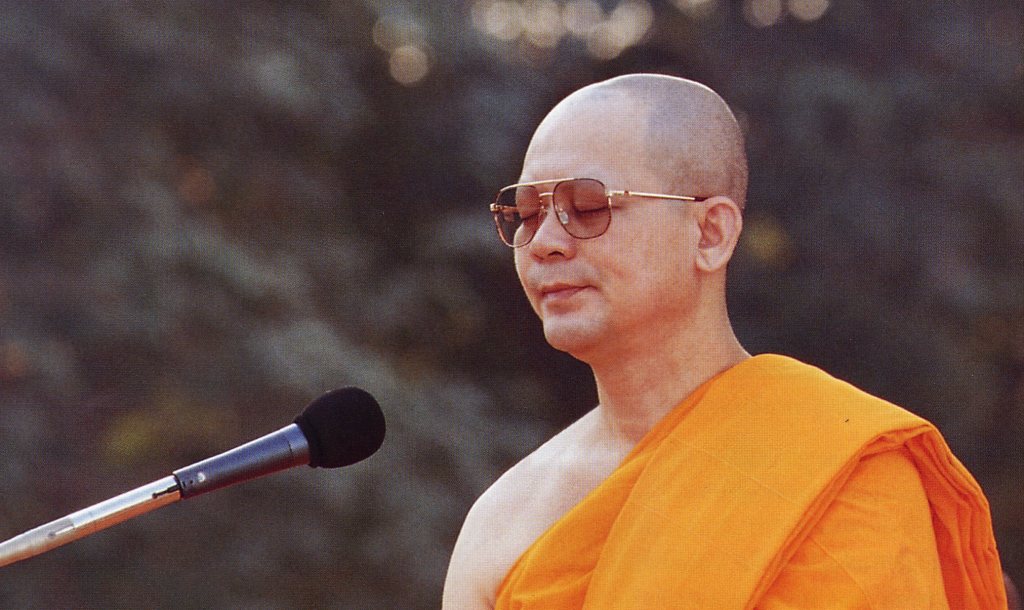
Why Phra Dhammajayo does not turn himself in.
The Theravādan Buddhist temple of Wat Phra Dhammakaya has been under siege by the junta of Thailand. The former Abbot, less respectfully referred to now as “Phra Dhammajayo”, has been accused of involvement in moneylaundering and encroachment upon Thai national land.
Multiple searches throughout the temple’s vast compounds by the military, with full cooperation from Wat Phra Dhammakaya, over the months of February and March 2017 have resulted in Luang Por Dhammajayo being missing in action. A big question at this point is, “Why doesn’t he just turn himself in?”
Such an enquiry necessitate a framework and background to put it in perspective.
Socially, Thailand is fuelled by “face-value” – the perception of who holds power pervades. Throughout Thailand’s history, power frequently changed hands among the ruling royal elite of various domestic, indigenous kingdoms. Thus, there is a social need for whoever holds the power to remind the people.
The first arrest warrant related to these charges was issued for Luang Por Dhammajayo – a more respectful title – on May 17th of 2106 due to him not presenting himself to the authorities to hear the charges against him. The temple had previously sent multiple official requests to have the charges read at the temple due to the former Abbot’s severe and ailing health. Nevertheless, after multiple failed attempts to enter the temple compound since the arrest warrant was issued due to devotees blocking the entrances, Article 44 was enacted by Prime Minister General Prayut Chan-o-cha and a full-on military siege was brought upon the temple at 3am of February 16, 2017.
Article 44 of the current Thai Constitution states that the Prime Minister may dictate any area of the Kingdom of Thailand a “special control zone” and under martial law. Herein the government also removes itself of any responsibility or liability to an autonomous judicial court.
Is Wat Phra Dhammakaya or Phra Dhammajayo a threat to national security or identity?
Wat Phra Dhammakaya has been under scrutiny and persecuting limelight from the Thai and International press since the late ‘90s. The temple is dubbed a sect of Buddhism, i.e. not ‘real’ Buddhism. Worse, it has been labeled a cult and we all know there is no coming back from that ominous title.
Any spotlight on the temple highlights a sense of it being stained and blemished. The mainstream press continues to beat the horse that Wat Phra Dhammakaya is a “controversial” temple with a dark past. Moreover, it has supposed affiliation with the Red-Shirt party including political ties with ousted former Thai Prime Minister Mr. Thaksin Shinawatra.
All this is conspiracy. Neither the temple nor its Abbot Emeritus Luang Por Dhammajayo has ever been convicted of any crime, even to this day.
The fact is, this predicament is not about Luang Por Dhammajayo wanting to turn himself in or not. Frankly, the devotees will not allow Luang Por Dhammajayo to turn himself in!
In reality, there is no proof or promise that Luang Por Dhammajayo will receive a fair trial. Recent arrests using the Computer Crime Act of Thai citizens who questioned or criticized the junta, and the March 2017 United Nations meeting in Geneva where Thai officials failed to address international concerns about the junta’s obligation to uphold civil and political rights, cause grave concern and doubt. Why would there then be an honest, altruistic system of justice in Thailand? This isn’t Kansas, Dorothy.
People have died and been abused. Anawat Thanacharoennat committed self-immolation outside the temple to raise public awareness against Article 44. A volunteer nurse, Pattana Chiangraeng, died due to the military barricades not permitting an oxygen tank and medicine to pass to save her from a simple asthma attack. Women, men, and monks who created a human shield to nonviolently protest against the siege were sent to ICUs for injuries inflicted during a confrontation wherein Thai military soldiers and police abused them.
Disciples of Wat Phra Dhammakaya feel the junta is stepping out of line with ulterior agendas, without proper evidence, using the hunt for Luang Por Dhammajayo as a smoke and dagger. It should be noted that the Thai junta spent over 100 million Baht of national funds in putting Wat Phra Dhammakaya under siege.
The devotees further believe there will not be sufficient medical care for Luang Por Dhammajayo’s dire medical condition of severe deep-vein thrombosis in the left leg, chronic venous insufficiency, diabetes, venous stasis ulcers, hyperlipidemia, sensitivity to light, allergies, hypertension, and vertigo. Books like The King Never Smiles by Paul M Handley or Welcome to Hell by Colin Martin showcase Thailand’s political and court systems as not known for their pleasant, or humane history. There is a very real possibility that “Phra Dhammajayo” will receive nether proper medical attention nor fair treatment while in custody. The fact that he is a 72 year-old man, and still a Buddhist monk, does not seem to interfere with the junta’s conviction to make an example out of him.
The international, and especially western world, need to understand a code that true Buddhist practitioners live by – honour, and seeing to the care of one’s teachers, most especially one’s “gurus” ครบาจารย. The act of gratitude and giving back is a well-known, fundamental, and cardinal virtue instilled in disciples and practitioners of BuddhaDharma, of not just Thailand but all of Asia and the world.
The media and press undervalue the profound depths of this last truth. Why would temple followers willingly expose Luang Por Dhammajayo, their teacher, to potential – and probable – unfair treatment, humiliation, and improper medical attention? All of which may even result in death? Most especially when they believe and know him to be innocent.
That is why Luang Por Dhammajayo is not being turned in.
Joshua spent three years as a fully ordained Buddhist monk from 2007-2010 at Wat Phra Dhammakaya. Studying Theravāda & Vajrayāna traditions, Joshua assisted as a translator, researcher, and scribe. For more information visit: www.joshuajayintoh.com
Facebook
Twitter
Soundcloud
Youtube
Rss

With respect, it isn’t for the temple’s followers to decide whether the Abbot is innocent. That has to be for the courts to decide.
Are the courts fair? Probably not. But then could not everybody facing charges use that defence? You have to deal with what’s in front of you rather than hat you’d like to be in front of you.
I don’t want to sound like an apologist for the junta, but if the monks and their supporters hadn’t prevented the army from entering the temple then the siege would not have been necessary and lives and injuries would have been spared.
So when the elections were blocked by the junta, and Suthep’s strong-arm men were causing public mayhem, and Bhudda Issara was running his kangaroo courts, where were Luang Por Dhammajayo and his followers? Correct me if I am wrong but, I don’t seem to recall them fighting for democracy at that time. And there are serious questions concerning this sect that requires some answers.
10
3
well i dont know if you should expect them to “fight for democracy”. If they do theyll be called political and dogged with more random allegations. plus the anti-democracy faction already dislikes the temple and that would just make the tensions worse.
5
1
Jake. All good points. What questions do you feel require answers to?
0
0
“That has to be for the courts to decide.””
You have to be joking. The rich and avaricious in Thailand have been held high by the corrupt judiciary for decades. Expecting anything other than corruption from the court system is a forlorn hope.
Dammajayo is a target because he is not easily scared or controlled, and has been since day one of the treasonous coup détat launched by a few untalented military men and supported by 300,000 soldiers in Thailand who regard blind obedience higher than rational thought. But they are thais so that shouldn’t surprise anyone.
But the wheel is beginning to turn. Slowly, and laggardly, but then again, it is Thailand and everything happens slowly except theft and fraud – they happens quite quickly. And often.
2
0
Jake – you have a heart-warming faith in the impartiality of Thailand’s Kafkaesque courts, and Thai law generally. How long have you lived in Thailand? Is it one day – or two?
3
2
Multiple searches throughout the temple’s vast compounds by the military, with full cooperation from Wat Phra Dhammakaya,
perhaps the author would like to offer a definition of cooperation ?
Dhammajayo’s Bed Not Meant to Deceive, Dhammakaya Says
http://www.khaosodenglish.com/culture/net/2017/02/17/dhammachayos-bed-not-meant-deceive-dhammakaya-says/
4
1
To falang, or maybe ฝรั่ง “farang” which besides a semi derogatory word for white person of European descent also means guava fruit.
I am happy to discuss this topic.
First off, Wat Phra Dhammakaya is a big place. Is there controversy? Sure. People are fallible. In Wat Phra Dhammakaya and the Dhammakaya Foundation – which is an NGO – there is a brigade of people that help to manage the projects, logistics, and affairs. Just like any regular and well-governed institution or organization. Although Phra Dhammajayo is the head, there are thousands of people in the organization.
I was in direct contact with some of the monastic personnel while the temple was under siege. It is important to note that what the Thai and International media present to the world is their story, with heir agenda, and their story of what they want to make the public believe. Is Wat Phra Dhammakaya perfect? No. But, in this case they are being persecuted and condemned to be guilty before proven innocent, when there is more than enough evidence to show that Phra Dhammajayo and the temple are innocent.
Every search throughout the temple’s vast compounds that the military police requested were properly and legally followed, with full cooperation from the temple and foundation’s staff. That is well documented. The police were were lead and guided by the staff to search wherever they wanted.
The point is that nobody knows where Phra Dhammajayo is. So it’s not the staff and personel’s fault that the police did not find Phra Dhammajayo. The general public have no idea where he is. Why would they? He is likely being protected by a small inner circle because of the injustice and corruption surrounding this case. Wouldn’t you want to help one of your loved ones if you knew, beyond any shadow of a doubt that that person is innocent. And if caught would likely die as a result, due to their very poor health?
It is unfair then to use “Dhammajayo’s Bed not meant to deceive”. There are parts of Thai culture and hidden messages that are meant to be sent to people. I personally don’t believe that Phra Dhammajayo ordered the towels and bed to be made up like that. It’s not his style. And likely came from one of the staff under him to exemplify a “smoke and dagger” tactic used by the Thai government in this case. But that is just speculation on my part and limited as such.
It very well may have been a message that “things are not what they seem”. What appears to be, is not what it really is. And not referring to Phra Dhammajayo being guilty, but rather, innocent and the victim of a manhunt.
3
1
Thank-you for the time to pen a detailed reply , unexpected and appreciated .
It is unfair to claim ‘full cooperation from Wat Phra Dhammakaya’ when the article I referenced plainly demonstrates this is not the case .
you then offer your personal beliefs as justification as to why the pictures are not what they are .
you are entitle to your personal beliefs as is anyone , you are not entitled to use said beliefs justification of a mistruth .
the point remains that there was not full cooperation .
1
0
Hey falang,
I appreciate your schooling on what to use as justifications and to what not to use. It is true that stories are skewed by personal bias. And this goes the same for you and me right now.
Were you at the temple when all this was happening? Or have you just read it from the media? Judgements are easy to make from afar and when there is detachment.
I see what you mean about cooperation. To add further detail, it is true that the temple offered full cooperation for the first 3 days wherein the police searched the compounds. After 3 days of full cooperation, the temple followers – the rightful owners of the temple and not the monks – got involved because they felt there was foul play at hand. That’s when the confrontations started. So yes, there was definitely not cooperation at that time. Not just as an American but as a human, I respect the fact that they started to stand up against injustice, oppression, and wrong accusation.
I believe I made clear in this article is that this is a very sticky subject and everyone just wants to write of WPD (Wat Phra Dhammakaya) as evil and corrupt, because they read it from a corrupt and skewed media. Thatnis equally unfair.
If I was to tell you that many of the articles published in international media – khaosod, Bangkok post, etc. – use personal beliefs and story-telling to create a justification to degrade defame and wrongly accuse the temple, what would you say? Oh that’s not possible!?! C’mon. Regimes protect their interests. Europeans will remember the Nazi Germany propaganda quote of, “the bigger the lie, the more people will believe it.”
Neither the Thai government nor WPD are perfect. If anyone was to take a good hard look at all the good things the WPD temple and foundation do around the country and internationally, you would be singing a different tune.
It’s just about getting at the right information. I don’t have it all. But I will stand up for WPD (accepting it’s faults too) because no one in the international community is. You have to have been there, speak the language, met with the masters there and talked to them to understand their side.
4
0
Joshua Jayintoh – you misquote the Nazis. Goebbels DID NOT say : “the bigger a lie, the more it will be believed”. Goebbels said : ” the more often you repeat a lie, the more it will be believed”. But ordinary Thais are often very skilled at spotting ” go hock”.
0
0
The email version of this jumble of nonsense attributed it to Mish Khan, whose work I’ve enjoyed in the past. I was going to ask if she is now on the Dhammakaya payroll (they pay well for this sort of thing) and somehow misplaced her English skills. But on the NM site it’s attributed to Joshua Jayintoh. Releived.
2
3
Hey Steve, as you know we are currently transitioning between Editors and during this period of transition, I am assisting the website in uploading some submissions. This has been a learning curve for me as well given I am the newest member involved in NM. The reason this name slip-up may have occurred is because I accidentally published the article first without selecting the author profile, for which I apologise to Joshua, and promptly changed within the next ten minutes. I wasn’t aware the email digest would attribute it to the original name on the article, thank you for pointing this out and if any concerns arise from this I’ll make sure to address them (although given I am an undergraduate with no real reputation I hope most people can assume there was a mix-up)
8
1
Thanks for the explanation Misha Khan – all us posters should be thankful to you, and everyone else @NM, for the great work you all do, under challenging, difficult circumstances – which go with the terrain. Not for the faint-hearted!!
3
0
Yes, I was impressed with your new found expertise. I thought you must have been having a few conversations with A/Prof. Jim Taylor, who is an extremely interesting scholar-activist although unlikely to be a welcome guest in The Realm anytime soon,.
1
0
Steve. I will not apologize for my stance and for standing up for the good in the temple, and questioning the motives of the Thai junta. If my writing offended you and your sense of literacy, that is something a psychologist can assist with, as I am not a professional writer or psycho-analyst.
Mish Khan has been very kind and compassionate to consider my article. I am not getting paid for it, am not on the temple’s payroll, and live in America away from the situation. The only thing I am getting out of this is a sense of peace for writing what truth I know, and for supporting those people who have given me gifts of virtue and knowledge that help me to live a better life, be a better man, a better father, interact with others in a more compassionate manner, and work in the world in a much more harmonious way.
I took a great amount of my own time, outside of full time work and raising a newborn to muster up what courage and words I could to write this jumble of nonsense because there is a phenomenal amount of good that Wat Phra Dhammakaya and the Dhammakaya Foundation do in Thailand and internationally. All this good is not discussed in the English media. People easily want to throw them away as a cult and as corrupt or evil because of what they have read about in the media. I am very lucky to have met with Phra Dhammajayo and the Vice-Abbot Phra Dattajeevo personally. I have studied directly under them. These are men of abnormal amounts of virtue, honor, and integrity. I can say that because I have experienced it and why they do what they do. Can you? Have you met with them? Have you been to the temple, seen the projects and programs they have here? Do you know what they are really like and not what someone else tells you? If you have not and form a biased opinion without answering these questions, that would be a jumble of nonsense and hypocritical.
And goodness forbid there would ever be hypocrisy – or Irony – on the world wide web.
7
0
Joshua, thanks for your thoughtful responses. These have helped to clarify your thesis. I want to say first that I think the fraud accusations against Phra Dhammachayo are bogus. The Wat returned the cash and there was no reason for them to know it was embezzled (though the amount might have raised suspicions). Also, there was absolutely no justification for the junta’s actions. On the other hand I happen to know that DK does pay well for propaganda pieces published internationally, even providing sample articles so that the writer needn’t know anything about the subject. I also know people who have been on the deep inside of DK and there is much that would qualify as “dark past” or even “present”. Anyway, Mish Khan is an aspiring academic and I didn’t want her name wrongly attached to a piece of questionable academic merit (sorry), quite independently of the position advocated. I wouldn’t have commented otherwise. Here are my concerns with the article. BTW, I speak, read and write Thai fluently—I’m a professional translator—and have lived here, immersed in the culture, for many years.
Note: I use the Royal Institute Romanizations below.
“Phra” is not less respectful than “Luang Pho”. “Pho” means “father” and “Luang Pho” something like “Reverend Father”, its more familiar and affectionate than the usual and more formal title “Phra”, something like “Venerable” (there just aren’t literal translations for these).
“Full cooperation” seems to include “women, men, and monks who created a human shield… against the siege.” That some were injured does not transform their human shield into full cooperation. You’ve addressed this somewhat in comments by acknowledging that resistance began after the first three days, but anybody following this (in Thai and with friends on all sides of the issue) knows that DK has been obstructing these investigations for years. You may want to distinguish these protesters from DK itself… but that just doesn’t fly.
The devotees will not allow Phra Dhammachayo to turn himself in? Are they holding him prisoner? Is that why no one has seen him in months… he’s locked in a tiny cell by a tiny group of devotees? But if they are so devoted wouldn’t they “allow” him to talk to the police if he wanted to? All these years he’s simply been wanted for questioning and refused to show up, or even to be questioned at the Wat. Face? Reputation is very important in Thailand, yes, but refusing (or devotees not allowing) to be seen talking to police is far, far beyond the pale, far beyond Thai concern with face.
The Wat is indeed “controversial”, as is Phra D., that just means people are talking about it and suspicious of it, as indeed they are and have been for decades. I haven’t seen anything about a “dark past” in the international media (though much is rumored among Thais), just that there is suspicion and many questions.
It is true that a teacher commands high levels of devotion in Thai culture—but that is for a close personal teacher, not a distant figurehead as Phra D. is to most. I don’t pretend to understand what seems to be a fanatical, sometimes deeply disturbing, level of devotion—but it isn’t simply attachment to a personal guru.
Is DK affiliated with the redshirts? Reviewing old newspaper stories it appears that there was a rather close association with Thaksin when he was PM, and many Thais, both redshirt and anti believe that DK is a redshirt temple. That, however, doesn’t make sense to me given that a great many devotees are non or anti redshirt.
Nor do I know why the junta chose to stage this siege and invasion. Dr. J. Taylor and Dr. Pavin have each suggest reasons, none of which hold water. I’m sure it has to do with behind the scenes jockeying for power among the various elite factions, but specifically? impossible to read.
3
1
Steve if neither Dr. Taylor’s nor Dr. Pavin’s explanations ” hold water” – then Wat Dhammakaya is NOT a “red-shirt temple”. Have I understood you correctly ?
0
0
I think we call all rely on Nick Nostitz to clarify this question concerning the “redness” of the temple:
2 years ago, Nick said: “And yes, i have been aware for the past ten years that Dhammakaya supports Thaksin.” http://www.newmandala.org/bangkoks-last-red-shirt-fortress/#comment-1922404
And just to confirm that awareness, 5 weeks ago Nick said:
“While quite a few Red Shirts i know are followers, Dhammakaya itself indeed is not outright Red, has many uninvolved, and also Yellow followers.”
http://www.newmandala.org/perplexing-case-wat-dhammakaya/#comment-1932923
So there you have your answer, Chris. Make of it what you will. Everyone else does!
1
0
Nope. One has nothing to do with the other & I don’t see how you made the connection. I think I agree with Joshua that DK isn’t a redshirt temple–but the claim that it is isn’t a “conspiracy”, or even a conspiracy theory, it’s a fairly common, but far from universal, opinion that’s been around for years. But there is much that is murky about both the DK and the junta’s actions.
0
0
คุณ Steve,
ตอนแรกผมขอแสดงความยินดีที่เร่มมีความเข้าใจระหว่างเราสองคน ไอผมก็พูดฟังเขียนอ่านภาษาไทยได้พอสมควร ผมมิได้เป็นนักปลแต่ก็รู้เรื่องนะครับ ความเป็นจริงเรื่องวัดพระธรรมกายเป็นเรื่องใหญ่ ซับซ้อน ต้องดูดีๆ ถึงจะรู้ทันรู้จริงได้ แล้วเราต้องพูดขวานผ่าซาก
To get to some of your points.
It is lovely to see you honor Ms. Mish Khan and hold her to the high standard she is deserving of. I on the other hand have not asked to be considered an academic, but rather, bring discussion and honest information to this topic. I am not here to learn how to become an academic, that journey is for people like you. And I try not to judge others, whomever they are, blindly or fall guilty of commiting internet trolling.
In retrospect, I absolutely agree with the 100% cooperation title I gave the temple as misleading; insomuch as they were 100% compliant for the first 3 days until they felt completely their human & religious right were becoming stomped all over by the military and police. At this point, they peacefully exhibited a defiance against. However from what I read in the official government-based media, they made it seem like the monks and laypeople were acting out and being aggressive to the police. Actually, they just created a human barracade and sat, meditated, and chanted some of the holy suttas in a peaceful albeit defiant protest. So thank you for that pull-up.
The “Teacher’s Day” วันครู – a national day in Thailand – exhibits that all teachers are traditionally held in great esteem and honor in the culture. I mean, you being a translator, must know and see that the very word for “teacher” – of any knowledge – in Thai ครู “Khruu” comes directly from the Sanskrit word गुरु “guru”. So obviously the ancient Thais wanted to impart a lesson there. One that is rooted in one’s world view, a sense of gratitude
กตเวทิตา, respect เคารพ, and honor. The more a person understand truth ธรรม, and develops their character, the more they understand devotion and gratitude to their teachers. That’s the only way one can really see the article in a more full light.
Although I appreciate the time and education you have in the Thai language, I respectfully disagree with your statement of “Phra Dhammajayo” not being less respectful. In terms of the Thai Sangha, and “Phra Dhammajayo’s” Royal title history – recently revoked – there has been a successive degradation of the terms applied and used for him. The better title for him would be พระเดจพระคุณ referring to a great monk’s moral might and virtue. However this is usually reserved for those monastics with honorary royal titles.
‘Phra’ พระ takes it roots from Sanskrit, where some scholars say it is from the word पर ‘para’ meaning supreme or highest. Some say it is ‘vara’ meaning excellent or best. The word is meant to denote the quality of their character, how they train themselves, and their status in society as worthy of veneration. Moreover the word also is related to พร ‘Pawrn’ meaning blessing, auspicious, or bestowing good wishes.
หลวงพ่อ “Reverend / Holy” “Father” is indeed more familiar, informal, and affectionate, which is what, us, his students prefer. Many famed monks are affectionately referred to as หลวงพ่อ Luang Por (I am familiar with the Royal Institute Romanizations) or หลวงปู่ Luang Pu because there is a closeness there. Phra Dhammajayo gives the colder, dryer, and more distant inference which is the perception and effect the negative media press want to achieve. หลวง Luang was also considered a higher title in ancient Thai civil nobility. That is why I described it as less respectful.
If the person you are acquainted with is Mano Laohavanich or Sulak Sivaraksa, I do not consider either of these men authorities on the temple. Accolades aside, no matter how deep Mano มะนาว – a greatly referenced “authority” and critic on Wat Phra Dhammakaya – thinks he was in the Dhammakaya temple, I could tell you some shocking first-hand accounts I know of him that are more than disturbing and shock me as to why people take him seriously. Most importantly, his post-graduate education at Oxford and Harvard was paid for by the Dhammakaya temple devotees.
Again, and respectfully, a lot of what I read here is that your information comes from things you read, or hear other people say, Thai or ฝรั่ง. It doesn’t come from personally knowing ‘Phra Dhammajayo’. I’m not asking you to at the same time. Yes the temple is “controversial”. Anything that big and grandiose is. If you could even manage to get 1 million New Yorkers to try and sit in silence and meditate together – and not hurt each other – in one place you better believe there would be some problems and ego clashes. But it doesn’t make the endeavor any less admirable or noble.
That said, the probability of having some wackos in the crowd is very high. And it is usually those whacks that make the most noise, and cause discord. Are there elements that are hard for us ‘farang’ to swallow. Of course. Are there elements that eerily remind us of crazy cults. Yes. But to focus on those things and not the underlying message or profundity of the universal Dharma teachings exemplified and taught in the temple that penetrate not just through the Theravādan lineage of Buddhism, but through all vehicles of Buddhism would be to throw the baby out with the bath water. Moreover, given all the ludicrous elements and politics of this current junta, it just shows that they are being made an example of, and are victims of a larger picture the Thai junta seems to intend to impose on its ‘subjects’.
And the temple is always described as controversial, both on Thai and English speaking media. They almost always reference court-cases, charges, or some drama which then equals that it has a “dark past”.
Luang Por Dhammajayo hasn’t been seen lately – before this chaos – because he is very ill. If you read the list of his medical conditions above, that is an official diagnosis from both independent and DSI doctors, you will see how very severe his condition is. And this is why the temple asked for the charge so now read at the the temple. He wasn’t running away or avoiding it, the temple tried to resolve the problem by asking the DSI – multiple times – to read the charges at the temple. DSI refused. It wasn’t about Phra Dhammajayo wanting to save face. My reference was to the junta and DSI making all this crazy commotion and eventual siege so they can save face.
Honestly I have no clue where he is or who he is with. I can confidently say not many do. The point of the article was not to say that the devotees are barracading around his living quarters – which yes they have done in the past and for good reason – preventing the police from taking him. In the west, looking at figures like Socrates who turned himself in, we consider that an example. So why does Phra Dhammajayo not turn himself in, even if he does become a martyr? Wouldn’t that degrade his image even more if he doesn’t turn himself in? The article was to say that it is not about Phra Dhammajayo wanting to turn himself in or not, meaning, this isn’t about his quality of character to not be strong enough to turn himself in. It is that the people around him who love and respect him, do not want him to suffer and be wrongly accused and convicted, much as Phra Phimontham was trailed and convicted in the 1950’s and 60’s when he stood up to injustice and tyranny. The funny thing is that Phra Dhammajayo isn’t stand up to injustice, being political like Buddha-Isara. He’s just trying to achieve his goal of educating people on – and spreading inner peace and the teachings of Lord Buddha.
Phra Phimontham was forceably disrobed, and jailed as an example to the public that you better fall in line and not make waves. The devotees of the temple just want to practice their faith, and at the same time do not want Luang Por Dhammajayo to turn himself in because of the obvious we all state here. So they in a way won’t let him turn himself in, and are protecting him. Also because he is so ill that he can hardly walk – if walk at all. Is it a perfect solution, no! But it is the decision they – whoever they are – are making.
As you said, the red shirt tie and connection to the temple is a conspiracy and really ill-founded. Temples humorously – and truly – call themselves “white shirts” because they stand for peace and harmony in the community. Wat Phra Dhammakaya is one of those temples.
2
0
Don’t really know what happened to that paragraph early starting with, “In retrospect, I absolutely agree…”. I wrote the comment using my phone and there were some autocorrect errors. Hope those screwed up sentences can be shifted through and figured out.
0
0
Thanks for the reply. I appologize for the harshness of my original post. Really I was just concerned with attribution. I have no problem with your contribution being published and don’t expect all contributors to be academics. As you said in Thai, issues surrounding the DK are complex, but I think it’s been tossed about enough in this thread. I’ll only say this: I can validly give informed criticism of DK and Phra D. without joining the one and knowing the other personally just as I can criticize the junta and General P. without being personally involved.
0
0
Given Joseph’s discussion of Thai terms, I feel I should offer some observations on same:
The Thai khru ครู is indeed from Sanskrit guru. A great many Thai words are derived from Sanskrit, and not quite so many from Pali. The meanings are often quite profoundly altered. The Thai “khru” is used for elementary and high school teachers, อาจารย์, “achan”, from skt “acariya” is used for university professors, but also for highly educated persons whether they teach or not. The combination ครูบาอาจารย์, “khrubachan”, mentioned by Joseph is perhaps close to what English speakers think of as “guru”. None of this, including the tradition of reverence for teachers, has anything to do with the extreme devotion some Thais develop for distant (often dead) religious leaders.
Other examples of Thai words derived from Sanskrit and Pali:
Upasak อุปสรรค is from Sanskrit “upasarga”. The Thai means obstacle; the Sanskrit means trouble, misfortune.
Wethana เวทนา is from Sanskrit/Pali “vedana”. The Thai means to feel sorry for, to pity; the Sanskrit means feeling, sensation, knowledge, perception and a host of other meanings, none of which have anything to do with feeling sorry for.
Sankhan, สังขาร, is from Pali “sankhara”. The Thai means the physical body, the Pali means compounded or conditioned.
Etc. etc. etc.
In other words the Sanskrit or Pali origionals of loan words tell us nothing obvious about current (or ancient) Thai meanings. BTW, ธรรม, “tham”, from Skt “dharma,” but pronounced more like the Pali “Dhamma” does not mean “truth”. In ordinary Thai it means “justice” or “fairness”, in context, it means “virtue”, “the teachings of the Buddha” plus the wide range of meanings from Buddhist doctrine.
On Luang, หลวง: Any older monk can be called Luang Pho, Luang Pu or Luang Ta—Luang Father, Luang Paternal Grandfather, Luang Maternal Grandfather respectively. Even I was called Luang Pho during my stint as a monk (I put a quick stop to that as I was only 50). There is also Luang Phi, Luang Older Brother. So what does “luang” mean? If I had more than one wife, my first wife would be mialuang, i.e. my Luang Wife; when I get on the highway, I’m driving on the thang luang, i.e. the luang way. The monks called Luang Pho/Pu/Ta in the press are those who have gained virtually universal reverence and devotion, usually after they’ve died. Such terms gives a sense of progenitor/protector. Thus it’s perfectly natural for DK devotees to refer to Phra D. (and any other older DK monk) as Luang Pho etc., but he doesn’t have the near universal devotion to merit that title in the press. OTOH, the press might have shown more respect by using his royal titles, most recently “Phrathepyanmahamuni” (just recently, unjustly, stripped).
0
0
Scott (Steve),
Great linguistic education going on here. I’m really glad you are aware of the roots of the Thai language in Pali and Sanskrit.
Indeed, the reference for the degradation of Phra Dhammajayo’s titles came from the stripping of his most recently honorary title of พระเทพญาณมหามุนี Phrathepyanmahamuni to the blunt and less respectful, พระ Phra Dhammajayo. I’m glad you caught onto that. Describing it in the article was too long and boring for most people.
Btw, by criticising any decision of the current King of Thailand (whom authorized the stripping of Phra Dhammajayo’s Honorary Royal Titles) it is a breach of the lèse majesté and computer crimes act. FYI.
In regards to our discussion of ครู “Khruu” and it’s etymology, I still disagree with your statement that the tradition of reverence for teachers has nothing to do with the extreme devotion some Thais develop for “distant” or dead religious leaders. That’s just simply not true. And from living in Thailand for over 9 years, traveling the countryside and speaking with Thais in their language, I just know that’s not true. Just like you can’t tell me that ปลาร้า isn’t fishy. I respect your diligence in articulating your point. I do. Besides the fact that Pali and Sanskrit scholars mock Thais for more or less butchering pronunciation of hose languages, there is a reason the scholars of the old kingdoms chose those words; including อาจารย์ “Ācārya”. Because there was no separation of church and state, and it was to remind the student that these are knowledges (math, science, art, etc. not just spiritual sciences and arts) that we use to make a living, support our family, contribute to society. Though there is a glossing over of this in the current society of Thailand, it doesn’t mean there is no connection. And since the Dhammakaya Foundation started the V-Star (“Star of Virtue”) program – which was so successful it went into the public school system of Thailand – it reminded both the student and the teachers of the importance of honoring that connection with respect and depth.
อาจารย์ “Achan/Acharn/Ajarn” is indeed used as a more respectful title, just as in Sanskrit cultures. The most common form of respect for these teachers is used in the ไหว้ “Wai”, used in everyday Thai life and tourism. It is held as a symbol of offering a lotus flower to that person for the expertise they possess, the gratitude the receiver has for that person imparting knowledge to them, and as a gesture of respect for the relationship they have.
I also respectfully disagree with your comment that “in other words the Sanskrit or Pali originals of loan words tell us nothing obvious about current or ancient Thai meanings”. That’s also just not true. That’s like saying French Italian or Spanish loan words from Latin cannot tell us anything about their meaning.
Thailand has been a practicing Buddhist – given its own form and amalgamation of Buddhism – since pre-Lanna period. Which is what, the 1200’s? The practice and culture of BuddhaDharma, or teachings of Lord Buddha, was intentionally put into the Thai language; much as the Tibetan language was with Sanskrit and Vajrayāna or Tantric Buddhism. These are facts.
Yes, ธรรม”Tham” comes from the Sanskrit word Dharma. It is used as you have described, and can take on many definitions. But really, in terms of its application from Buddhist teachings, it means “nature”. And this is highlighted in the Thai word for nature ธรรมชาติ. Since Buddha taught the way to understanding the “truth” of one’s own existential nature and the reality/nature ธรรม of the universe, it is labeled and referred to as “the teachings of Lord Buddha” in Thai Buddhist culture. From that base point, it makes sense as to why these use it in other ordinary ways, e.g. justice, fairness, virtue (though the more complete word for virtue is คุณ). Once we understand our nature, we understand the undeniable and unavoidable ‘truth’. Hence why I opted for “truth”, imperfect as it is because it necessitates all this background information to fully understand the various applications of the word ธรรม. Same goes for words like สังขาร and เวทนา. The only way to see how they are connected is through being a practitioner of BuddhaDharma.
It is also helpful in knowing when to stop beating a dead horse. Happy trails and trials on the linguistic journey.
Joseph (Joshua) “น้องชัวร์”
0
0
I thought it was an enjoyable piece, followed by a series of enjoyable comments. I make no comment on the propriety or otherwise of the Dhammakaya Foundation, other than to say I have no doubt whatever that the government’s complaints about these people have little or no merit. That is not so much an endorsement of the temple, as an expression of considerable cynicism regarding the current government. To be candid, the gnashing of teeth and beating your breasts by this current disreputable bunch who seized power in a few years ago seems to be an extraordinary amount of pure humbug. To say that the temple is dishonest and corrupt is a splendid example of the pot calling the kettle black. If I were to have any of the worthless Prayuth, Prem or Prawit shake my hand, my first instinct would be to count my fingers such is my estimation of their integrity and honesty.
Having said all that, I don’t think there’s any doubt that is the Dhammakaya Temple is the centre of an active cult, but I do not see that this accusation has much significance, given that the practice of Buddhism in Thailand is almost exclusively a cult anyway, and were Buddha to tread the earth once more, I sincerely doubt he would recognise anything of what he taught being put into practice in what passes for Buddhism today. Indeed, I find it hard to digest any talk about the religions in Thailand given the widespread and slavishly-followed and equally disgracefulcult of personality which was deliberately built up around the last King. It’s no different at all.
I have no doubt whatever, that the motivation behind the persecution of the Dhammakaya Foundation has nothing to do with the alleged acceptance of stolen money or corruption and I note that Mr Prayuth himself is alleged to have a personal fortune of upwards of 100 million Baht, which he refuses to account for, and which he refuses to allow investigation of, while simultaneously demanding the prosecution of other corrupt people in Thailand (of which there are a great many, thieving seeming to be almost a national preoccupation among Thais). So any complaint he might have about anyone else falls at the first hurdle – it seems the pot calls quite a lot of kettles black, which cannot possibly be a surprise to the Thai people. Because of that one (undeniable) fact, my complete lack of faith in the Thai people and what I believe to be, a miserable and worthless culture is fully justified.
It seems to me to be plainly evident at Thailand could do with rather more honestly Buddhist temples. I cannot comment on your personal view as to the honesty of Phra Dhammajayo and his colleagues: but if reflected in fact, then perhaps we could do with more of his ilk, whether or not he propounds truly Buddhist teachings, or a mere distortion of them. In a country where I would estimate that 95% of people believe wholeheartedly in what is effectively a synthetic cult anyway, I cannot see any basis at all for accusing anybody else of following cultish teachings or practices. Hominem, nosce te ipsum.
.
6
0
An interesting supplement to this piece. although the authors are different the combination of both provide a very broad picture of what happened.
http://www.newmandala.org/perplexing-case-wat-dhammakaya/
2
1
This is the way a feudal hierarchy reacts to any challenge. As soon as a hump starts to develop on the side of the pyramid of power, the hierarchy swings into action to smooth it out. Dhammajayo was at the head of one of those humps. The classic method of smoothing out humps is by pretending there are rules that have been broken. There are, indeed, pseudo-rules, which powerful people are allowed to break, but those deeds will be held against them only if they get too big for their boots. The lawless system for the powerful is an essential part of feudal society. It is their privilege, so long as they don’t poke their heads up above those who have the means to crush them.
Feudalism does involve high culture (which fundamentalist capitalism does not), but just beneath the surface is the same naked power structure that one finds in a pack of wild dogs. Civilised outsiders are still waiting for high-status Thais to behave less like dogs and to shift to a genuine rules-based culture.
Dammajayo was thrust up on a financial bubble of rich-men’s meritmaking that got out of control. His head poked up too high, and he is being dealt with in the same way as Cardinal Wolsey or Thaksin Shinawat.
12
1
To R.N. England,
That is well said, and a clear wholistic description of the tip of the iceberg. A similar situation has happened to other monks in Thailand in the past who knowingly or unknowingly challenged the “authority’s” motives and paradigm.
To Tim Robinson,
It is a good supplement indeed! And very true about attempts to fight for democracy.
2
1
The title ‘Iron of Integrity’ perplexeds.
We are talking about a notorious criminally defrocked abbot who had fleeced and conned unwary followers of their life savings plus financial scandals aplenty.
And who is the monk in the photo?
4
6
The monk in the photo is Luang Por Dhammajayo.
It’s not clear that he is a criminal. Interested if you can share evidence of his supposed misdemeanours.
1
0
Tuck.
With regard, it is apparent that you don’t know the story here as the monk pictured on the top is the ‘notorious’ former Abbot Phra Dhammajayo.
The whole point of writing the piece was to begin to show another side to the story the commercial media and news outlets are not sharing, or being controlled not to share. The very fact that you think the Abbot is a criminal and a cult leader is from reading about it, being conditioned by the media to believe that, not ever having met and talked to him personally or been to the temple and seen what happens there and why they happen – what’s the motivation behind it – both the good and the more difficult to culturally understand / e.g. not so good.
Also, the title should read: “The Irony of Integrity”.
Thanks for reading and initiating discussion. There’s a lot to talk about here.
3
1
IMHO, this comment has no merit. Declared a criminal by whom? A bunch or treasonous and corrupt soldiers?
Defrocked by whom? A bunch of senior parasites whose credentials of spirituality are moot? The same people who, while criticising Phra Dhammajayo, make no comment and take no action against Phra Buddha Issara?
They have no credibility at all in my estimation.
1
0
Joshua spent three years at Wat Dhammakaya and had not seen, heard or smelt anything foul or sinister during all that time . . .
2
2
Tuck. C’mon dude. You are straight up internet trolling right now.
If you really read what I said, especially in the comments, you’d know it’s not like that and see the emotional short-sightedness of your comment post.
There is foul play in all the organizations – including all religions – because there are foul people everywhere. But that doesn’t mean that Phra Dhammajayo is guilty or that the Thai government doesn’t have foul stinky sinister play going on.
It’s easy to judge from afar when a person hasn’t really experienced something for themselves.
5
0
Thai junta lifts control on Buddist temple
“Restriction on the Dhammakaya temple is revoked,” Prime Minister Prayuth Chan-ocha told reporters.
Phra Dhammachayo helped found the temple and remains influential. Aides said they have not seen him for months and that he is too sick for questioning.
http://www.sowetanlive.co.za/news/world-news/2017/04/12/thai-junta-lifts-control-on-buddist-temple
Begs the question , if they haven’t seen him for months how do they know he is too sick for questioning ?
2
1
Mr Prayuth is in the process of walking back some of his fascist actions, and I believe the ones concerning the Dammachayo are among them.
As a behaviourist, I was fascinated to watch the to the recent signing of the new constitution (not the one approved by an absolute minority of the Thai people, but an amended version never presented to the people). The looks on the face of the King when looking at Prayuth were priceless, and noticed by Prayuth himself, who responded with a face full of smugness and fear. He should be feeling fear too if what I surmise is happening is in fact happening.
Within days he had walked back several of his fascist actions and Prawit has deserted the world hub of medical tourism for an unspecified country for unspecified health reasons.
You couldn’t have more fun at the zoo, and it’s going to become really entertaining this year – before (what I believe will be) the non-coronation of the new head boy, whom I suspect will fall at what will be nearly the final hurdle, or whom will do a deal which does not include the military. Run rabbits run.
3
0
The Dictator ain’t walking nothing back …
Thailand’s military government has banned its citizens contacting or sharing social media posts from three outspoken critics living outside of the country.
http://www.watoday.com.au/world/thailand-instructs-citizens-to-stop-following-three-critics-online-20170413-gvk4lt.html
Under the unprecedented move, online interaction with the critics has been deemed to be a violation of the country’s Computer/Cyber Crimes Act, which carries a prison sentence of up to 15 years on each count.
In a statement Thailand’s Ministry of Digital Economy and Society named Pavin Chachavalpongpun, an associate professor at the Centre for Southeast Asian Studies at Kyoto University, Somak Jeamteerasakul, who is living in exile in France and Scottish journalist and author Andrew MacGregor Marshall.
3
0
Sure he is. The number of occasions when something new is proposed (either law or policy) only to be reversed if public opinion (mainly evidenced by social media) gets frantic have increased this year. Or at least that is my perception. That is ‘walking things back’. As a result of fear, including fear of the new head boy who I believe may yet upset a certain soldier’s apple cart.
Might easily be wrong, but that’s my perception, solidified by watching the interactions between the new head boy and the muppet-general at the counterfeit-constitution-signing.
5
0
Well said Morgan. And it’s not only rabbits. The cat is still among the pigeons.
0
0
What Michael Wilson “some yellow shirts” support Nick Nostitz’s mostly red-shirt Dhammakaya ? Then there’s still some hope for Thai reconciliation.
0
0