 Facebook
 Twitter
 Soundcloud
 Youtube
 Rss




Indonesia seems to be caught between drought and deluge as the effects of climate change bite. As a developing El Niño intensified dry conditions across much of the archipelago, scientists and government agencies warned of rising wildfire risks. By late July 2026, satellite monitoring had recorded more fire hotspots than at the same point in any previous year on record, raising fears of a devastating fire season.
At the same time, memories of recent climate-related disasters remain painfully fresh. Just months earlier, Cyclone Senyar had triggered catastrophic floods and landslides across parts of Sumatra, causing widespread destruction and death, exposing the vulnerability of communities living in landscapes transformed by logging, plantation expansion and infrastructure development.
Yet concerns about deforestation and environmental degradation have struggled to gain traction in Indonesia’s political mainstream. Shortly after taking office, President Prabowo Subianto embraced ongoing extractivism, urging the continued expansion of oil palm plantations and dismissing concerns about deforestation on the grounds that oil palms are also trees that absorb carbon dioxide. His speech on the topic quickly went viral and continues to circulate widely online.
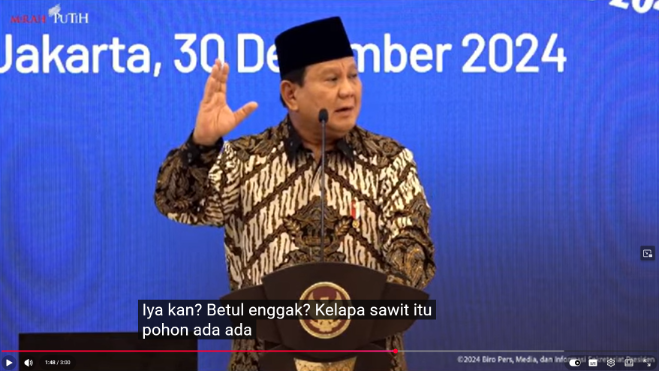
Speech by Indonesian president Prabowo Subianto, 30.12.2024: ‘Right? Isn’t that right? The oil palm is a tree, isn’t it?’ (Source: https://www.youtube.com/watch?v=58i6qhUCBEY)
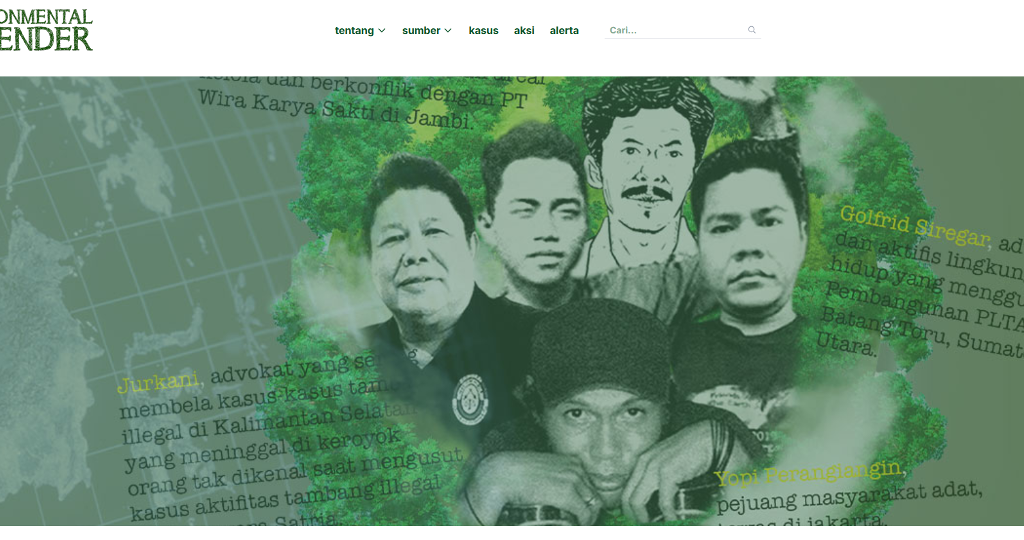
Within this political landscape, threats against environmental defenders—defined as individuals or groups who work towards protecting environments from harmful extractive interventions and against related human rights abuse—continue to rise, as clearly documented in the Environmental Defender monitoring platform developed by Auriga Nusantara, an Indonesian environmental advocacy NGO. Increasingly, journalists covering land conflicts, mining operations, plantation expansion, and strategic national projects find themselves facing the same pressures as environmental activists.
I have directly encountered these challenges through an ongoing research project investigating the digital-environment nexus (often known by the shorthand Diginex) in Indonesia. Recognising the disastrous environmental and social impacts of large-scale national projects and the rapid spread of digital media in Indonesia, my research aims to develop a better understanding of how environmental issues are framed in digital media, how media are used to mobilise against environmental destruction, and how framing and activism influence media users’ environmental practices. Here, I wish to put a particular focus on the struggle of environmental journalists within this broader setting.
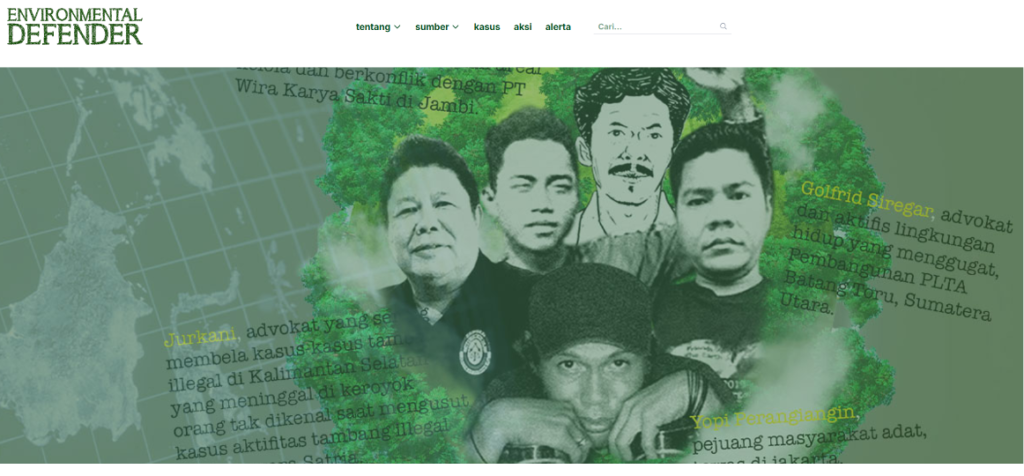
Environmental Defender platform, Auriga Nusantara
(Source: https://environmentaldefender.id/id)
Environmental conflict and the risks of reporting it
Environmental conflicts are not simply disputes over forests, rivers, mines or infrastructure projects—they are also struggles over knowledge, representation and power. As a result, environmental issues do not automatically become public concerns. Rather, they emerge through processes of public claims-making in which governments, corporations, activists and journalists compete to define problems, assign responsibility and propose solutions.
Media therefore do not merely report environmental issues: they actively shape how environmental degradation and environmental justice are understood. Digital media have intensified and reconfigured these dynamics. Journalists, activists and affected communities can now bypass traditional gatekeepers and connect local struggles to much wider audiences. Investigative reporting and environmental campaigning increasingly intersect online, generating counter-narratives that challenge dominant development agendas and expose the social and ecological costs of large-scale projects.
“Murni top-down”: a look at Prabowo’s village cooperatives
The unravelling of community-driven development
Indonesia provides a particularly revealing example. The country is simultaneously a biodiversity hotspot and a major greenhouse gas emitter, while experiencing numerous environmental and land conflicts. Mining, plantation expansion, food estates, deforestation and large-scale infrastructure projects have generated disputes over land rights, environmental destruction and social justice. Many of these conflicts involve powerful political and economic interests, making independent reporting both difficult and necessary.
The pressures intensified under the development agenda established by former president Joko Widodo (or Jokowi). Strategic National Projects (Proyek Strategis Nasional or PSN) were designed to accelerate investment and infrastructure development by reducing regulatory obstacles. Such measures have severely weakened environmental safeguards and intensified conflicts between affected communities, corporations and the state, on the pretext of boosting the national economy. As part of this, attacks on environmental defenders have risen sharply, ranging from intimidation and harassment to criminalisation.
As an investigative journalist conveyed to me, almost no environmental movement has succeeded in the Jokowi era. Centralised decision-making and military repression around PSNs have marginalised any other kind of land use and undermined protests in affected regions. Those who still dare to report on or organise activism around such cases, face serious consequences. One environmental journalist, for instance, described how they and their family experienced both physical and digital threats, by both unknown subjects and the military. Those attacks took place on individual and organisational levels, threatening not only the journalist but also the organisation they were part of.
Journalists investigating environmental conflicts operate within this increasingly hostile environment. Concerns about shrinking civic space became particularly visible in 2024, when a proposed revision of Indonesia’s Broadcasting Bill (RUU Penyiaran) threatened to restrict investigative reporting. Environmental groups immediately highlighted the potential consequences. As Greenpeace Indonesia warned at the time, “this might be the last environmental investigation we get to watch”.
There was substantial pushback and the bill was put on hold. Discussions continue until today, with a new draft bill being released in September 2026. In a context where environmental concerns are frequently subordinated to economic growth and resource extraction, environmental journalism remains one of the few mechanisms through which environmental harms and their social consequences are subjected to public scrutiny. At the same time, and under such conditions, can environmental journalists remain mere observers, or do they inevitably become environmental defenders as well?
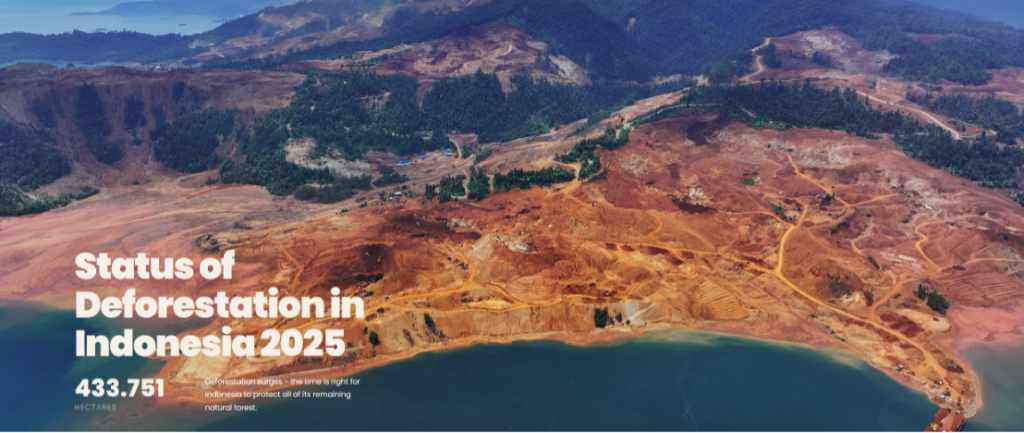
Simontini: Status of Deforestation in Indonesia 2025
(Source: https://simontini.id/en/status-of-deforestation-in-indonesia-2025)
When journalists become environmental defenders
Environmental journalism in Indonesia forms part of a broader landscape of environmental awareness raising and advocacy that has emerged over the years due to the increasing environmental impact of government policies. Alongside journalists, researchers, environmental NGOs, documentary filmmakers, artists and community organisations have all contributed to making environmental destruction visible and politically consequential.
In practice, the boundaries between these actors are often difficult to draw. During my research, many environmental journalists readily embraced their dual role as journalists and activist. The ones who were hesitant—stressing the importance of rigorous reporting over personal convictions—still acknowledged their dependence on activist networks and NGOs for access to data, field investigations and local knowledge, when their own resources were limited.
This blurring of boundaries resonates with arguments made by environmental journalism pioneer Michael Frome in his 1998 book Green Ink. Frome maintained that complete neutrality is impossible because journalists inevitably make choices about what to cover and whose voices to amplify. For him, environmental journalism is not advocacy at the expense of facts, but writing with a purpose, grounded in evidence while enabling informed public participation in environmental decision-making.
The Indonesian context gives these debates particular urgency. Following democratisation in 1998, Indonesia experienced an unprecedented expansion of press freedom and media diversity. Over the last decade, however, journalists have operated in an increasingly restrictive environment marked by democratic decline, oligarchic influence, media concentration and shrinking civic space. The 2020 Omnibus Law on Job Creation and the rapid expansion of Strategic National Projects exemplify a development model that prioritises investment and economic growth while weakening environmental safeguards and public participation.
On top of political and corporate pressure from above, environmental journalists in Indonesia face various other challenges.This begins with public attitudes: survey evidence suggests that, although concern about climate change in Indonesia is increasing, knowledge and engagement remain underdeveloped, highlighting the ongoing challenge of communicating environmental issues to broader audiences.
Within media organisations, stories on mining, deforestation, food estates or pollution are often considered high-risk and low-revenue. Moreover, journalists reporting on these issues are increasingly exposed to intimidation, criminalisation and legal harassment, frequently through Indonesia’s controversial Electronic Information and Transactions (ITE) Law, or their content gets lost in misinformation, spread by so-called cybertroops to control and push through the narratives of Indonesian elites.
According to Auriga Nusantara, more than a thousand environmental defenders, including environmental journalists, experienced threats, violence or criminalisation between 2014 and 2025. Journalists continue to collect, verify and analyse information according to professional standards. Yet by documenting environmental harm, challenging official narratives and amplifying the voices of affected communities, they inevitably turn into environmental activists.
These actors do neither cease to be journalists nor simply become activists; rather, the political consequences of doing their journalistic work and putting their names to stories of environmental destruction increasingly puts them in similar positions as environmental defenders or activists. The question, therefore, is not whether environmental journalists have become activists, but why contemporary Indonesia increasingly places them in similar positions of vulnerability and resistance.
Building resilience: how environmental journalists organise and adapt
To cope with these oppressive conditions, environmental journalists in Indonesia have developed various strategies. They have built networks of solidarity, collaboration, and mutual support. Similar initiatives have emerged globally through organisations such as the Earth Journalism Network. In Indonesia, the Society of Indonesian Environmental Journalists (SIEJ) was founded in 2006 by veteran environmental journalist Harry Surjadi and a group of colleagues concerned about the marginal place of environmental reporting in Indonesian media.
Environmental journalism clearly suffers from a structural disadvantage. Environmental stories require time, specialised knowledge, and extensive fieldwork, while commercial media are driven by fast news cycles and audience metrics. SIEJ was created to strengthen journalists’ ability to report on environmental issues while building broader public awareness of environmental challenges.
Over the past two decades, the organisation has grown into a nationwide network spanning most Indonesian provinces and connecting journalists working across mainstream, alternative, and environmental media. Through training programs, reporting grants, editors’ forums, and networking initiatives, SIEJ helps journalists develop the skills and resources needed to cover increasingly complex environmental conflicts and survive in an incresasingly precarious media space. It also plays an important role in strengthening safety protocols, including digital security, risk assessment, and support mechanisms for journalists facing intimidation, harassment, or violence.
“Murni top-down”: a look at Prabowo’s village cooperatives
The unravelling of community-driven development
Just as important as training is collaboration. As several journalists told me, collaborative reporting has become both a reporting strategy and a protection mechanism when facing and uncovering the strong entanglements of political and economic interests and implicated environmental destruction. Organising collectively, collaborating on specific cases, and experimenting with new forms of journalism and a constantly changing media landscape, they seek not only to protect themselves, but also to sustain environmental journalism as a public good.
SIEJ and affiliated media initiatives have also experimented with new ways of engaging audiences. To break through dominant government narratives and reach out in particular to younger audiences, they maintain a strong social media profile and constantly adapt their social media strategies to translate complex environmental news into accessible, often visualised, units.
They also established the independent platform Ekuatorial as a dedicated outlet for environmental reporting, combining investigative journalism with storytelling, citizen participation and digital outreach. Both SIEJ and Ekuatorial increasingly draw on ideas associated with constructive journalism, which aims not only to expose environmental problems but initiate constructive discussions around possible responses, alternatives and solutions—a positive vibe that resonates much better with Indonesian audiences.
The objective is not to replace critical investigation with optimism, but to make environmental reporting more relatable, accessible, and meaningful to a wider public. Such advancements can also become means to deal with the pressures and precarity environmental journalists face through centering dialogue and solution, rather than aggressive desconstruction.
Looking ahead
For environmental journalists in Indonesia, the question is no longer simply how to report environmental conflicts, but how to continue doing so amid growing political and economic pressures. Networks such as SIEJ, collaborations between journalists, researchers and civil society organisations, and emerging forms of constructive and investigative journalism offer important ways of coping with an increasingly difficult environment.
Yet these initiatives can only mitigate, not resolve, the underlying problems. Meaningful change would require stronger legal protections, greater media independence, and a reinvigoration of civic space, developments that currently appear unlikely after more than a decade of democratic decline and increasing restrictions on critical voices.
The journalists reporting on Indonesia’s (literally) burning environmental issues know this well. Despite threats, intimidation and criminalisation, they continue documenting environmental destruction and amplifying the concerns of affected communities. Their lived realities suggest that environmental journalism in Indonesia has become more than a profession. In a context where environmental governance is weakening and avenues for public scrutiny are narrowing, it increasingly functions as a form of environmental defence—in Michael Frome’s words, as “a way of living, of looking at the world, and at oneself” that almost always comes with risk and sacrifice.