 Facebook
 Twitter
 Soundcloud
 Youtube
 Rss
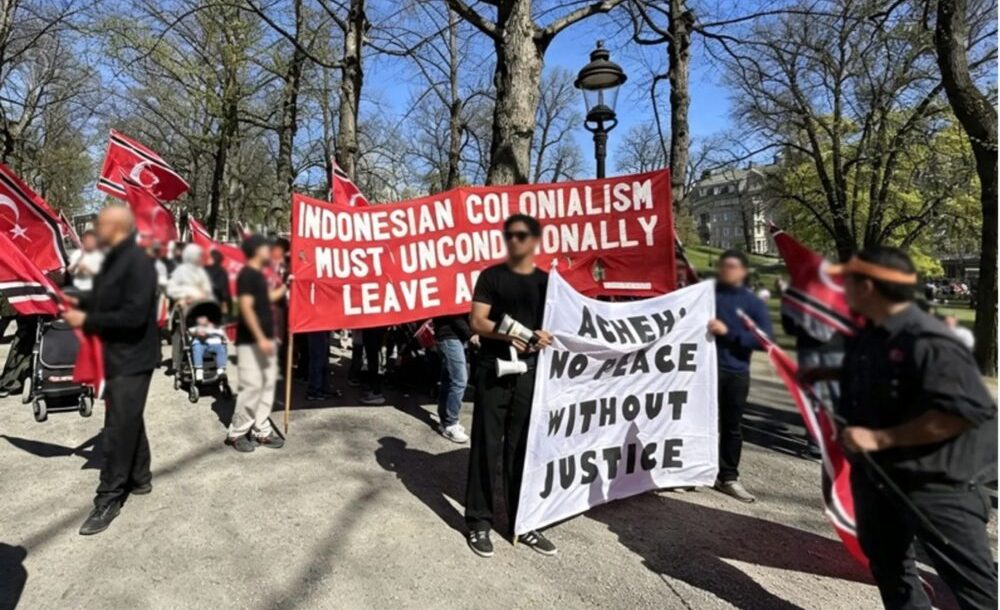




On 1 May 2026, as Stockholm commemorated International Workers’ Day (or May Day), distinctive banners were seen flying alongside standard European labour flags. Yet one flag stood out: the crescent-and-star flag carried by the activists of the Aceh–Sumatra National Liberation Front (ASNLF). They used the occasion to hold a peaceful demonstration, marching from Humlegården Park to Norra Bantorget in the centre of the city.
As part of my qualitative fieldwork on ethnonationalist ideology among the Acehnese diaspora in Sweden, I walked alongside these activists. I witnessed how they voiced the key point underpinning their activism: that 21 years after its signing, the 2005 Helsinki Memorandum of Understanding (MoU) that helped draw Aceh’s decades-long pro-independence insurgency to an end has failed to deliver justice for the Acehnese and economic prosperity that they consider essential to post-conflict reconciliation.
The snapshot of the ASNLF I provide here draws on Benedict Anderson’s idea of “long-distance nationalism” as a conceptual framework, contextualising it among other ethnonationalist movements in Asian diaspora communities. Yet I also relate the ASNLF’s activism to persistent critiques, including those made by scholars, of post-conflict democratisation to illustrate how domestic governance failures also galvanise Acehnese ethnonationalism from afar.
Yet as first-hand memory of the insurgency fades, personal experiences of state violence are giving way to parental narratives as a wellspring of Acehnese nationalism in the diaspora—and both of these things increasingly share space with digital platforms, as social media becomes key in sustaining pro-independence discourse and giving these diaspora groups a role as a critical watchdog regarding Aceh’s position within Indonesia.
Trajectories of exile and diaspora nationalism
During the conflict between the Free Aceh Movement (Gerakan Aceh Merdeka/GAM) and the Indonesian government (1976–2005), Aceh experienced some of the highest levels of state violence of any region in Indonesia since the 1965-66 massacres. Violence intensified significantly when the region was designated a Military Operation Zone (Daerah Operasi Militer/DOM, 1989–1998). Amnesty International reports indicated that between 10,000 and 30,000 people lost their lives during the main phase of military operations between 1989 and 2004, many of whom were civilians.
2026 marks the 21st anniversary of the signing of the peace agreement. Although Jakarta and international observers frequently praise the peace agreement as a major success story in conflict resolution, diaspora groups such as the ASNLF vehemently reject this narrative. For them, peace is merely a formality; they argue that Aceh remains structurally marginalised and systematically excluded from public policy. This sentiment fuels their persistent demands for independence, as well as the continued raising of the GAM flag both in Sweden and Aceh during peace commemorations on 15 August 2026.
The ASNLF was declared by Hasan Tiro in 1976. The Indonesian government subsequently referred to it as the Free Aceh Movement, whose Indonesian acronym GAM became the name by which the ASNLF became nationally and internationally known during the conflict (1976–2005). The ASNLF was re-declared in Brønderslev, Denmark, in April 2012 to represent the faction that rejected the political compromises offered by the Indonesian government in the Helsinki MoU. The rebooted organisation was formed within the Acehnese diaspora, particularly those with backgrounds as former combatants, sympathisers, and victims of violence who felt betrayed by the peace deal struck with Jakarta.
As we marched together during the May Day demonstration in Stockholm, members of ASNLF shared stories of their harrowing migration journeys. Their stories were nearly identical: they left Aceh after appearing on Indonesian military target lists because of their affiliation with GAM. Each activist carried memories of suffering, having either witnessed family members being killed during the conflict, endured arbitrary arrest, or survived brutal military torture. Their journeys to Sweden were fraught with danger; most left Aceh on wooden boats, crossing the Strait of Malacca to Malaysia to seek political asylum. In Malaysia, they were housed in UNHCR refugee camps, where many languished for up to a decade before finally being resettled in Sweden.
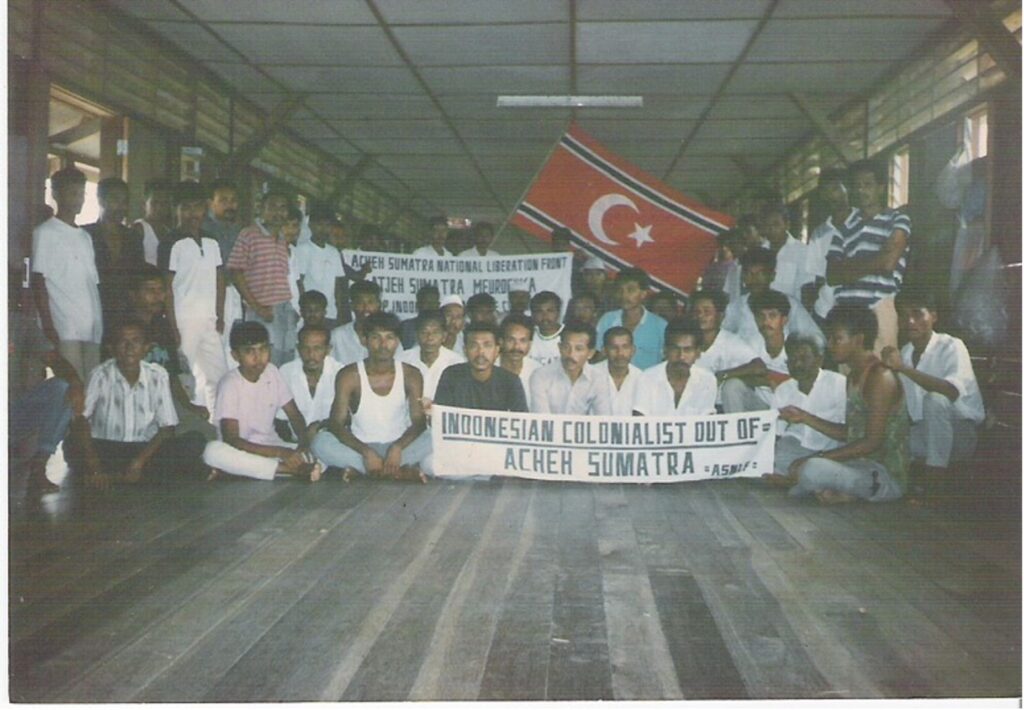
Waiting for resettlement in Langkap Detention Camp circa 1993, Perak, Malaysia
(Photo: archive of an ASNLF member)
The resurrected ASNLF can be understood within the broader literature on diaspora-based nationalism, or what Benedict Anderson termed “long-distance nationalism”. Anderson argued that modern globalisation and transnational migration enable dispersed populations to participate actively in the politics of their ancestral homelands. This dynamic creates a distinctive form of political mobilisation. Diaspora activists operate within safe, democratic host countries; enjoying freedom of expression and legal protections, they are unencumbered by the daily pressures of state repression or the need for political compromise. Consequently, diaspora nationalism can embody uncompromised, pure ideologies that reject peaceful, negotiated settlements in the homeland.
This pattern is evident in several other Asian ethnonationalist movements, such as the Republic of South Maluku (RMS), the United Liberation Movement for West Papua (ULMWP), and the Khalistan movement among the Sikh diasporas. In the case of the RMS, a Netherlands-based government-in-exile has existed since 1966. Although political life in Maluku was largely integrated into Indonesia following the defeat of RMS forces in the 1950 Ambon conflict, second- and third-generation Moluccans in the Netherlands have maintained the RMS’ ideological demands. They have advocated for independence for over seven decades through annual commemorations of the RMS’ declaration of independence on 25 April and through international lobbying.
Two women and the blind spots of national history in the Malay world
Herstory between borders
Indeed, we can compare these Indonesian cases with a South Asian analogue in the form of the pro-Khalistan activism, which persists in the global Sikh diaspora long after Sikh political parties in India re-engaged in state-facilitated electoral politics—a move similarly driven by the need for their own security and survival after military crackdowns by the national government.
It is precisely within this tradition of “long-distance nationalism” that the ASNLF in Sweden operates. Following the Helsinki Agreement, former GAM commanders and elites opted for a peaceful path; they established local political parties and managed special autonomy funds provided by the Indonesian government. However, the ASNLF in Sweden remained committed to the concept of “Free Aceh” formulated by Hasan Tiro in 1976. This concept formed the core of the Acehnese ethnonationalist ideology that Tiro instilled in all members of GAM as its central doctrine. In Sweden, this ideology continues to be upheld and drives the struggle for independence, as they believe the European democratic system affords them protection.
Viewing homeland politics from afar
ASNLF’s long-distance nationalism is fostered and sustained not just by feelings of betrayal stemming from the peace deal, but by its sympathisers’ perspectives on contemporary political developments in Aceh. The ASNLF views the post-conflict transition in Aceh as having become a vehicle for local elites to collude with the state, and laments the failure of both Aceh’s local political elites and the Indonesian government to establish a just politics and economic prosperity.
Olle Törnquist‘s critique of post-conflict democratisation offers a compelling framework for understanding this failure. Törnquist argues that peace agreements often falter when post-conflict institution-building prioritises elite power-sharing arrangements over popular representation and democratic rights.
This analytical lens is mirrored in how the ASNLF views post-conflict Aceh, where the peace agreement enabled former GAM combatants and state elites to transform wartime command structures into peacetime patronage networks. The ASNLF frequently cites official data from Statistics Indonesia (BPS) showing a poverty rate of 12–14% in Aceh, placing it among the provinces with the highest poverty levels on the island of Sumatra. They argue that peace has devolved into a transactional system and that domestic political compromises have failed to improve the welfare of the Acehnese.
The ASNLF’s critique extends to the stagnant performance of the Truth and Reconciliation Commission (TRC) in delivering justice for victims of the Aceh conflict. They also interpret the moralistic application of sharia law (qanun) as an ideological smokescreen designed to divert public attention from systemic corruption and economic hardship.
These grievances reached a breaking point following the devastating flash floods that struck Aceh in late November 2025; the disaster claimed more than 415 lives and displaced over 487,000 residents. ASNLF figures have interpreted this catastrophe as a direct consequence of unchecked resource exploitation and state paralysis. They highlight the government’s ineffective emergency response—and its refusal to classify the event as a national disaster—as evidence that transactional governance poses a direct threat to human safety.
For the ASNLF, witnessing these failures from afar has reinforced their sense of long-distance nationalism. Unencumbered by the risk of domestic political repression, the ASNLF voices these grievances in international forums to challenge Jakarta’s narrative and foster a new generation of activism in exile.
Soft-power ethnonationalism across generations
Driven by the conviction that Indonesia’s reconciliation model has failed to deliver, the ASNLF has shifted Acehnese ethnonationalism’s ideology from armed struggle to soft-power diplomacy on the international stage. As a member of the UNPO, the ASNLF has voiced its demands before the UN Human Rights Council and the European Parliament, while aligning its cause with movements such as the ULMWP and the RMS.
The ASNLF promotes Acehnese ethnonationalism by organising events, including the annual “De Atjeh–Oorlog” (Aceh War) demonstration on 26 March, commemorating the Dutch declaration of war against the Sovereign State of Aceh in 1873. They also hold annual public discussions alongside the ULMWP and the RMS. Every 4 December, the ASNLF commemorates its anniversary with speeches intended to reinforce Acehnese ethnonationalist ideology. All their activities are documented via digital media, including personal Facebook accounts, their website, and a YouTube channel.
Crucially, this long-distance activism endures thanks to the passing down of the ideology of Acehnese ethnonationalism to the “Young ASNLF”. Representing a third generation born in Sweden (aged 12–25), these young people actively participate in various actions alongside their parents. Much like the youth of the RMS and ULMWP, the Young ASNLF in Sweden continues the struggle, engaging in a variety of activities and demonstrations. At peaceful demonstrations in Stockholm, they carry banners reading “Aceh: No peace without justice” while chanting “Free Aceh!”.
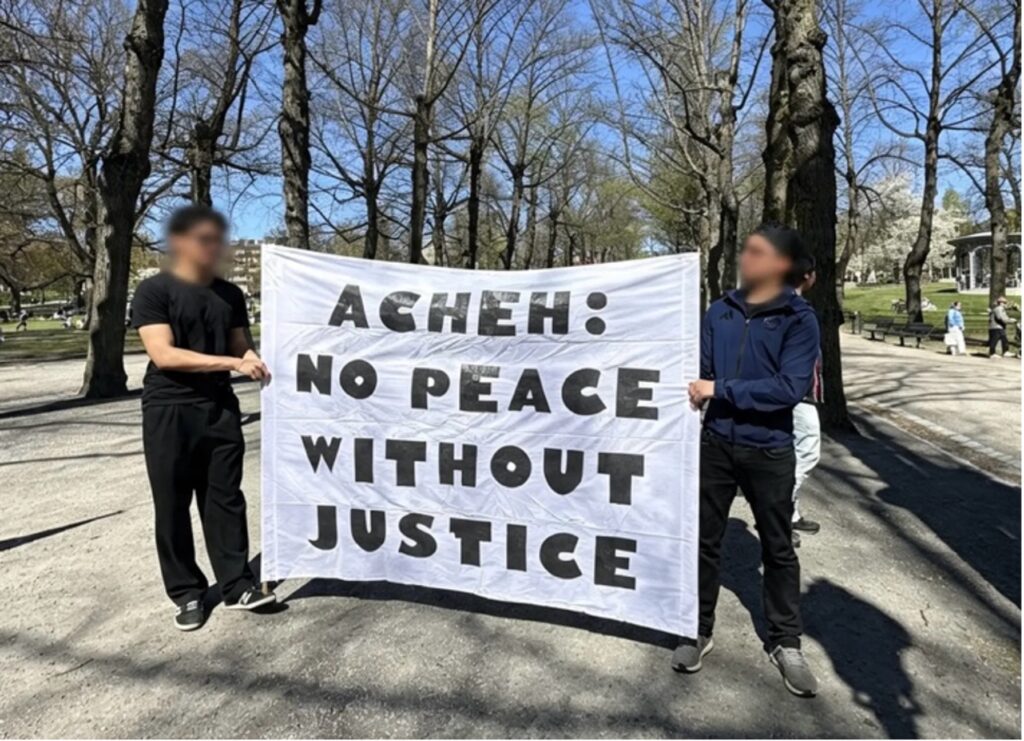
Young ASNLF holding a banner during the Peace Demonstration, Stockholm, 1 May 2026 (Photo: author)
In my conversations with the Young ASNLF, they recounted how their parents had involved them in activism from an early age. Despite holding Swedish citizenship, they remain fluent in Acehnese, practise Acehnese customs and culture, and firmly reject an Indonesian identity. The intensity of their sentiment is not driven by direct, firsthand experience of the current situation in Aceh; rather, it stems from their internalisation of narratives regarding suffering and the conflict-related trauma experienced by their parents, as well as the ideology of Acehnese ethnonationalism passed down to them.
The future and limits of Acehnese exile politics
The ASNLF presents a different dynamic from other ethnonationalist movements, such as the ULMWP. Papuan exile diplomacy has gained “cachet” among Western activists and Pacific nations because it intersects with indigenous rights, deforestation, and active guerrilla warfare in Papua. Consequently, Jakarta expends considerable diplomatic energy countering the ULMWP abroad.
In contrast, the ASNLF operates within a post-conflict reality grounded in the 2005 MoU. The Aceh conflict is internationally recognised as one that was successfully resolved through a peace agreement that also integrated GAM into the Republic of Indonesia. Regarding Indonesia’s stability and international diplomacy, ASNLF activities in Sweden are viewed by Jakarta as a manageable nuisance that poses no threat to the country’s diplomatic standing. This is because the ASNLF possesses neither military power nor formal diplomatic recognition.
Two women and the blind spots of national history in the Malay world
Herstory between borders
Operating beyond the reach of state co-optation, the ASNLF ensures that various shortcomings in post-MoU governance remain under critical scrutiny from afar. If commitments to peace continue to be disregarded by the Indonesian and Acehnese governments, the ASNLF’s narrative of independence could garner domestic sympathy.