Facebook
  Twitter
  Soundcloud
  Youtube
  Rss
Rss 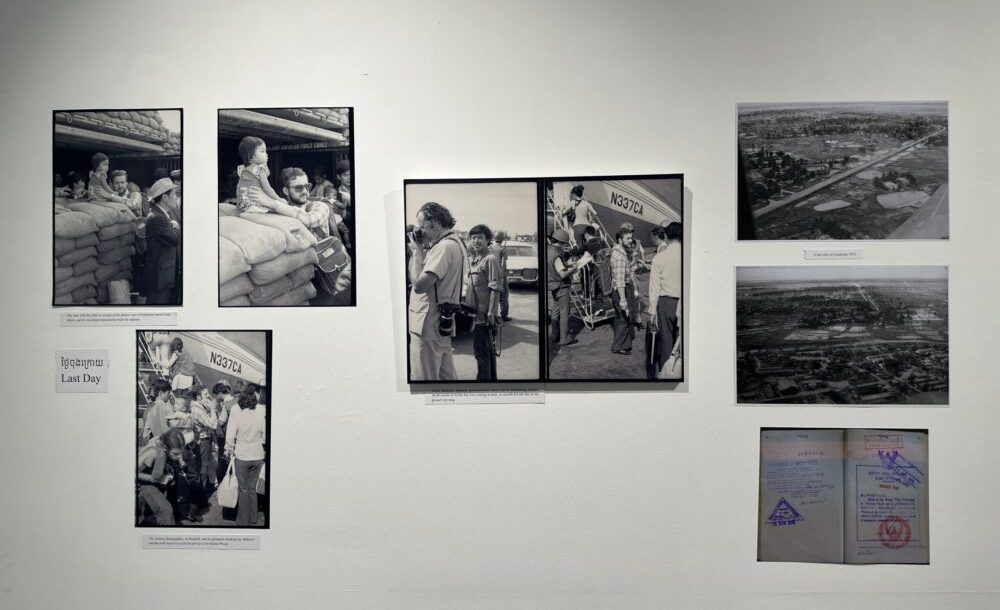




British photographer Colin Grafton’s exhibition Cambodia 1972–1975 opened at the art gallery of the SOSORO Museum of Money and Economy in Phnom Penh in August 2025. It was one of the few projects organised by local and international institutions in Cambodia last northern summer that commemorated the fall of Phnom Penh to the Khmer Rouge on 17 April 1975, which marked the start of “Year Zero”, as Pol Pot and his inner circle’s radical attempt to “reset” Cambodia is also known. Grafton, a long-term resident of Cambodia, curated the exhibition with his wife and collaborator Keiko Kitamura-Grafton, drawing together several bodies of work from Grafton’s larger photo collection, presented here for the first time as a single exhibition.
The Khmer Rouge victory in April 1975 put an end to five years of conflict between the pro-US Khmer Republic and the communist insurgency. The 1970–1975 civil war was far more than a tragic prelude to the Khmer Rouge genocidal rule (1975–1979). Over 500,000 tons of US bombs were dropped to destroy Vietcong sanctuaries inside Cambodia. Perhaps as many as three million people (approximately half the country’s population) were displaced in the course of the war, as they fled bombardments, combat operations, and Khmer Rouge’s advance in the countryside. The number of victims is unknown, but conservative estimates range between 150,000 and 250,000 deaths.
In public memory, the crimes of Democratic Kampuchea have overshadowed the brutality of the civil war. Although the Khmer Rouge committed atrocities before 1975 in the zones they controlled, the Extraordinary Chambers in the Courts of Cambodia (ECCC) did not include the period 1970–1975 in the Tribunal’s jurisdictional scope. One might say conveniently so, since a wider temporal scope would have put the role of the United States and China as facilitators (to say the least) in the spotlight. Cambodia’s civil war has never received the same attention as Vietnam’s. As journalist William Shawcross argued, it was often seen as a “sideshow” to the larger story of the Vietnam War. Moreover, while the Khmer Republic was welcomed by part of the Cambodian population (mostly urban circles), sympathies for the new regime did not run high in the international public opinion. The republican regime was often dismissed as an incompetent and corrupt puppet in the pay of Washington. Shared at the time by mainstream and more militant media, this simplistic view has endured. Unsurprisingly, the whole period remains a “blind spot” in Cambodia today, especially for the younger generations.
Cambodia 1972–1975 puts the civil war back on the page. Yet, the exhibition is not about war photography. Grafton did not shoot combat operations, military parades, or corpses. He did not intend to produce a journalistic record for newspapers. In fact, he did not see himself as a photojournalist. He simply liked photography, and after he befriended the Japanese photographer Naoki Mabuchi (1944–2011), he started taking pictures. Grafton was interested in the everyday, the humble, and the little details that revealed people’s resourcefulness in these times of hardship. He wanted to show ordinary people’s life in wartime Cambodia.
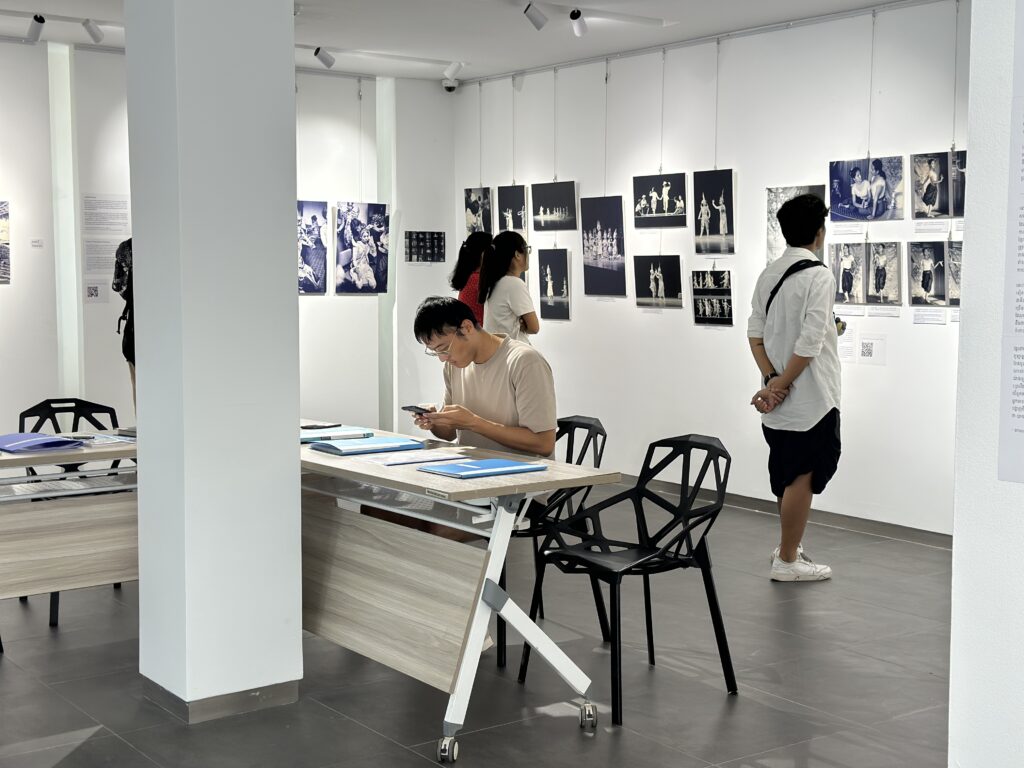
Photo: author. Exhibition photos depicted with permission of Colin Grafton.
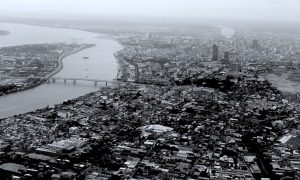
Grafton arrived in Cambodia in November 1972 after spending two years in Laos. In March 1973, he started teaching English at the English Teachers’ Association in Phnom Penh (ETAPP), a language school founded and run by the Americans Egon Rassow Jr. and Samuel Jackson III. He worked there until the school closed in March 1975. In April, he evacuated aboard a C-130 aircraft that had flown in from Thailand with rice and munitions and returned to Bangkok with evacuees. Tellingly, the exhibition’s last two pictures are aerial views he shot from the plane, a fitting image for a country that became inaccessible until the end of the Khmer Rouge’s regime in January 1979.
After Grafton was given a Russian bicycle (without brakes, as he likes to recall), he began to explore Phnom Penh. The street scenes he photographed during these explorations form a large part of the exhibition. As the Khmer Rouge tightened its grip on the city, the boundary between home front and frontline became increasingly blurred. War reshaped Phnom Penh in myriad ways, most visibly, but not only, through the presence of soldiers and barbed wire. While traditional small trades like the ice-vendor or the street hairdresser survived, other more directly war-related trades appeared. Grafton’s photos captured, for example, an Indigenous Khmer man with his hair sticking out of his military helmet selling protective amulets, or three wounded soldiers playing music and collecting money in a brass shell case.
For Phnom Penh residents, the riverfront had long been a place for socialising. During the conflict, it offered them a new kind of leisure. In “Drinks, snacks, and ice cream”, a small crowd sits and stands by the river. People look at the opposite bank. We do not see what happens there, but the caption explains that they watch, as if it were a spectacle, governmental aircraft bomb Khmer Rouge positions across the Mekong. War did burst into Phnom Penh’s everyday life even more brutally, as the city was regularly hit by enemy rockets. The area near Bassac Lane where Grafton lived then was struck in December 1973. Fortunately, he was away on a trip. When he came back, he found the nearby pagoda partly destroyed and his neighbors’ house burned to the ground. By chance, his own bungalow had survived the attack.
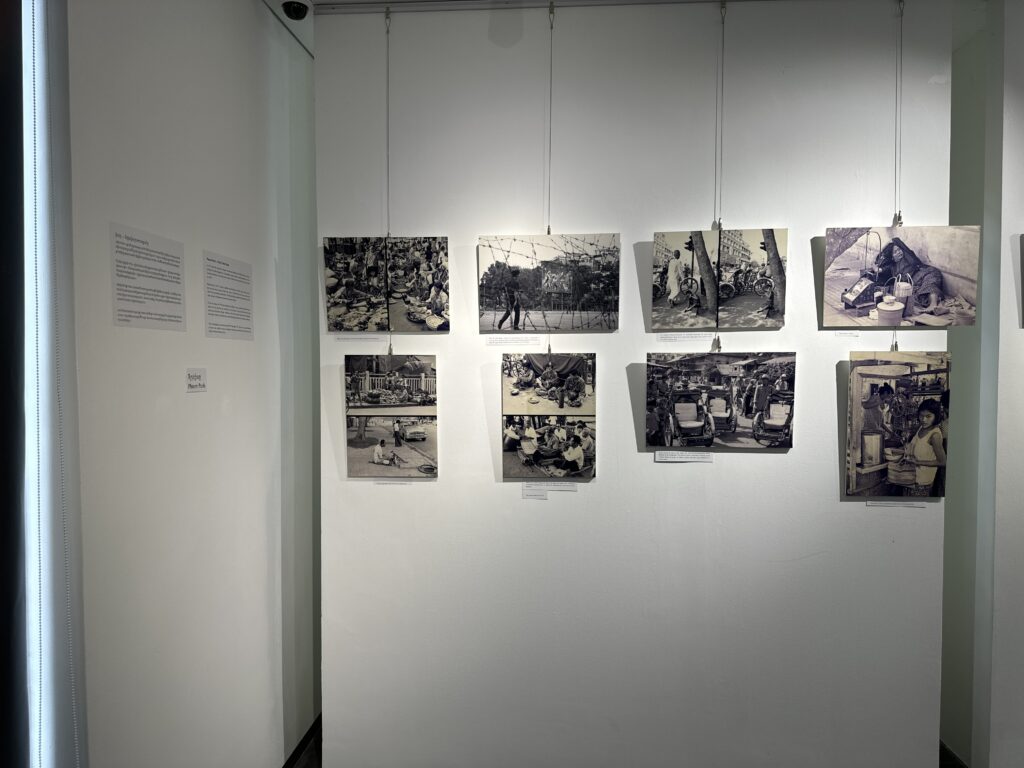
Photo: author. Exhibition photos depicted with permission of Colin Grafton.
Looking at the display, one is struck by how many faces there are: people from the street, children, friends, ETAPP students and staff. The first one, in the order of the exhibition visit, is “Mr. Bigsmile”, the moto driver from Sisophon who agreed to take Grafton to the Banteay Chhmar temple soon after his arrival. It was Grafton’s first trip inside Cambodia, and to reach the temple he had to pretend he was an archaeologist on an important mission. Mr. Bigsmile was his first friend in Cambodia, and his portrait is shown next to that of Mao Gim Hong, the soldier who authorised Grafton to continue his journey to the temple (under military escort). Grafton identifies as many people as possible, and when he cannot, he adds a little comment that fixes the person in the viewer’s mind—an elderly man photographed because Grafton found him elegant, the cheeky vegetable sellers, or the mischievous girls at the market.
One cannot help but wonder what became of all these people. Sometimes, we have the answer, and sometimes it is a happy one. For instance, ETAPP secretary Pantha, who studied classical dance and wanted to write a book. She asked Grafton to take pictures and bought a roll of film for him. In the teachers’ wooden house, she rigged a flowered brocade as a backdrop, donned her silk dance practice costume, and performed twenty poses. She kept the negatives and printed two sets, one for her and one for Grafton. The Khmer Rouge later destroyed her set. Pantha managed to hide the negatives in her house before being deported to the countryside, like all Phnom Penh inhabitants. Unfortunately, her house was destroyed by an artillery shell in 1979. Pantha survived the Khmer Rouge, and when she and Grafton met again forty years later, her gave her his own set.
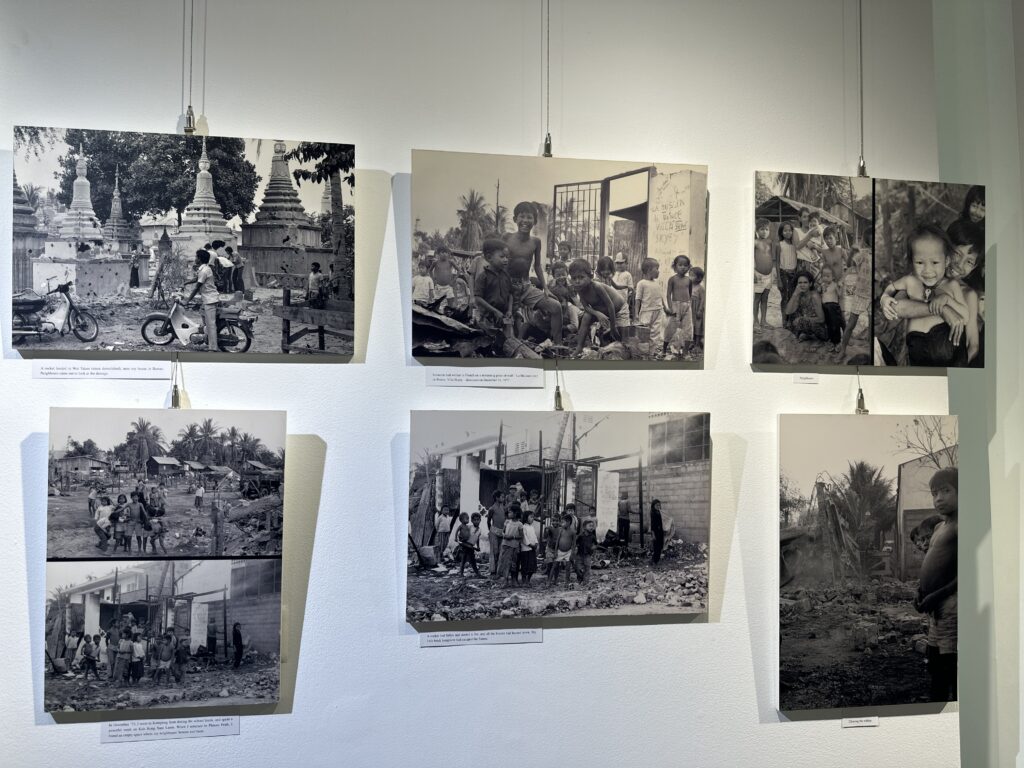
Photo: author. Exhibition photos depicted with permission of Colin Grafton.
Grafton and Kitamura-Grafton selected several of Pantha’s poses for exhibition. They are named, explained and presented along with the apsaras series (“Dancers”). Grafton had the chance to photograph the Royal Ballet performing at Suramarit Theater in 1974. At the time, they had almost stopped performing in public because of the war, and this performance might have been the last they gave before the Khmer Rouge takeover. He photographed them backstage and on stage. The women paid little attention to his presence as he captured their preparation routine. These photos are a precious archive of Khmer classical dance, an art form that was nearly destroyed by the Pol Pot regime. The Khmer Rouge sought to eradicate what they saw as a symbol of royalty and elite culture and specifically targeted the dancers and the musicians. Possibly up to 90 percent of Cambodian artists died in Democratic Kampuchea. After 1979, Khmer classical dance was gradually revived as the few surviving apsaras trained a new generation of dancers.
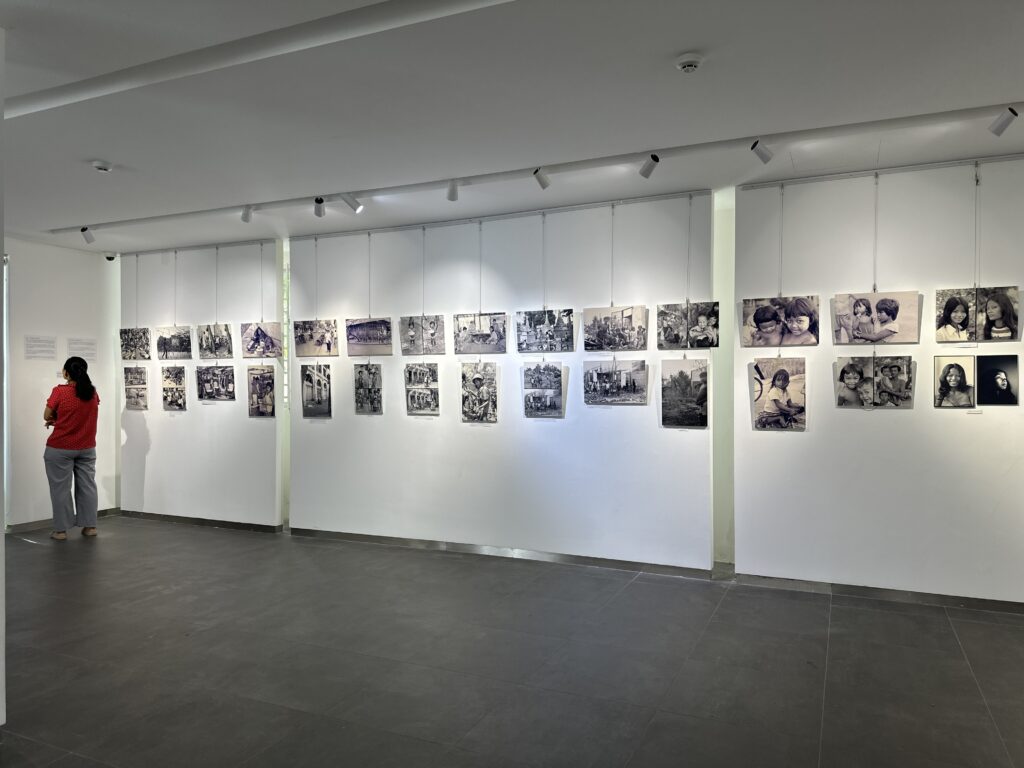
Photo: author. Exhibition photos depicted with permission of Colin Grafton.
As a historian and researcher, I was fascinated by the historical information I could gather from the exhibition, especially since the Khmer Republic’s existing archive is limited. For example, the republican government produced many propaganda posters that people carried in demonstrations and parades or put on utility poles or the back of cyclos and cars. To my knowledge, none have survived. The only visual record we now have of them comes from press photos, pictorials, and newsreels. However, the posters do not always appear clearly because of the low quality of these images. Grafton’s photo of the billboard in a street near the Old Market is an exception. The propaganda drawing depicts the Cambodian people, whose union is represented by a soldier, a civil servant, a woman, and a farmer armed with guns and hoes. They are successfully repelling the enemy, in this case a white-clad Sihanouk and his Vietcong allies, recognisable by their black clothing and conical hat.
Most of the photos in the exhibition are in black and white since colour film was hard to obtain. Yet, Grafton once found a roll, which he used to photograph touristic sites. These images are grouped in a section he titled, with irony, “Glorious Colors”, possibly as a nod to prince Norodom Sihanouk’s illustrated magazines of the 1960s which celebrated Cambodia’s achievements and his own. The section features a rare view of the monument of the Republic, a four to five meter high white obelisk bearing Buddhist symbols and the republican motto (liberty, equality, fraternity, prosperity, and happiness) in Khmer on one side. Unveiled in October 1970 for the proclamation of the Republic, it stood between the Royal Palace and the riverfront, as a symbol of both the end of the ancient regime and the new regime’s claim to uphold Khmer traditions. The monument was most likely destroyed within days or weeks of the Khmer Rouge victory. Only a few images of it survive—some pictures, newsreels, and drawings, all in black and white. Grafton’s photo is thus a rare opportunity to see the monument in color. It somehow makes it more tangible. It also includes elements that do not appear in other images I have seen, such as two military tents, one each side of the monument, where soldiers were camping.
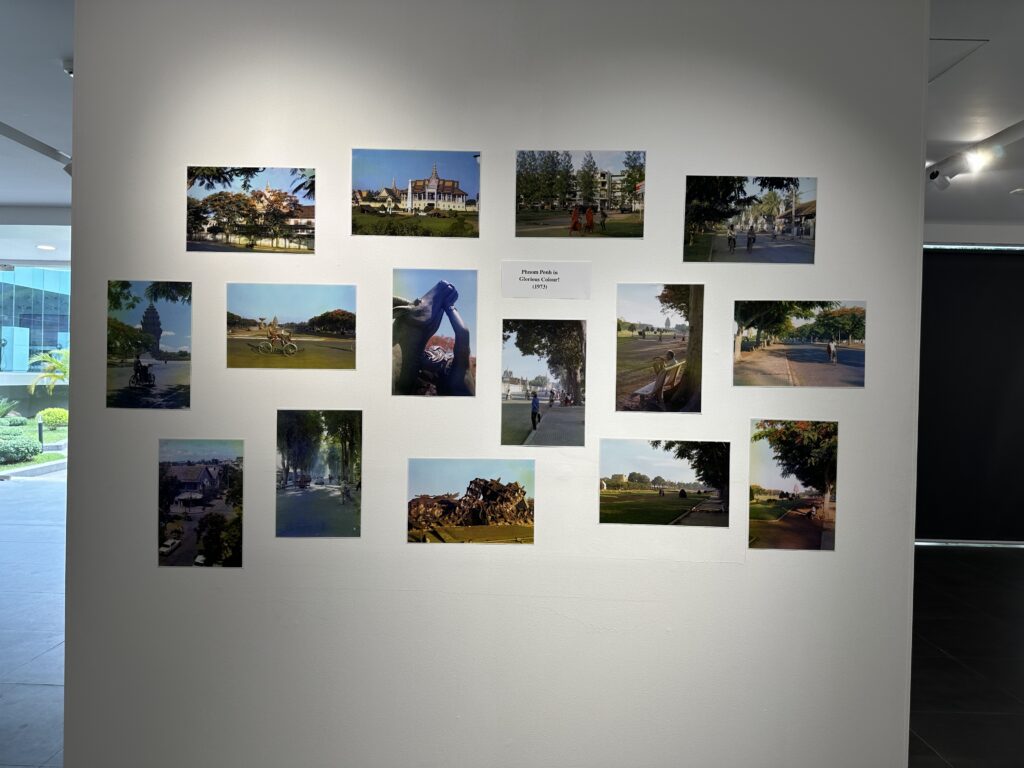
Photo: author. Exhibition photos depicted with permission of Colin Grafton.
By 1973, the Khmer Rouge controlled about two thirds of Cambodia. The Khmer Republic was reduced to Phnom Penh, its surrounding buffer zone, and a loose network of often besieged provincial towns. It was difficult to go further than 40km from the capital city, and Grafton remembers that he felt trapped. In late 1973, he managed to rent a motorbike and make short trips to the countryside. The photos he took on these occasions are probably the closest he ever was to war photography. In October 1974, for example, he went to Oudong with his ETAPP colleague Joe Sedlacek. The city had been taken over by the Khmer Rouge and re-captured by the governmental army. Along the way, they witnessed the extent of the destruction in the area. The photos show damaged pagodas with traces of shelling and fighting, a collapsed mosque in a destroyed Cham (Muslim) village. Sedlacek also photographed Grafton with republican soldiers and seized Chinese rockets. In Phnom Praset, 25km north of Phnom Penh, they came across bodies of people killed some days before. To Sedlacek’s surprise, Grafton photographed them as evidence of the massacre. Those images are not included in the exhibition; the only trace of the macabre discovery is its effect on Sedlacek, pictured as he sits, shocked, in a small café.
Another section of the exhibition’s takes us far away from Phnom Penh, documenting Grafton’s trip to Pailin in western Cambodia, including countryside landscapes. At a river, Grafton photographed Kola people (ethnic Shan gem traders who migrated from Burma) as they were panning gems. At first, the hundred men, women, and children did not see him, but then some noticed him, and the last photo of the sequence shows them all turned to Grafton. Another image represents a small café in Pailin with a few disparate tables and stools. There’s a board on top of its corrugated iron rooftop, with drawings of a coffee boiler pot and a commercial aircraft with B-52 written on it, an indication of how little Cambodians knew about the very bombers that wreaked havoc on their country. In Khmer, B-52 is pronounced “bi-ha-pi”. Considering how much Cambodia suffered from Nixon and Kissinger’s massive bombing campaigns, the dark irony was not lost on Grafton.
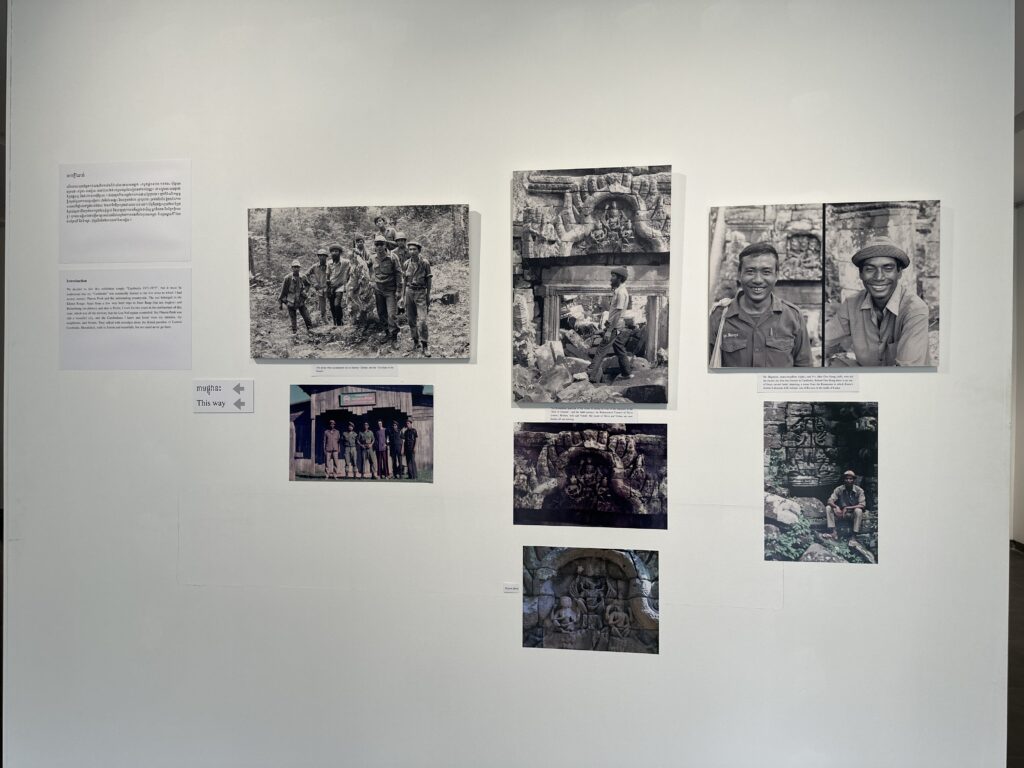
Photo: author. Exhibition photos depicted with permission of Colin Grafton.
In 2017 Grafton travelled back to Pailin and tried to find the café. He was unsuccessful, but the picture amused the Cambodians who were shown it. During this trip, he and Kitamura-Grafton revisited the locations where he had been in the 1970s and he took photos from the same vantage points. The resulting images, in color and smaller size, are displayed just below their 1970s counterparts for comparison. The wooden houses once visible from Wat Phnom Yat, the temple at the foot of the mountains overlooking Pailin, have now vanished. The stone guardians Grafton photographed on the temple roof are still here but they too have changed. One that once held an AK-47-like rifle (many people carried guns for protection then) now holds an agricultural tool.
The final section, “Last Day”, depicts Grafton’s evacuation. His friend Naoki drove him to Pochentong airport. There, Grafton waited with others until they could run to the C-130 under enemy fire. Evacuees were allowed only a small bag. He took his prints and negatives. He hoped he would be able to return to Cambodia. Meanwhile he decided to stay in Thailand. When it became clear that he couldn’t return, he went to Japan with Naoki’s help. Grafton doubted his pictures held any interest but photographers he knew in Japan persuaded him otherwise. He showed his photos for the first time in London in 1980, printing them at night in the darkroom of the school where his father worked. The exhibition, of took place in a local library—5×7 prints on a few panels. Half the pictures were from the Khmer Republic, half from refugee camps on the Thai border. Grafton did not want to show his images in an art gallery. He just wanted to be useful and inform British people about the situation in Cambodia.
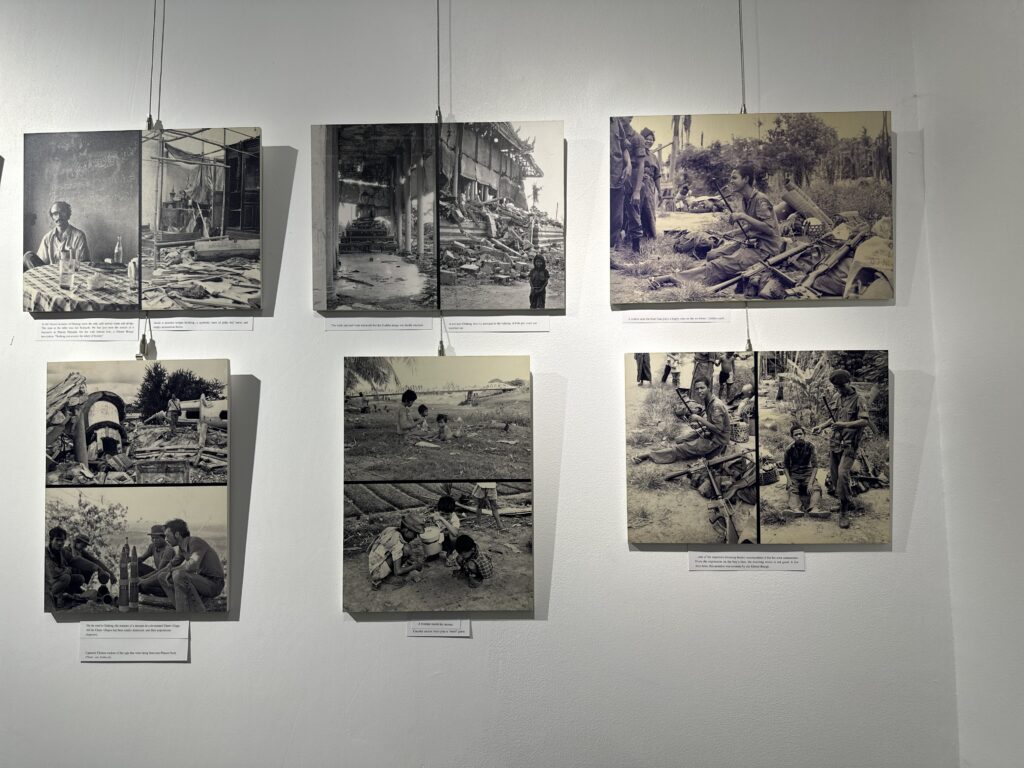
Photo: author. Exhibition photos depicted with permission of Colin Grafton.
Life in the UK was not for Grafton. He returned to Japan and made a few small exhibits there. By the mid-2010s, he and Kitamura-Grafton settled in Cambodia, partly thanks to the “dancers” series. After a fortuitous meeting with one of the surviving apsaras in Tokyo in 2006, the idea was born to locate the other survivors and show the Apsara series in Cambodia. Based in Phnom Penh, Grafton and Kitamura-Grafton are tireless archive activists. Over the past decade, they have often collaborated with local archive institutions, such as Bophana Audiovisual Center and Tuol Sleng Genocide Museum, and helped to preserve, make public, research, and teach about archives. For the Cambodia 1972-1975 exhibition, they organised presentations for history and photography students and gallery talks for the public, one of which I attended. Grafton is a gifted storyteller and the audience clearly enjoyed his stories, which he brought to life by bringing objects from that era: the Nikon camera he used, the glasses he wore, and a piece of a Chinese rocket that had exploded not far from his house. The gallery talks were recorded and published on YouTube, to reach an even broader public.
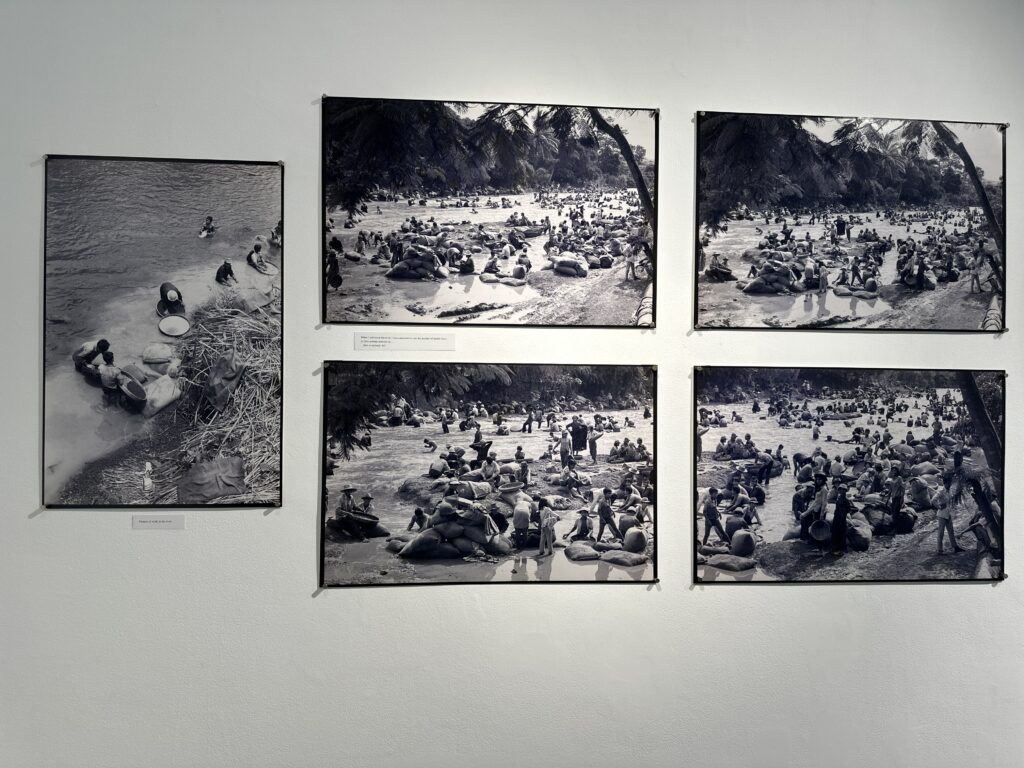
Photo: author. Exhibition photos depicted with permission of Colin Grafton.
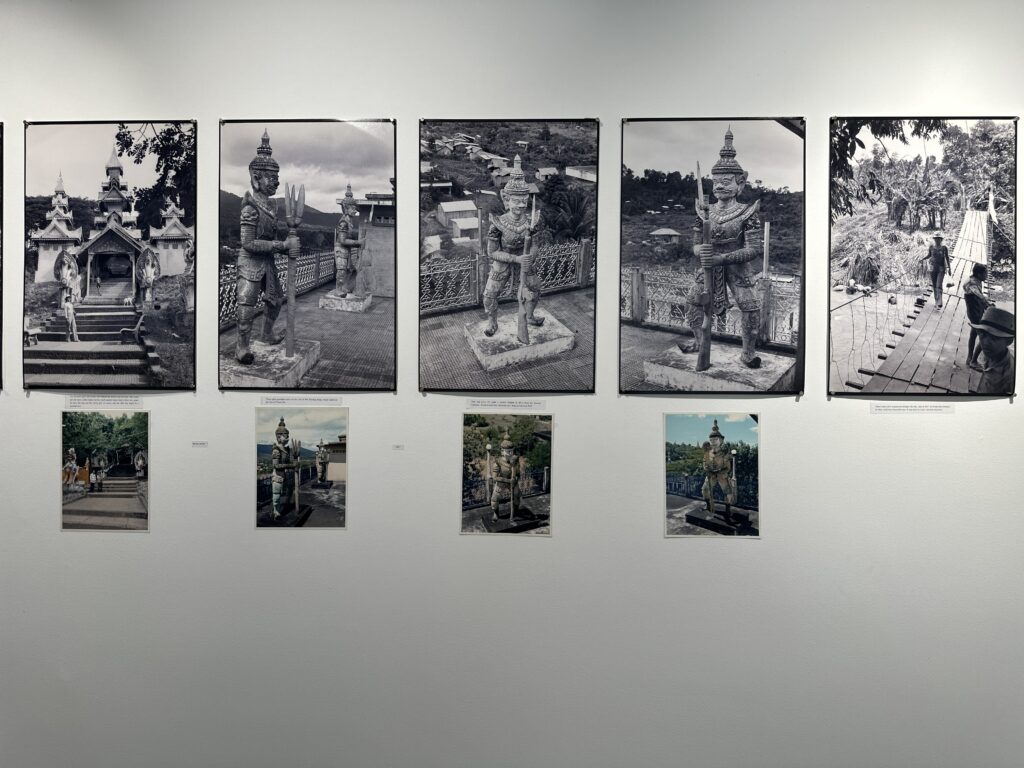
Photo: author. Exhibition photos depicted with permission of Colin Grafton.
Singapore’s Albatross File Exhibition is bad history that diminishes Lee Kuan Yew
Comfort trumps scrutiny
I think about a photo by Al Rockoff I saw once: a charred body. Maybe a soldier, maybe a guerrilla, maybe a civilian. Such pictures are undeniably important: that is war. Yet, Grafton’s photos show another side of it: how life goes on, how people adjust, how they support each other. Grafton’s gaze, sometimes bittersweet, often humorous, and always compassionate, made it easier, especially for younger Cambodians, to relate to people’s experiences beyond the cliché image of the Khmer Republic. Thus, the exhibition opened a venue for a much-needed discussion, a significant step which will hopefully be followed by many other initiatives.