 Facebook
  Twitter
  Soundcloud
  Youtube
  Rss
Rss 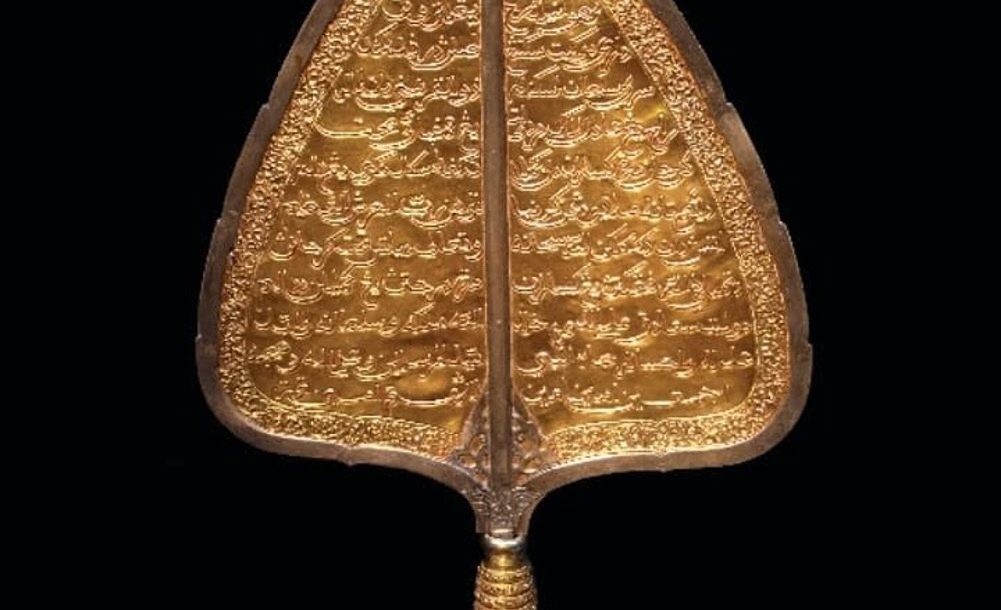




In October 1822, Dutch troops landed on Pulau Penyengat, a tiny island south of Singapore in the Riau archipelago. The island had been granted to Engku Puteri Raja Hamidah upon her marriage to Sultan Mahmud Shah III, whose death in 1811 triggered a decade-long succession crisis that became a stage for the Anglo–Dutch contest for influence within the Riau–Johor sultanate.
These two colonial powers faced the common challenge of legitimising the rule of the different princes whose coronations as Mahmud Shah’s successor each had helped engineer. By court custom, possession of a fan-shaped item of royal regalia known as the Cogan was necessary for the lawful installation of a sultan. As custodian of the Cogan, Mahmud Shah’s widow, Engku Puteri, had an important role in determining the legitimacy of a succession, and thus held substantial political clout.
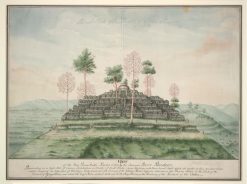
It was the goal of securing the Cogan on behalf of their favoured sultan that brought Dutch forces to Engku Puteri’s island base in 1822. She would not surrender the regalia, so colonial troops took them by force. Though her refusal could not prevent the intervention, it denied the succession the legitimacy that the Dutch sought from the existing court.
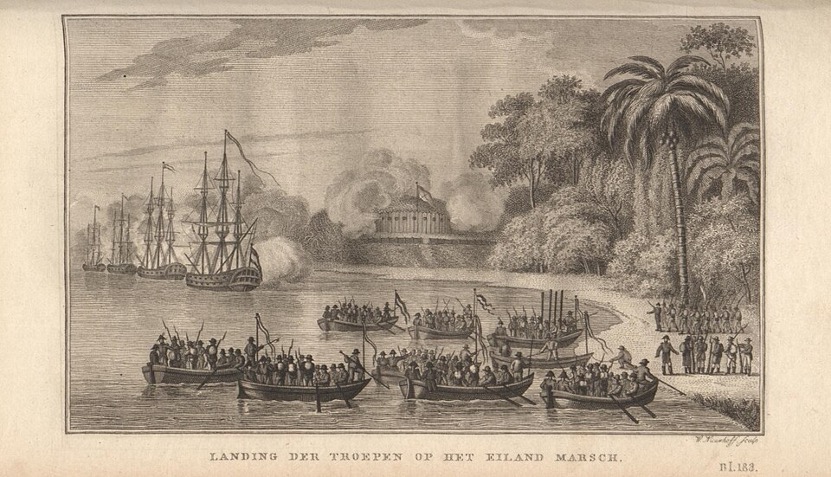
Figure 1: Dutch troops landing on Pulau Penyengat (Image: Staatsbibliothek zu Berlin).
The Riau–Johor political world within which Engku Puteri exercised authority was soon divided around her. On 17 March 1824, Britain and the Netherlands signed the Anglo–Dutch Treaty, separating their spheres of influence across a maritime region long connected by royal courts, trade, kinship and political authority. Riau and Lingga—including Pulau Penyengat—fell increasingly within the Dutch sphere, while Singapore and territories farther north came under British influence, helping establish the colonial division from which today’s national borders later developed.
Engku Puteri’s resistance to the Dutch agenda has secured her position as an icon of Malay resistance to colonialism within Indonesia, and she is periodically mentioned as a potential candidate to be given National Hero (Pahlawan Nasional) status by the Indonesian government. Yet she exercised her authority in the name of a political unit that stretched across today’s national borders. Her story is therefore the ideal starting point for considering larger questions: how should national histories account for political lives formed before today’s borders existed? And where do they place women whose authority does not fit easily into the categories later states use to organise the past?
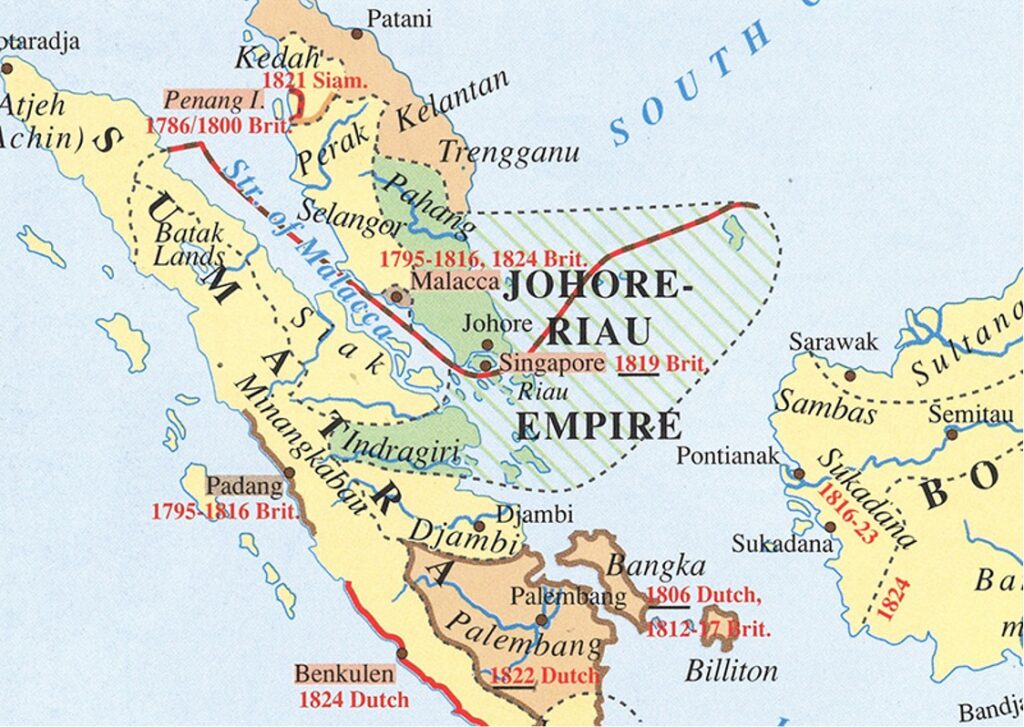
Figure 2: The Johore-Riau Empire bisected by 19th-century colonial treaty lines across the Straits of Malacca, dividing the British sphere (north/east) from the Dutch sphere (south/west) (Image: BiblioAsia Vol. 18, Issue 2, 2022)
The boundaries of memory
Every August, three neighbouring countries commemorate different moments of nationhood: Singapore marks its separation from Malaysia on 9 August 1965; Indonesia commemorates the proclamation of independence on 17 August 1945; Malaysia celebrates the independence of the Federation of Malaya on 31 August 1957. Placed side by side, these anniversaries are part of telling three distinct national stories, yet much of the political history behind them took shape before the borders between Indonesia, Malaysia and Singapore existed in their present form.
The colonial division of Engku Puteri’s maritime world was one stage in the longer process that produced those borders. Courts, families, trading networks and political movements had long connected communities across the Straits. The region already recognises this kind of overlap in cultural heritage: in 2024, Brunei, Indonesia, Malaysia, Singapore and Thailand jointly nominated the kebaya, which UNESCO recognised as shared intangible cultural heritage.
Political lives, meanwhile, are harder to accommodate across borders. National histories tend to place people within particular territories, institutions and founding moments. Women can be especially difficult to fit into the picture, because their political authority often operated outside formal office. When political worlds were later divided between states, their biographies could be divided with them, both figuratively and literally: the surviving record of Engku Puteri’s life is now dispersed across archives in Indonesia, the Netherlands, Britain and Singapore.
The difficulty is not simply that women have been left out. Lenore Manderson’s work on women in UMNO demonstrates how women could be politically important while facing limits on their authority. Studies of Indonesia’s National Heroes likewise make clear that national commemoration is selective: the category itself has changed over time, including in the ways female heroism is represented. Geography adds another complication: across the Straits, the same political figure can be celebrated in one country and condemned in another.
Khatijah Sidek (1918–1982)
These complications arise not just when a new border divides the political units within which individuals sought or wielded political power, but also when people themselves move across those emergent borders. This was the case with Khatijah Sidek, whose political life connected Sumatra, Singapore and Malaya before those places were firmly separated by national borders.
Born in Pariaman, West Sumatra, in 1918, Khatijah encountered Indonesian nationalism while still at school. In 1935, while training as a teacher in Padang Panjang, West Sumatra, she founded Ardjasni, a small student group where she developed the organising skills that later shaped her political career. After the Japanese surrender in 1945, she helped organise Puteri Kesatria, which trained young women for the Indonesian revolutionary struggle.
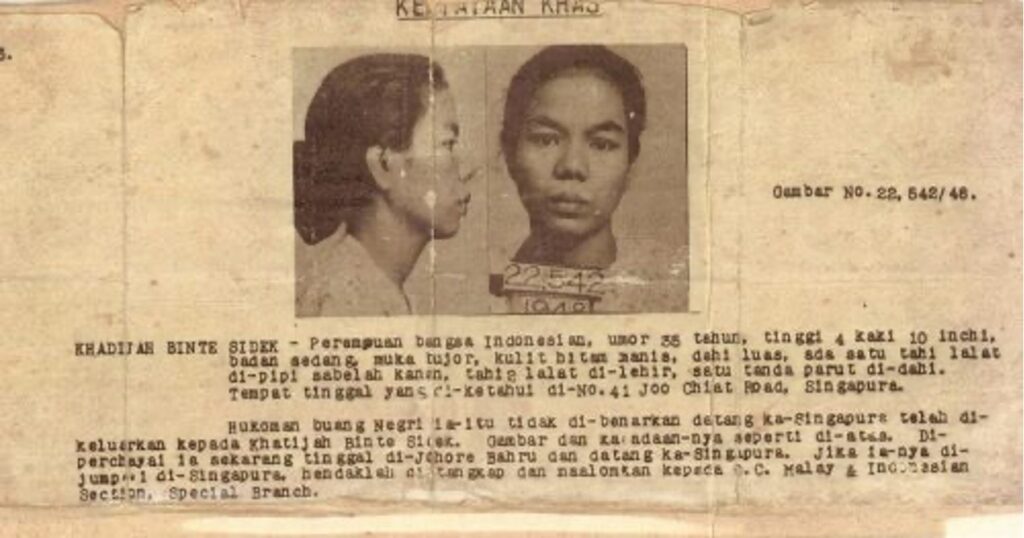
Figure 3: Banishment order and mugshot of Khatijah Sidek issued by the British colonial Special Branch in Singapore, c. 1948–1950 (Image: KhadijahSidek.blogspot.com)
Crossing the Straits changed the direction of her career. Khatijah first visited Malaya in 1946 and later settled in Singapore, where she helped organise the Himpunan Wanita Indonesia–Malaya (HIMWIM). These connections were not unusual in a period when national boundaries and identities were still unsettled. As Maznah Mohamad has noted, some Malay nationalists still imagined a larger Melayu Raya linking Malaya and Indonesia.
Maznah describes women in Malaya’s political history as an “absent presence”, important to political developments but incompletely represented in the histories later written about them. Khatijah’s story adds a geographical dimension to that problem. Her politics developed across a world of overlapping affiliations that later national histories would divide between Indonesia, Singapore and Malaya.
British authorities regarded these political networks with suspicion. Khatijah was detained without trial in Singapore in 1948. When she was released in January 1950, she was required to live in Johor. Her imprisonment later became one of the charges political opponents used against her. Helen Ting notes another label repeatedly applied to Khatijah: orang luar, an “outsider”.
Yet she quickly became important within the political movement that would dominate independent Malaya. Khatijah joined UMNO in 1953 and was elected leader of Kaum Ibu, its women’s wing, the following year. She travelled across the peninsula recruiting village women and rebuilding local branches. Khatijah later claimed that during ten months as Kaum Ibu’s information officer she established 130 branches and recruited around 10,000 members. Ting cautions that these figures cannot be independently confirmed, but they indicate the scale of the mobilisation Khatijah associated with her work.
Khatijah wanted that organisational strength to bring women greater political power. She pressed for more women on UMNO’s Supreme Council, greater autonomy for Kaum Ibu, and more female candidates. At the party’s 1954 General Assembly, Kaum Ibu demanded five of UMNO’s 35 prospective seats in the coming federal election. Male delegates resisted. When Khatijah challenged them publicly, the Johor Bahru division tried to expel her. The attempt failed, but the conflict continued.
In September 1956, the division again called for her removal and she was subsequently expelled; two months later, UMNO’s Supreme Council upheld the decision in her absence. The official reasons concerned party discipline, her speeches, and her public conduct. Ting places the dispute within a wider struggle over gender and authority inside UMNO. Khatijah rejected a political arrangement in which women mobilised members, raised funds, and delivered votes while men controlled candidacies and senior positions.
Her Indonesian origins offer no simple explanation for her expulsion. Her political style, challenges to male authority and disputes over party discipline all mattered. But her background could make her more vulnerable. Khatijah entered Malayan politics with a political identity formed through Indonesian anti-colonial activism and cross-strait organising. As Ting notes, opponents could invoke both her imprisonment and her status as an orang luar to discredit her.
The timing of Khatijah’s expulsion from UMNO was to have significant consequences. When Malaya became independent in August 1957, Khatijah stood outside UMNO. She had helped build the party’s women’s movement but was absent from it at the moment that would later occupy the centre of UMNO’s account of national independence. Her political career nonetheless continued. Khatijah joined the Pan-Malayan Islamic Party, later PAS, at the end of 1958 and won the parliamentary seat of Dungun, Terengganu, in the 1959 general election. She represented Dungun until 1964, speaking in parliament on girls’ education, rural development, health, and vocational training.
Khatijah’s story is therefore more complicated than one of historical neglect. Indonesia was where her politics first took shape, Singapore was a centre of her cross-strait organising and the site of her imprisonment, and Malaya was where she became a major party organiser and parliamentarian. Each national history contains only part of her political life.
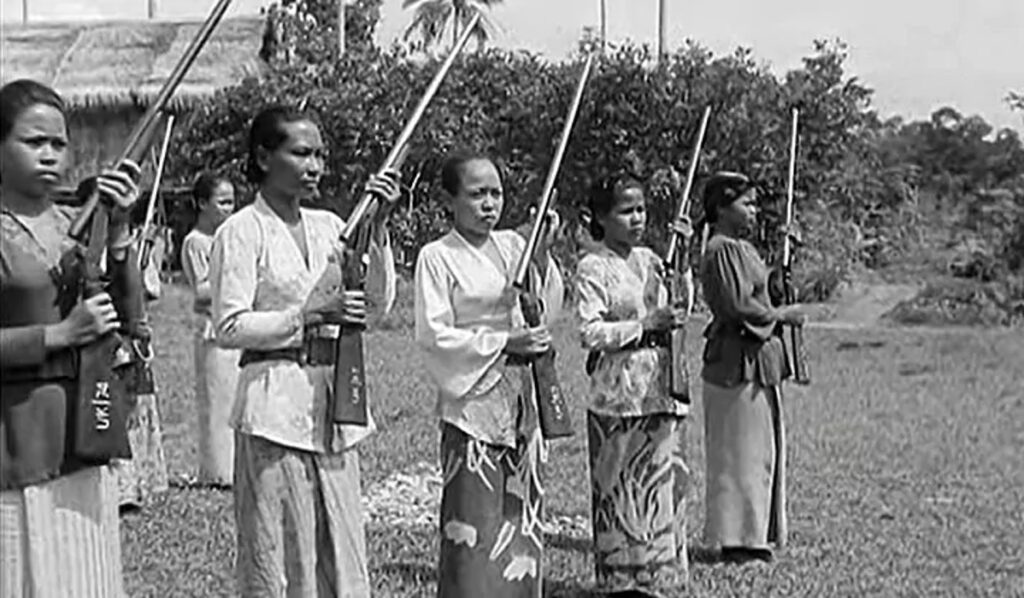
Figure 4: Khatijah Sidek leading a Kaum Ibu assembly in the 1950s. Her political career connected Indonesian anti-colonial activism, Singapore-based organising and the struggle for political representation in Malaya. (Image: The Rakyat Post)
From pioneer to outsider
Yet Malaysia has not completely forgotten Khatijah Sidek. Her Memoir Khatijah Sidek: Puteri Kesateria Bangsa, first published by Penerbit UKM in 1995 and subsequently reprinted, preserves her own account of her political life. She appears in scholarship and projects documenting Malaysian women’s history: one study calls her a “silenced” figure in the history of UMNO, while the Sejarah Wanita project presents her as an important campaigner for women’s political representation. Yet though she is readily described as a pioneering women’s leader, organiser and campaigner, she is still hard to find at the centre of the conventional story of Malayan independence.
Gender alone cannot explain this marginality in the national story. Tun Fatimah Hashim, who succeeded Khatijah as leader of Kaum Ibu, remained in UMNO and later became Malaysia’s first woman cabinet minister. Tun Aishah Ghani provides an even closer comparison; like Khatijah, Aishah had strong connections to Indonesia: she studied in Padang Panjang and Padang, and her early politics included the Malay Nationalist Party and its women’s wing, AWAS. But Aishah later built a long career inside UMNO, leading Wanita UMNO from 1972 to 1984 and serving as Minister of Social Welfare from 1973 to 1984. Connections to Indonesia clearly did not prevent a woman from becoming part of Malaysia’s national political establishment.
What distinguishes Khatijah, rather, is the trajectory of her career: she arrived in UMNO with political experience and networks extending across Sumatra and Singapore, rose rapidly within the party, was expelled before independence, and then joined the opposition. Her expulsion from UMNO in 1956 left her outside the party when independence came the following August. Her subsequent move to PAS placed her in opposition to the political organisation that would dominate the postcolonial state.
Founding narratives tend to privilege people whose careers can be connected to the institutions, parties and defining moments of the state that followed. But Khatijah’s life does not lead neatly towards a single national destination. That is precisely why it helps us recover the political world that later national histories divided.
Recognition and the problem of national borders
Whereas Khatijah’s political life crossed borders, a century earlier the borders crossed Engku Puteri’s. The royal family on Pulau Penyengat to which she belonged later produced three (male) Indonesian National Heroes: Raja Haji Fisabilillah, designated in 1997, Raja Ali Haji in 2004, and Sultan Mahmud Riayat Syah in 2017. Engku Puteri was Raja Haji’s daughter, Raja Ali Haji’s aunt and Sultan Mahmud’s consort, but she has not received the same official recognition.
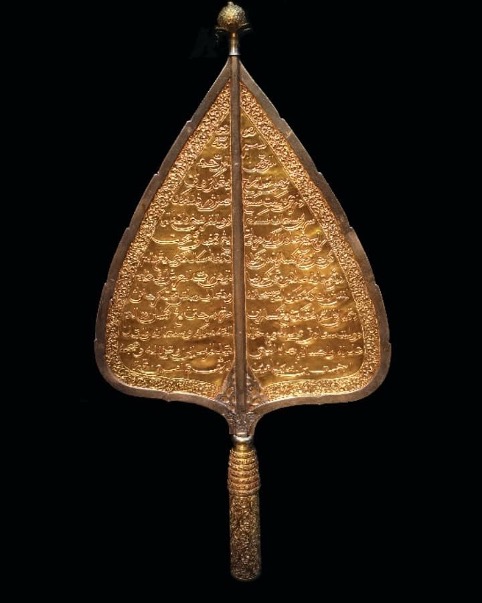
Figure 7 The Cogan, royal regalia of the Riau–Lingga court. Possession of it gave Engku Puteri Raja Hamidah authority over dynastic legitimacy and made her refusal in 1822 politically consequential (Image: Museum Nasional Indonesia)
Engku Puteri’s place outside Indonesia’s National Hero roll may still change. Her name has circulated as a possible candidate in Kepulauan Riau Province for years. In January 2023, the Tanjungpinang city government announced an effort to nominate her, though the supporting documentation had yet to be prepared. In November 2025, a local historian again urged that a formal proposal be completed.
The process itself is revealing of the forms of “heroism” that are liable to receive official recognition. Indonesia does not designate National Heroes through reputation alone: candidates move through research, documentary review and several levels of official evaluation before reaching the president. The candidacy criteria are broad enough to recognise political struggle, influential ideas and works, sustained service, and contributions with national significance.
Yet they still ask the past to speak in the language of the modern state, a requirement that is straightforward for some historical figures and less so for others. Engku Puteri exercised authority through a dynastic system that stretched across the Riau–Johor world. Her political leverage came from the regalia she held and from the legitimacy she could grant or withhold in a royal succession. Contrast this with her male relatives given National Hero status: Raja Haji could be commemorated through armed resistance to Dutch expansion, Raja Ali Haji through literary and intellectual achievement, and Sultan Mahmud through resistance to colonial power.
Engku Puteri’s authority took a different form. She used her custodianship of the Cogan regalia to resist Dutch intervention in the succession. These actions made her politically consequential within the Riau–Johor court, but they do not map as neatly onto the military, literary and anti-colonial narratives through which the men around her later entered Indonesia’s national hero canon. Today, her tomb on Pulau Penyengat sits in modern Indonesia, a 19th-century centre of Malay-Islamic scholarship. Yet labelling Engku Puteri as strictly Indonesian or Malaysian ignores how her authority was anchored across Johor and Singapore.
Rethinking biographies
The national anniversaries celebrated in Southeast Asia in the past month make history look tidier than it was. Singapore, Indonesia and Malaysia commemorate different dates because their modern states emerged through different political paths. Yet the lives that preceded those states were often connected across the borders that later separated them.
Khatijah Sidek crossed those emerging boundaries, while Engku Puteri Raja Hamidah belonged to a political world that was divided around her. Their histories cannot be reduced to the same experience, but both become distorted when read only from the perspective of the nation that came later.
That is why recovering women like Khatijah and Engku Puteri cannot mean simply finding a place for them inside an existing national story. Their biographies sometimes require us to question the shape of that story itself. This is not a case for romanticising an earlier borderless region. It is a case for starting with the political worlds people actually inhabited, then tracing how colonialism and nation-building divided them.
Bangun melur bangun melati,
Kembang bunga petang dan pagi,
Biar lebur biar mati,
Namun tak mahu dijajah lagi.
(Rise jasmine, bloom white jasmine,
Flowers blossoming dusk and dawn,
Though we be crushed, though we perish,
Never again shall we be colonised.)