 Facebook
 Twitter
 Soundcloud
 Youtube
 Rss




This essay appears as part of a special series supported by the ANU Malaysia Institute
• • • • • • • •
Every major reform agenda in Malaysia faces obstacles in obtaining support, passing through parliament, and subsequent implementation. Reforms have thus far mostly centred around the need to prevent conflicts of interest, restore independent institutions, introduce new regulations and improve processes, with the ultimate goal of combating corruption.
The consequential 14th general elections (GE14) in 2018, where Pakatan Harapan formed a government for the first time, catapulted the language of institutional reforms into the mainstream. Reeling from the aftermath of 1MDB and its implications, the appetite for reforms was high. The short-lived PH government and subsequent years of political turmoil and Covid-19 put a halt to the reform agenda.
The 15th general elections in 2022 (GE15) ushered in Anwar Ibrahim’s premiership and renewed hope for the passing of institutional reforms. To date, the three most crucial reforms needed to combat corruption at its core—separating the Attorney General from the Public Prosecutor, reforming the Malaysian Anti-Corruption Commission (MACC), and passing the Political Financing Act, have not materialised.
In this essay, I will focus on political financing reform and break down the different elements of this reform, what problem each element tries to solve and the main obstacles preventing the passage of the law.
Money politics and money in politics
That politics is expensive and requires one to have access to an exceptional amount of resources to survive is not news, although the spending dynamics change according to context. Generally, money is needed in Malaysia’s politics for a politician to enter, maintain longevity, and cater to constituent needs. The process involved in acquiring that money, where that money comes from and how that money is spent is largely unregulated. Furthermore, laws do exist to combat money laundering, corruption, criminal breach of trust and tax evasion, but raising and spending money for the political purposes remain unregulated. The Election Offences Act 1954 stipulates campaign spending limits for election candidates at both the national and state levels (RM200,000 for the former and RM100,000 for the latter). First hand accounts from politicians themselves indicate that the limits are too low and are routinely violated, partly due to poor enforcement by the Election Commission.
Catering to constituent needs constitute a large amount of spending for any politician in Malaysia. The funds required for this are often referred to as Constituency Development Funds (CDF), which are controlled and distributed by the Implementation and Coordination Unit (ICU) under the Prime Minister’s Office. These funds are separate from political financing, as they are used by elected representatives to provide public facilities, build small infrastructure projects, as well as providing support for vulnerable populations and NGOs. The unequal distribution of CDF, where it is either withheld or a lesser amount is given to Opposition MPs—a practice inherited from the days of UMNO—is one of the most contentious issues in Anwar’s administration.
Although separate from political financing, it is important to bring up CDF as it is a significant source of money for politicians and it develops a dependency relationship between politicians and their constituents. The weaponisation of CDF as a political tool to sideline the opposition also shows that CDF is not insulated from politics. It is also likely that elected representatives need other sources of funding to cater to other needs, such as cash handouts during weddings, funerals, and ad hoc requests to pay for electricity bills, grocery items and more.
The level of transparency and accountability surrounding the distribution of CDF remains poor. There is no established formula for distribution and no obligation to report spending to the public, although some MPs do it voluntarily. CDF make up just one part of the money ecosystem surrounding politicians. The money needed to maintain their party offices, pay for party staff, and run campaigns (both internal party elections and national elections) constitutes a chunk of funds that are currently not subject to public scrutiny.
Regulating political financing: the beginnings
Studies on the link between business, money, and politics in Malaysia have been conducted since the early 1990s, with scholars such as Terence Gomez and Jomo KS as early pioneers. The need for a law regulating political financing has been advocated for since as early as 2009, but it was not until the 1MDB corruption scandal became global news in 2015 that the lack of regulation surrounding political donations and spending captured the nation’s imagination.
Malaysians realised that RM2.6 billion in the personal bank account of then Prime Minister Najib Razak, purportedly from a Saudi prince and to be used, among other reasons, for GE13, was made possible by the fact that no law against such donations existed. It was Najib himself who established the National Consultative Committee on Political Financing (Jawatankuasa Konsultatif Nasional Mengenai Pendanaan Politik/JKNMPP) in August 2015, a few months after the 1MDB scandal broke. The Committee published 32 recommendations, which were submitted to the government a year later, with little follow-up.
PH’s campaign for GE14 centred around 1MDB, and its manifesto then included a promise to form a committee to study and prepare a draft of a Political Financing Act. Upon winning power, PH acted swiftly to produce the National Anti-Corruption Plan (NACP) 2019–2023, which had legislation on political funding as its first, most urgent initiative. The short-lived PH government did not survive long enough to see the initiative through, but it was continued under the Ismail Sabri administration, although the draft never saw the light of day. The 2022 PH manifesto once again promised a Political Funding Act, and despite all signs looking positive, it is unlikely that the law will be tabled and passed in time for GE16.
The All-Party Parliamentary Group on Political Financing
The change of government in 2018 heralded new opportunities for civil society to engage in the legislative process. Among the initiatives introduced in Parliament was the All-Party Parliamentary Group, a platform in which MPs and civil society can come together to discuss different topics. Institute for Democracy and Economic Affairs (IDEAS) acted as the Secretariat of the APPG on Political Financing, which drafted its own Political Financing Bill at the end of 2023.
The bill drafted by the APPG is not considered the government’s version, hence it is not an official document. However, it was well-received by the Legal Affairs Department in the Minister of Law and Institutional Reforms (BHEUU), and has been used by them in their own comparative analysis. The fact that a bill drafted largely by civil society even got that far is remarkable, but at the same time should not be viewed as a firm commitment by the government to draft their own bill and carry it through until it passes into law.
The starts and stops that have been made in enacting the Political Financing Act illuminates a few key issues. First, the delay in tabling the bill in Parliament cannot be blamed on a lack of will from political actors. Second, civil society involvement in the process of the drafting the act has been sustained, which is uncommon in Malaysia. Third, no politician or political party has publicly expressed opposition to the act, indicating universal support for a law that will fundamentally change the nature of politics in Malaysia. Fourth, a government-commissioned public survey showed that 88% of respondents agree that Malaysia needs a Political Financing Act. The question then is: what is actually preventing the bill from being tabled in Parliament? In reality, some key elements of a Political Financing Act are contentious and have sparked disagreements between civil society, politicians and political parties.
The core element of transparency
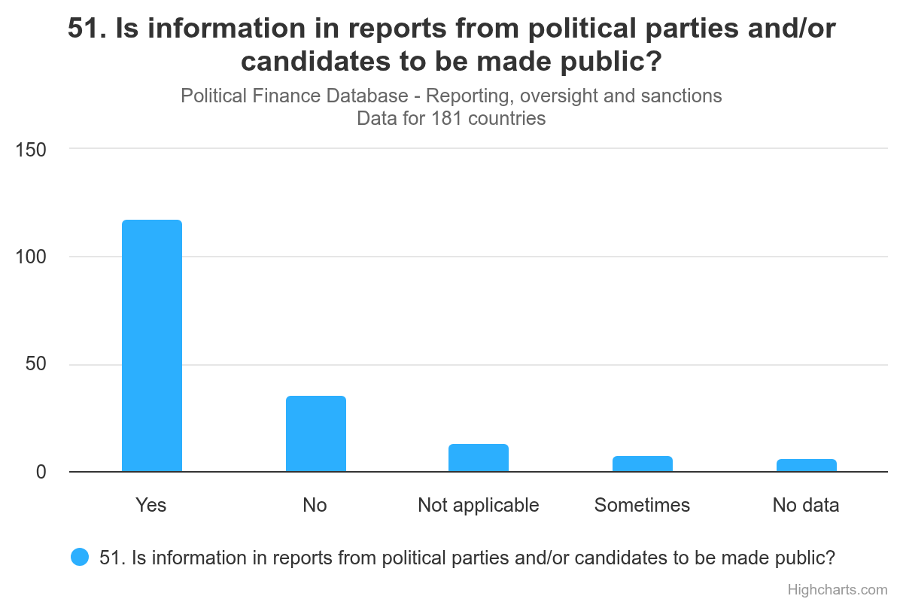
Downloaded from International IDEA database
The cornerstone principle of any Political Financing Act is the requirement for political parties to publicly disclose the identity of their donors. International IDEA’s chart above shows that a large majority of countries require their political parties to disclose their financial reports publicly. The purpose is to ensure the public knows who is financing their candidates and, in turn, to keep politics “clean” and free from capture by special interests or billionaires who can have an outsized influence on policymaking. In countries like Malaysia, where procurement processes are not watertight and corruption and cronyism are commonplace, an unregulated political finance ecosystem opens the door to those with the positions and resources to buy their way through. Therefore, introducing transparency to the system is the main purpose of political finance regulation.
However, it is exactly transparency that is difficult and unpalatable for some politicians to accept. Politicians from different sides of the aisle are fearful of transparency for different reasons. Some of the bigger, well-established parties fear that their sources of wealth will be revealed, while smaller parties that have historically been in opposition are afraid that transparency might victimise their donors. Some of the smaller parties have expressed fears that exposing their donors will cause them to stop donating altogether.
A middle ground that can be struck is to have a minimum threshold amount that must be publicly declared. The APPG bill suggested RM10,000 as the amount, though this was subject to intense debate between the APPG members and other MPs. Many in civil society felt that RM10,000 was too high a threshold, while some MPs felt it should be higher. If the bill ever gets tabled in Parliament, determining this disclosure threshold should be the focus of debate between the MPs. Too high a threshold risks lower amounts escaping regulation, and too low a threshold might discourage small donors. Determining the “sweet spot” that balances the need for transparency and accountability with the realities of different political parties is key. If political parties cannot balance these competing factors, then political finance reform would stumble before it has even started.
The right regulatory body for accountability
A point of contention for many of the institutional reforms Malaysia needs is what the regulatory body for that particular reform area should look like, who the regulators should consist of, and how and what their appointment process is like. In the case of political financing, a regulatory body is needed to implement the provisions in the Political Financing Act. They should serve as an impartial, independent and publicly trusted institution, with the right skills to monitor and analyse financial transactions moving in and out of political parties.
While the expected role of the regulatory body is clear, many disagree on who are the best persons to be entrusted with the job. The APPG bill proposes a Political Financing Commission as the regulator, and members of the commission are to be appointed by the Yang di-Pertuan Agong on the recommendation of the Parliamentary Committee on Political Financing. This structure was proposed to ensure a democratic mandate for members of the Commission, and to prevent the appointment process from being controlled by the executive or prime minister.
However, during the deliberations, some expressed scepticism that such an important role should be entrusted to a parliamentary committee, whose members consist of MPs belonging to political parties. Stakeholders did not believe that MPs can be impartial and independent in their recommendations. Similarly, the Political Financing Commission was also perceived as a body that will get captured by the interests of the dominant political parties or the executive, incidents that have happened with other commissions such as the Malaysian Anti-Corruption Commission (MACC) and the Election Commission (EC).
The contention surrounding how and who will regulate political financing reflects a deeper trust deficit towards institutions in Malaysia. For political financing reform to truly have teeth, a restoration of trust across all of Malaysia’s institutions is needed. The first step towards realising this is to improve transparency in appointing the heads of these institutions.
Levelling the playing field through public funding
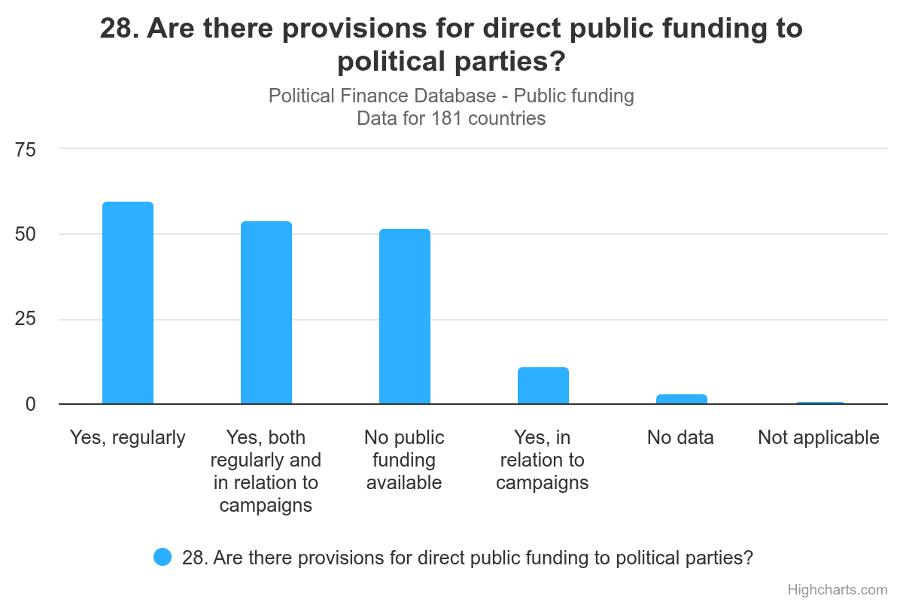
Downloaded from International IDEA database
Another intended outcome of a comprehensive law on political financing is to level the playing field between political parties. This can be achieved by introducing public funding for political parties, a system where the government allocates a portion of the national budget for political parties to cover their operating or campaign costs, with the condition that the party meets the minimum threshold of votes or seats won. Through public funding, both well-resourced parties and parties that struggle with funds can at least operate on a more equal footing.
Public funding can also result in reduced reliance on private donors, which should subsequently reduce the risk of private interests controlling politics. Public funding can also be used as an incentive to improve women’s participation in politics, where parties that nominate more women in winnable seats receive a higher allocation of public funds. In this respect, public funding can be a game-changer for gender parity in Malaysian politics, as currently only 13.5% of MPs are women, which is abysmal.
Politicians generally support public funding—it would be hard to find a politician who will reject money going into their party’s account—however, convincing the public that their taxpayer money is going to political parties (already perceived as being rich and corrupt) will be a challenging task. Public funding also requires the Ministry of Finance to agree to allocate a portion of the national budget for political parties, which might also face resistance as Malaysia’s fiscal space tightens further.
Conclusion
The path to political financing reform in Malaysia remains fraught with political hesitation, institutional distrust, and technical disagreements over disclosure thresholds and regulatory oversight. Yet, the need for reform has never been more pressing. Without transparent and equitable financing structures, money politics will continue to undermine democratic governance and erode public trust. With GE16 looming in just over a year, the prospect of a comprehensive Political Financing Act being passed before the next election appears increasingly unlikely.
But urgency must not come at the expense of substance. A watered-down law, passed merely to demonstrate progress, could do more harm than good by entrenching weaknesses rather than addressing them. What political financing reform needs is not simply legislation, but a genuine commitment to clean politics, backed by a strong mandate from the highest levels of political leadership and sustained public pressure. Public support for reform is there. The real question is whether Malaysia’s political leaders have the courage to match it.